An everyday object designed around the hook
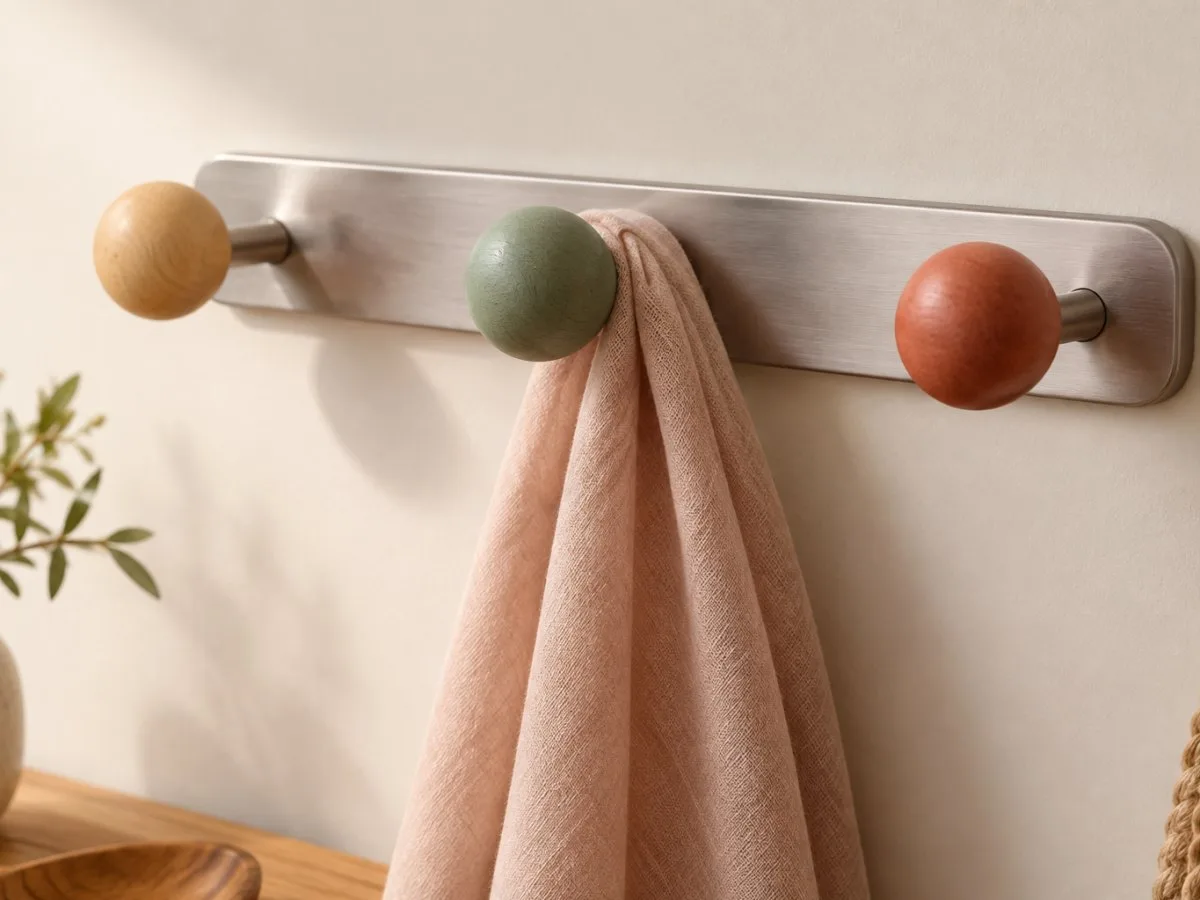
Charles and Ray Eames’s Hang-It-All starts with a simple domestic task: hanging coats, hats, scarves, and other belongings. Developed in 1953, it organizes this function with a rectangular frame of coated steel wire and a series of short pieces that project outward. Painted wooden balls at their ends serve as hooks.
The rounded shape is more than a visual detail. The balls can help keep delicate garments, such as a lightweight linen coat or a sweater, from snagging or getting holes—something that can happen with a conventional hook. The design stands out for its color, but its everyday appeal also lies in how it manages contact between the object and clothing.
Wire, wood, and a legible structure
The composition is easy to read at a glance: a horizontal rectangular frame supports hanging points arranged at different heights and angles. The design description details four vertical pieces of wire, repeatedly bent and welded to the frame; eight painted wooden balls sit at their slightly staggered ends. Other short pieces, bent at different angles, end in six smaller balls.
The use of wire connects the coat rack with other Eames furniture that employed steel-rod structures, including the Wire chairs and the bases of the ETR and LTR tables. This material continuity places the coat rack within a broader exploration of wire without reducing it to a mere variation on those pieces: here, the structure turns curves into visible, distinct points of support.
A playful look with a practical purpose
The colored balls can make the Hang-It-All look playful. But the visual play does not replace its function: each sphere marks a place to hang something and offers a rounded surface for doing so. It was first marketed by Tigrett, a toy company that also distributed other Eames products. The original description presented it as an object for children to hang their belongings on.
This combination of color and utility offers one way to think about the coat rack in an everyday space. It can serve as a visual accent in an entryway or a room, but whether a particular location is suitable depends on the needs of the space; the available documentation provides no dimensions or installation instructions.
Color variations and design continuity
The original version is associated with balls painted in several colors. The range has expanded to include other combinations, among them walnut balls with black wire and a version in Pride colors. A color exploration presented by Eames Office begins with a “stonewash” blue frame and red balls, based on a color proposal discovered in its archive.
The variations change the object’s visual presence, not its basic principle: a steel structure and wooden balls that act as hooks. The available information indicates that the Hang-It-All continues to be produced through Herman Miller and Vitra; it does not provide comparative specifications, dimensions, or region-specific availability conditions here.
A small design study on the wall
The Hang-It-All shows how a formal decision can serve both function and expression: the balls make the object recognizable and, with their rounded shape, can help keep delicate garments from snagging or getting holes. Rather than hiding its structure, the design makes it part of its character. The result is a coat rack whose presence depends as much on the arrangement of its hooks as on the way color turns a routine task into a visible element of a space.
At a glance
Scope
Editorial reading; this is not a site visit or a technical evaluation.
Sources and references
HANG-IT-ALL | Eames Foundation ↗17/11/2026
EAMES HANG-IT-ALL - Eames Office ↗18/11/2026