





The architecture of everyday life
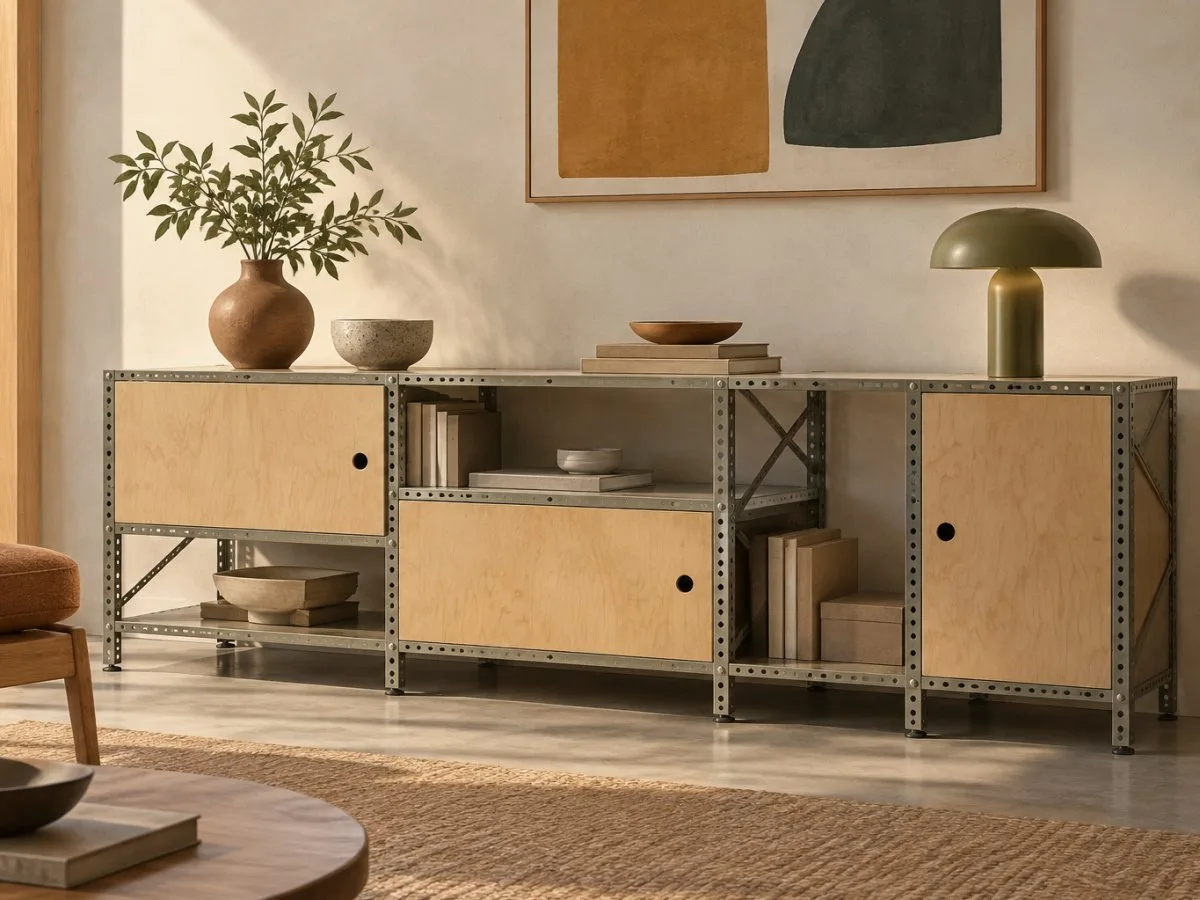
The Eames Storage Units (ESU) and Eames Desk Units (EDU) invite us to read furniture through its structure. Supports, panels and braces remain visible, so the way the components fit together explains much of the designs’ appearance. Storage is not presented simply as a closed box, but as a system of related parts that can serve a living room, dining room, bedroom or workspace.
The system was developed around 1949 and introduced for sale in 1950. Its central idea was to apply principles of industrial production to domestic life. Rather than conceal construction beneath a continuous decorative surface, the designs show how a shared set of components can support different arrangements and uses. That clarity makes each unit both a piece of furniture and a small piece of architecture.
Standardized parts and visible materials
Perforated steel extrusions and diagonal bracing define the frame. Shelves, drawers and panels complete the units without necessarily hiding that framework. Reusing standard components made it possible to build several configurations from a common system, while manufacturing economies were part of the design proposition.
Historical finishes included walnut or birch wood, plywood, enameled Masonite panels and metal components. Open sections, doors and drawers could be combined to vary both storage capacity and the visual character of a unit. Color mattered, too: versions in primary colors were offered alongside more neutral combinations.
Material honesty does not mean every part has to share the same finish. The frame can remain exposed while a panel adds color or a door provides a wood surface. Such contrasts help distinguish the roles of different components and give the front of a unit its rhythm.
Configuration and personalization
The system accommodated open storage, enclosed compartments and drawers. Buyers could select among interior components, but that did not make each unit a fully bespoke commission. Personalization took place within a range of parts and arrangements established by the design.
Sliding plywood doors with circular indentations are among the system’s most recognizable details. They grew out of an earlier development for storage furniture in 1946 and added texture to the surface. A door’s appearance alone, however, cannot identify or authenticate a piece. Model, edition and supporting documentation matter as well.
| Component | Role in the system | Effect in a room |
|---|---|---|
| Steel frame | Organizes and supports the components | Makes the assembly legible |
| Diagonal bracing | Contributes to the structure | Creates visible crosses and diagonals |
| Open shelves | Keep objects accessible and in view | Make the front appear more open |
| Doors and drawers | Enclose and protect contents | Alternate solid surfaces with open sections |
| Colored panels | Complete the modules | Add contrast and visual rhythm |
Dimensions and the room around the unit
ESU configurations ranged from low storage units to tall bookcases, so there is no single measurement that describes the entire family. Width, depth and height should always be tied to a particular model and edition; a historical dimension does not automatically describe a current reissue.
Historical desk documentation gives two widths, 44 and 60 inches, and describes versions as standalone desks or with returns for typewriters. The plywood tops had rounded edges, softening the point where the work surface meets someone moving past it.
When assessing how a unit might fit at home, it is more useful to start with its intended role than to copy an isolated measurement. A low module can provide storage and a surface; a taller one changes the visual relationship with the wall and calls for attention to its placement. The specification for the chosen model should guide measurements and installation. Historical context is not a substitute for the manufacturer’s installation and safety instructions.
The connection with the Eames House
Charles and Ray Eames moved into their house in December 1949. The relationship between the residence and the storage units is best understood through their construction, rather than as a decorative resemblance. In both, industrial forms and components are combined in ways that keep their organization visible.
Cross-bracing appears on the house’s façade and in the storage units, at different scales and in different structural contexts. That affinity does not make a piece of furniture a miniature replica of a building. Instead, it points to a shared approach: work with the properties of materials and organize their connections to meet a practical need.
The appearance therefore follows decisions about support, enclosure, access and use. Color and proportion matter, but they belong to a construction logic that the user can see.
From industrial vocabulary to domestic use
The connection to industrial shelving is visible in the perforated components and bracing. By bringing this vocabulary into the home, the Eameses showed that an exposed structure could coexist with personal objects, books and wood surfaces. Production efficiency and domestic warmth did not have to conceal one another.
The units were sold assembled in specified configurations. Even delivery was considered part of the user experience: large cardboard shipping boxes were decorated and could be reused as playhouses. Printed lines suggested doors, windows and awnings, while wooden reinforcing splines from the packaging could be used in the transformation.
That detail extends the design beyond the furniture itself. Delivery, unpacking and reusing the box could all become part of everyday life, without requiring the buyer to know the object’s history.
Continuity and reissues
Original production continued until 1955. Later reissues brought back the logic of standard components and visible structure, but their configurations and finishes should be distinguished from historical examples. Contemporary offerings include storage furniture in different heights and combinations.
The persistence of the design does not make all versions interchangeable. Differences in dimensions, materials and finishes mean that specific information is needed before comparing an older piece with a current one. The design’s history helps explain its approach; documentation for each edition is needed to establish its particular characteristics.
A practical way to read the system
When looking at an ESU or EDU, it can help to consider four aspects:
- Structure: Notice how the profiles, panels and braces meet, without treating appearance alone as proof of authenticity.
- Organization: Identify what remains exposed and what sits behind doors or inside drawers, and relate that arrangement to the intended use.
- Junctions: Look at edges, supports and transitions between wood and metal.
- Edition: Check dimensions and finishes against the relevant specification, especially for a historical piece or a reissue.
This approach reveals furniture as a set of decisions about materials, production and everyday life. The designs’ value as a point of reference lies in making those relationships legible, rather than requiring the structure to disappear behind decoration.
At a glance
Scope
Editorial reading; this is not a site visit or technical assessment.
Sources and references
EAMES STORAGE UNITS AND DESKS | Eames Foundation ↗23/10/2026 Eames Foundation, Eames Storage Units and Desks
Eames Desk Unit (EDU) | Eames Foundation ↗23/10/2026 Eames Foundation, Eames Desk Unit (EDU)
EAMES STORAGE UNITS (ESU) | Eames Foundation ↗23/10/2026 Eames Foundation, Eames Storage Units (ESU)
MoMA · Charles Eames y Ray Eames: Eames Storage Unit (ESU), 1950 ↗1950 · objeto 434.1992 · 24/10/2026 MoMA, Charles Eames and Ray Eames: Eames Storage Unit (ESU), 1950
Vitra · Eames Storage Unit ESU ↗Ficha de producto consultada el October 24, 2026 · 24/10/2026 Vitra, Eames Storage Unit ESU