





Engineering as an aesthetic language
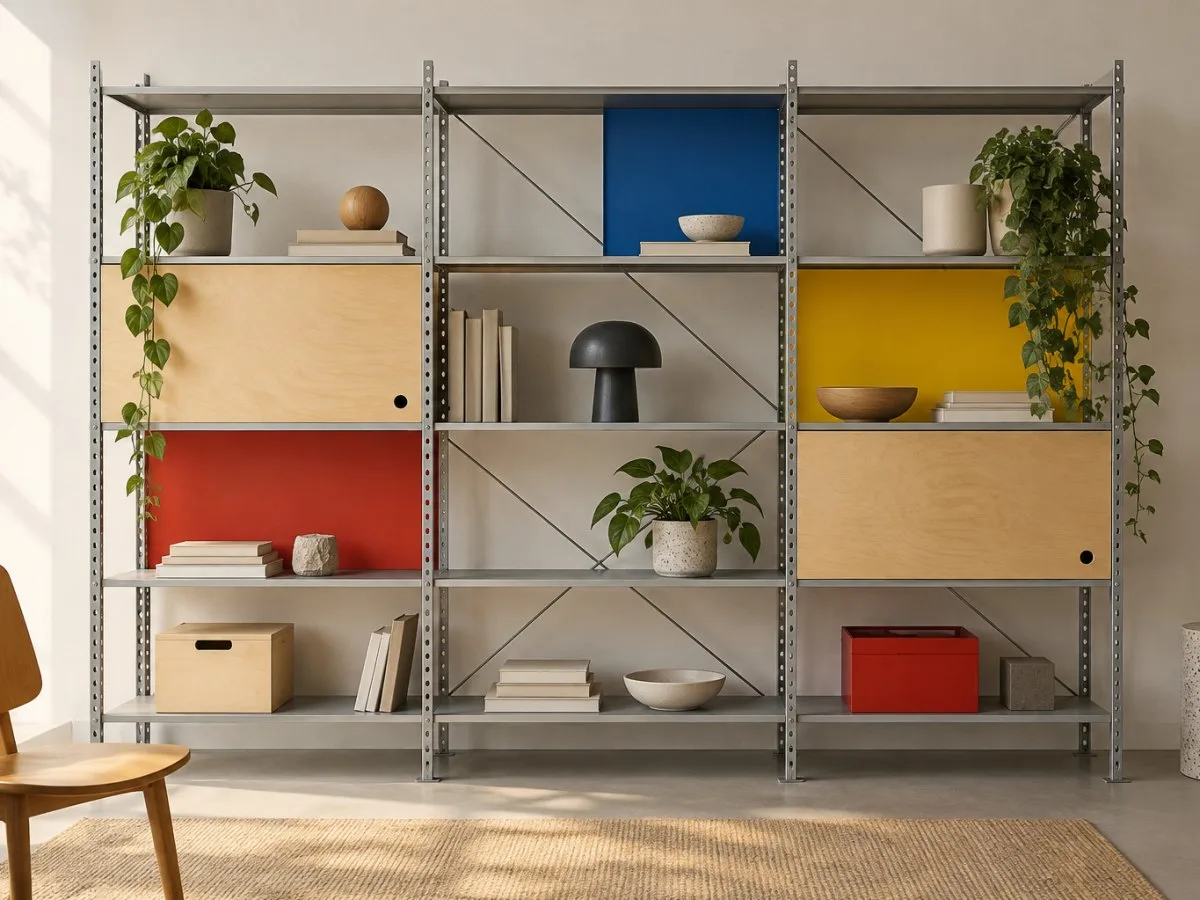
In the history of furniture design, few pieces have translated the logic of construction into a spatial experience as directly as the Eames Storage Units (ESU). Designed by Charles and Ray Eames, these units are not decorative objects that conceal their function; they are structures that make their methods, mechanics and reasons fully apparent. The ESU’s construction is described as an ingenious, inventive system—simple and openly engineered, like a bridge. Its elements come together with a fine, unforced logic, making the structure not a technical secret but the object’s visual focus.
This approach challenges the traditional idea of furniture as a closed box. Instead, the ESU proposes a form of domestic architecture based on honesty of materials. Its perforated extruded-steel structure and diagonal bracing are presented without ornament or concealment. This decision is not merely aesthetic; it connects industrial production with the user’s everyday experience.
Standardization and manufacturing economy
At the heart of the Eames Storage Units is the standardization of parts. Unlike made-to-measure furniture or limited editions, the ESU was designed to allow exceptional manufacturing economies. Combinations of standard elements could be arranged into several different types of units to serve a wide range of uses. The modular system allowed configurations ranging from low credenzas to tall bookshelves, with options for open storage, closed storage and drawers.
Standardization reduced manufacturing costs, resulting in lower prices for consumers, and broadened access to high-quality design. The same components could be used to make several different kinds of storage units. The approach showed that functional complexity does not necessarily require complex production, but can instead depend on a rigorous logic of assembly.
| Component | Material | Function |
|---|---|---|
| Structure | Perforated extruded steel | Support and spatial definition |
| Bracing | Diagonal wire | Structural stability |
| Doors | Thin plywood | Closure and protection |
| Panels | Perforated metal or enameled Masonite | Infill and organization |
The connection to the Eames House
There is a clear connection between the construction of the Eames House and the assembly of these storage units. Charles and Ray Eames moved into their own home in December 1949. The residence uses cross-bracing on its façade for structural stability, at a much larger scale than the crossed-wire bracing on the storage units.
However, it would be a mistake to think that the similarities between the Eames House and the Eames Storage Units are about their appearance. Charles and Ray did not approach design as a visual exercise. Rather, the house and the storage units look the way they do because each is a direct, natural assembly of standard shapes made from the materials used. Structure is not a surface layer; it is the essence of the form.
Materials and finishes: The truth of the object
True to the Eames philosophy, all materials were presented honestly. The extruded-steel structure was unadorned and unconcealed. Buyers could customize the interior arrangement by choosing drawers or plywood doors, along with filler panels of perforated metal or enameled Masonite.
The wooden elements of the storage units and desks were made of walnut or birch. In the original version, there were two color options: “Colorful” units in the primary colors red, blue and yellow, and “Neutral” units in beige and grey. The thin plywood doors, which Charles and Ray had first developed in 1946 for their original case goods, were molded with circular indentations. These gave the doors a considered appearance and increased the wood’s durability and resistance to warping.
In current production, manufacturers such as Vitra have updated the color palette to offer a fresh, contemporary look while celebrating the spirit of the 1940s and 1950s. Current finishes include black powder-coated metal surfaces, birch plywood shelves with a clear lacquer finish, and powder-coated aluminum panels in colors such as pale blue, mauve grey, fawn, Eames red and rusty orange.
From the industrial market to the domestic interior
There had never been anything like the ESU in the consumer market. Its closest parallel was industrial shelving, but this was years before interior decorators began using the words “High Tech.” The ESU brought the aesthetic of exposed structure into the domestic interior, transforming what had been a purely functional element into a desirable design object.
The storage units and desks were sold to consumers fully assembled, in configurations determined by Charles and Ray Eames. In 1950, flat-pack shipping was not yet an accepted practice in the furniture industry; otherwise, the units would have been sold that way. Instead, the Eameses took care of their customers through to the delivery of the goods.
Packaging as a play object
The Eameses designed playful decorations for the large boxes in which the assembled units were shipped, encouraging parents to give the boxes to their children as play objects. Each cardboard box was printed with a colorful red-and-black design featuring Herman Miller’s distinctive “M.” Each heavy cardboard carton was reinforced with wooden splines. Once the furniture had been removed, the splines could be taken off and attached to the bottom of the cartons, turning the boxes into playhouses for young children.
The early boxes came with separate leaflets offering instructions on “How to Make a Playhouse,” but the process was self-explanatory: dotted lines suggested where to make an entrance and a view out, as well as cheerful awnings. This detail reveals the Eameses’ attention to the full product experience, from manufacture to its eventual use.
Public debut and legacy
The Eames Storage Units were first presented to the public in the “Eames room” at Alexander Girard’s “An Exhibition for Modern Living” at the Detroit Institute of Arts. They went on sale to the public in 1950. Original production and sales continued until 1955. At the end of the twentieth century, and continuing to the present, the Eames Storage Units and Eames Desk Units returned to the sales offerings of their partners.
The ESU continues to be produced by Herman Miller and Vitra. Its significance endures not only because of its functionality, but because it demonstrates that design can be rigorous, economical and deeply human at once. Its transparent structure invites users to understand how the space they inhabit is built, breaking down the boundary between the object and its process of creation.
Implications for contemporary design
The lesson of the Eames Storage Units for contemporary design is the importance of constructive logic. At a time when complexity is often mistaken for innovation, the ESU reminds us that simplicity can be the result of sophisticated engineering. Exposing the structure is not an aesthetic whim, but a natural consequence of using materials honestly.
The ESU’s ability to adapt to different spaces and functions also demonstrates the value of modularity. In today’s homes, where space is often limited and multifunctional, the ability to reconfigure storage remains a fundamental need. The ESU offers a solution that is not only visually striking but also practical.
The connection between the architecture of the Eames House and the ESU furniture also suggests that design is not limited to objects, but encompasses the entire environment. The coherence between the house’s structure and the furniture’s structure creates a unified spatial experience in which each element reinforces the logic of the whole.
Conclusion
The Eames Storage Units represent a milestone in furniture design because they integrate engineering, manufacturing economy and aesthetics in a single object. Their exposed structure, standardized components and material honesty make them a lasting example of how design can improve everyday life. By revealing the logic of their construction, the ESU invites users to appreciate not only the form but also the process that makes it possible. In a world that often seeks opacity and complexity, the ESU’s clarity remains a powerful and necessary proposition.
At a glance
Scope
Editorial reading; this is not a site visit or technical assessment.
Sources and references
EAMES STORAGE UNITS (ESU) | Eames Foundation ↗23/10/2026 Eames Foundation, “EAMES STORAGE UNITS (ESU)”
Eames Storage Unit ESU | Official Vitra® Website UN ↗23/10/2026 Vitra, “Eames Storage Unit ESU”
EAMES STORAGE UNITS AND DESKS | Eames Foundation ↗23/10/2026 Eames Foundation, “EAMES STORAGE UNITS AND DESKS”