





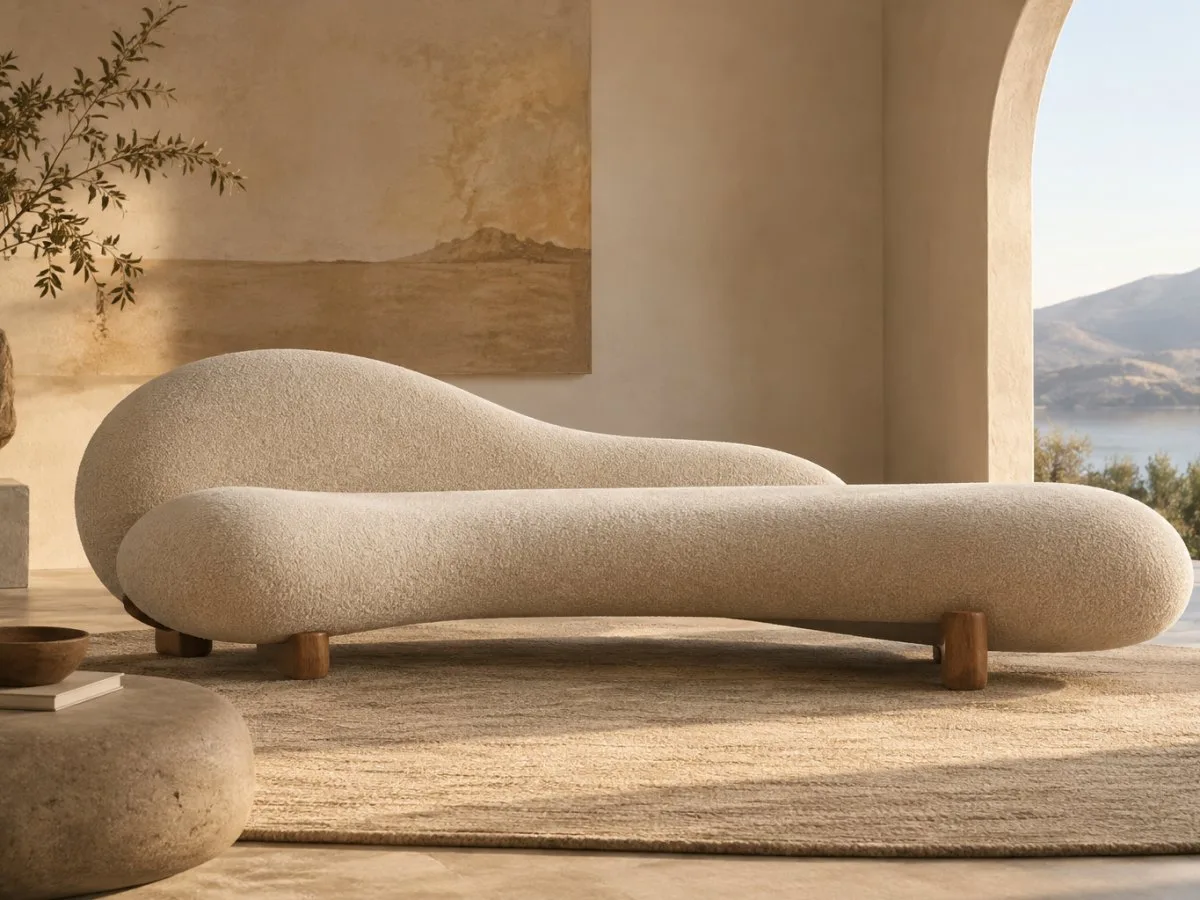
A form that departs from the conventional sofa
Isamu Noguchi’s Freeform Sofa is distinguished by its elongated profile, with gentle curves and slopes. Together with the ottoman, its forms may call to mind flattened river stones; The Noguchi Museum’s description compares them to “rocks that roll around.” This is a reading of its silhouette, not its material: the sofa is made of wood and upholstered padding.
Specifications describe a beech frame and solid-wood legs, as well as foam and fabric covers. Vitra specifies a solid beech frame and a wooden structure with polyurethane foam in the body and cushions; The Noguchi Museum also notes the beech frame and describes maple or walnut legs. In Vitra’s re-edition, the legs are solid maple with a lacquer finish. The design tension lies in giving sculptural presence to a soft object intended for sitting.
From postwar design to re-edition
Records date the design to around 1948, although Vitra’s product page dates it to 1946. The Vitra Design Museum places Herman Miller’s production between 1949 and approximately 1951; The Noguchi Museum says the sofa was produced briefly beginning in 1950. Vitra describes the sofa and ottoman as having been produced in limited numbers around 1950.
The dates distinguish the moment of conception from the period of manufacture, although the records do not define the latter in the same way. Vitra states that its re-editions have been produced since 2002, in collaboration with the Isamu Noguchi Foundation in New York. This re-edition is distinct from examples of the initial production; the available information does not establish that manufacturing has continued uninterrupted since then.
Wood, upholstery, and proportion
The organic form does not eliminate the structure a seat requires. In Vitra’s specification, the frame is solid beech; the body and cushions incorporate a wooden structure and polyurethane foam. The covers are removable, and the legs are lacquered solid maple. The Noguchi Museum’s specification also describes a beech frame, maple or walnut legs, and a removable cover.
The dimensions published by The Noguchi Museum for the sofa are 300 cm wide, 130.2 cm deep, and 72 cm high overall. That specification gives a seat height of 31.8 cm; Vitra, in turn, specifies 32 cm without load and 28 cm with load. These figures correspond to the respective specifications and stated conditions, rather than to one universal measurement.
Its scale and extended silhouette may give the sofa a strong presence in a room. Its relationship to the ottoman and the open space around it offers one way to think about placement, but the documentation does not prescribe a single arrangement or determine how it will work in a particular interior.
A design between sculpture and everyday use
Noguchi’s work encompassed sculpture, furniture, lighting, interiors, and outdoor spaces. In the Freeform, this breadth can be seen in the continuity of the line and the upholstered mass, which appears visually less rigid than a rectilinear sofa. Even so, it remains recognizable as a seat: it brings together a sitting surface, backrest, upholstery, and legs.
Vitra describes it for use in homes as well as lobbies, hotels, and retail spaces. This range allows it to be read as domestic seating or as a sculptural presence in a shared space. Its visual character comes from the silhouette and the relationship between the upholstered surfaces and wooden supports, not from an added ornament.
What to observe in a room
When looking at the Freeform in a room, three relationships may be revealing: the sofa’s curve against the architecture’s straight lines, the contrast between upholstery and legs, and its distance from other furniture. These are ways of observing it, not installation requirements. The documentation describes the design, materials, and specific dimensions, but does not provide a comparative assessment of comfort or determine which configuration works best in each interior.
At a glance
Scope
Editorial reading; does not constitute a visit or technical assessment.
Sources and references
Freeform Sofa | Official Vitra® Online Shop US ↗21/11/2026
Noguchi Freeform Sofa – The Noguchi Museum ↗21/11/2026
Collection - The Noguchi Museum ↗21/11/2026
Online Collection Vitra Design Museum ↗21/11/2026