





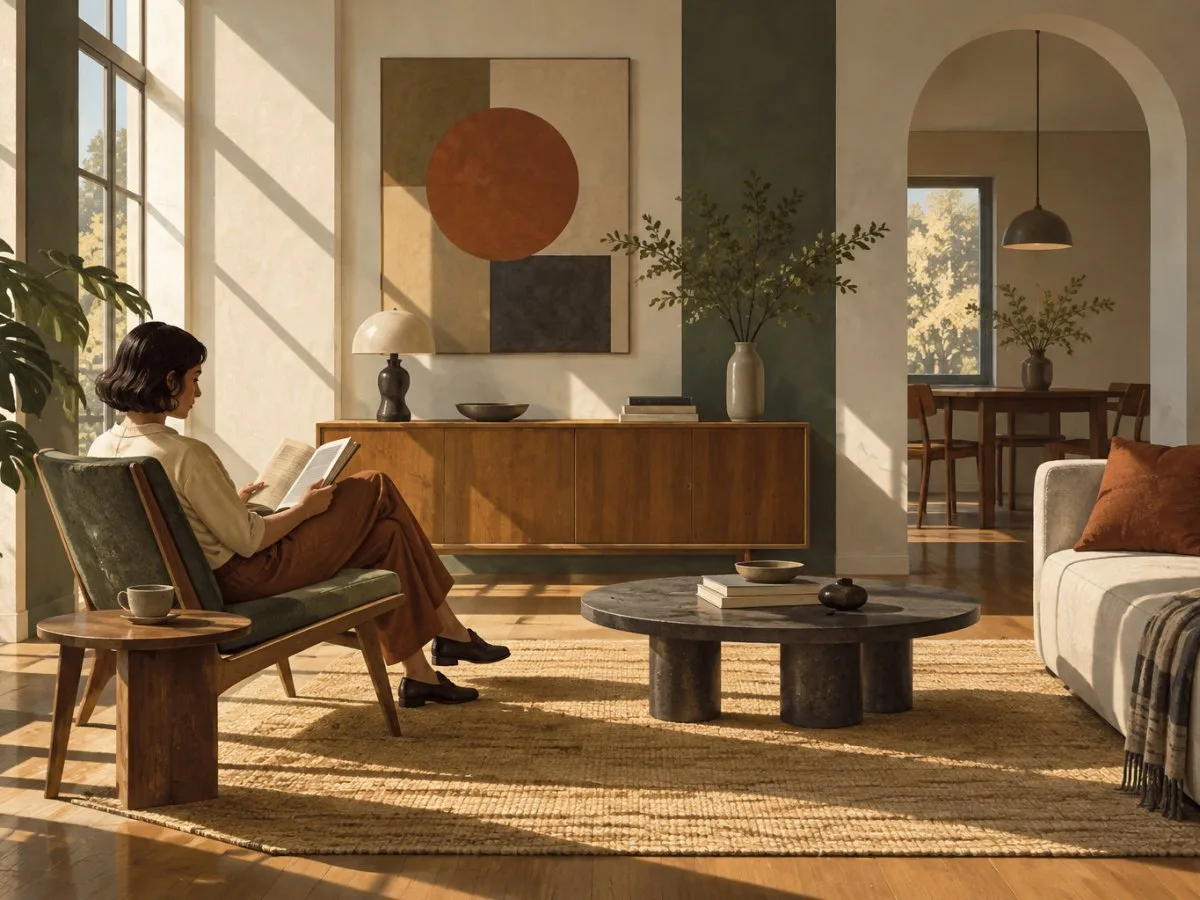
Interior design has evolved from a discipline centered on ornamentation into a field that redefines the relationship between people and their everyday surroundings. This transformation, particularly visible in the twentieth century, reflects not only aesthetic change but also a profound reshaping of social, technological, and political needs.
The founding question: How should we live?
Since the Department of Architecture and Design was established in the early 1930s, cultural institutions have approached design not as mere decoration but as a means of shaping everyday experience. The question “How should we live?” has become a central way to understand the modern interior. The concern is not simply the beauty of an isolated object, but the synthesis of elements within a specific setting: a home, an exhibition space, or a shop.
This perspective means recognizing the interior as a complex system. Materials, manufacturing processes, and collaborations among architects, designers, and craftspeople shape how we inhabit space. External factors, such as political ideologies and technological advances, leave their mark on the layout of a kitchen or the choice of a tapestry.
The synthesis of an environment: beyond the iconic object
Design is often understood through famous individual pieces. Yet understanding the modern interior requires looking beyond the isolated object. Attention shifts to the integration of elements within a complete environment. A kitchen, for example, is not just a set of furnishings; it is a space that reflects ideas about efficiency, gender, and domestic life.
In this context, collaboration becomes fundamental. Projects such as Lilly Reich and Mies van der Rohe’s Velvet and Silk Café (1927) and Grete Lihotzky’s Frankfurt Kitchen (1926–1927) are not simply furniture designs but propositions for living. They bring architecture, furnishings, textiles, and lighting together in a coherent vision of inhabited space.
The role of women in interior design
A critical reading of the modern interior cannot overlook the fundamental role of women architects and designers. For decades, their contributions were often credited to male collaborators or relegated to the background. Yet figures such as Eileen Gray, Charlotte Perriand, Lilly Reich, and Grete Lihotzky were pioneers in defining functional spaces of aesthetic rigor.
Eileen Gray, for example, designed furnishings for the E-1027 house (1929), a project that challenged the conventions of its time by integrating art with everyday life. In collaboration with Le Corbusier and Pierre Jeanneret, Charlotte Perriand developed spaces for study and rest that reflected a modern vision of privacy and functionality, as seen in the Maison du Brésil (1959).
These designers did more than create objects: they redefined the experience of inhabiting space. Their work showed that interior design could be a form of intellectual and social expression, not merely a technical task.
Materials, textures, and the tactile dimension
The modern interior is defined not only by form but also by material. Textiles, wallpapers, and surface finishes play a crucial role in creating atmospheres. The texture of fabric, the gleam of metal, or the warmth of wood influences how we perceive a space.
In this sense, interior design is a multisensory experience. The choice of materials is not arbitrary; it responds to functional, aesthetic, and symbolic considerations. A tapestry does more than cover a wall: it absorbs sound, regulates temperature, and adds a layer of cultural meaning to a space.
The interior as a space for display and consumption
Interior design is not limited to the home. It also shapes public spaces such as museums, shops, and cafés. In these settings, the interior becomes a tool for communication and consumption. The arrangement of objects, lighting, and the movement of people are carefully designed to guide the visitor’s experience.
Re-creating a historic café in a museum, for example, is not simply a nostalgic evocation; it is an opportunity to explore how design has influenced consumer culture. Such temporary spaces allow the public to experience firsthand the ideas that shaped modernity.
Conclusion: Design as a critical practice
Interior design is much more than a decorative discipline. It is a critical practice that questions our ways of life, our social relationships, and our material environment. Studying the modern interior teaches us about the history of design and gives us tools to reflect on how we want to live in the present.
The lesson from twentieth-century designers is clear: space is not a passive container but an active agent in shaping human experience. Every design decision, from the choice of a color to the placement of a piece of furniture, has implications beyond aesthetics.
At a glance
Scope
Editorial reading; this is not a visit or a technical assessment.
Sources and references
Interior design | MoMA ↗26/10/2026
How Should We Live? Propositions for the Modern Interior | MoMA ↗26/10/2026
Furniture and interiors | MoMA ↗26/10/2026