





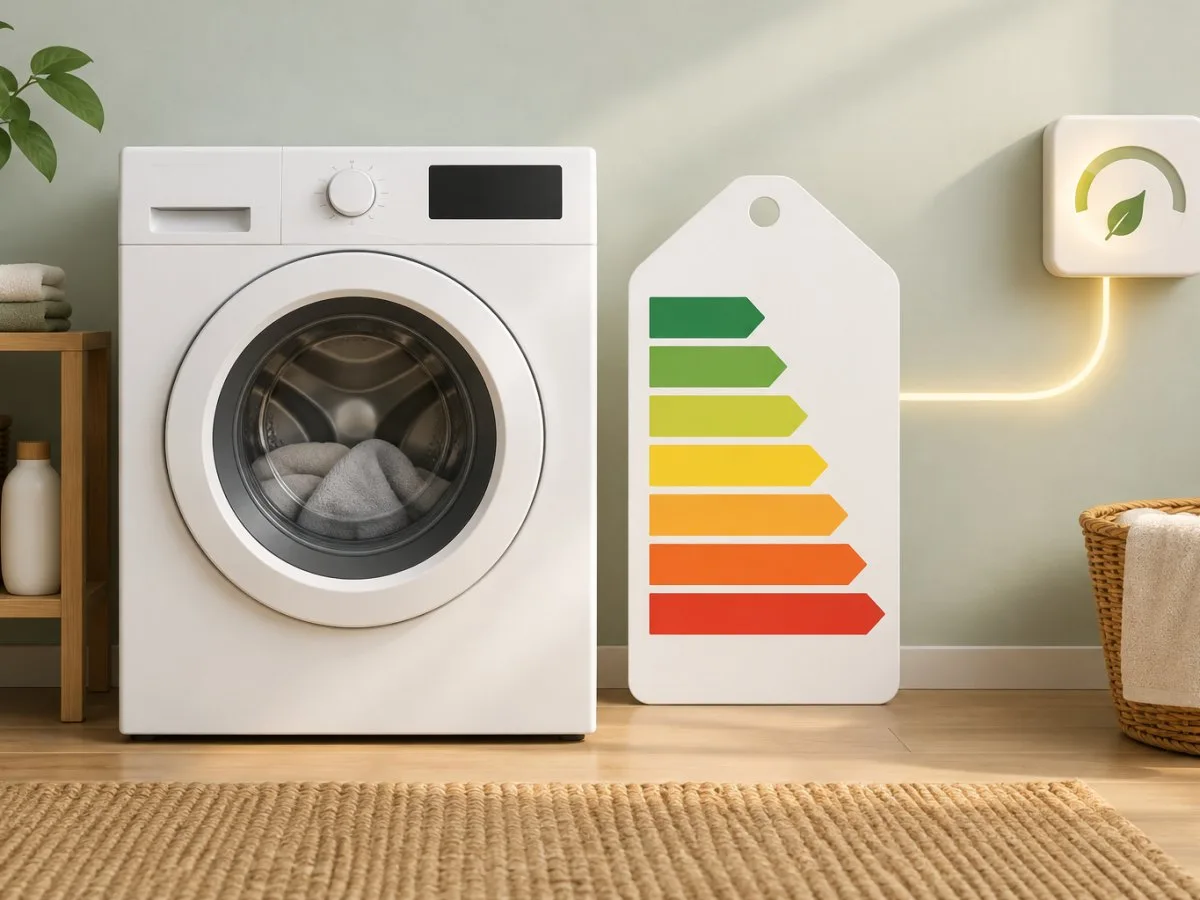
Start with the label—and check which scale applies
The EU energy label helps compare products within categories for which energy labelling rules apply. On the rescaled label, A is the most efficient class and G the least efficient. That scale was introduced gradually from 2021, starting with five product groups. The latest-generation label is now found on dishwashers, washing machines, refrigerators, electronic displays, light sources and tyres. Label formats and requirements remain category-specific, so check the label for the product you are considering rather than assuming every product uses the same scale.
Some older labels use classes such as A+++ to D. Do not treat an old class as directly equivalent to a class on the rescaled label: the parameters and test methods used to classify products have changed, so there is no precise mapping between generations.
A label can show more than an efficiency class. Depending on the product, it may include energy consumption, water use, noise, capacity, repairability or reliability information. These details can matter alongside the headline letter.
EU rules cover a range of products, but energy labelling does not apply to every product covered by ecodesign rules. Requirements are set out by product category. For example, the Commission’s product list identifies both energy labelling and ecodesign for dishwashers, washing machines, refrigerators and light sources, while some other categories are listed under ecodesign alone. Check the applicable product-specific information and compare products within the same category; an energy class is not a universal measure across different kinds of appliances.
Use EPREL to look beyond the label
The QR code on labels in the latest generation links to the product’s record in the European Product Registry for Energy Labelling (EPREL). You can also search EPREL for a model or filter products by criteria. A product record provides more detail than the label alone, including a product information sheet and declared performance data.
EPREL is useful for checking that you have the right model and comparing registered information. Treat declared figures as a comparison aid, not as a promise of a particular household bill.
When scanning a label QR code, check that the destination is the official EU domain, ec.europa.eu, before opening it. QR codes can be replaced with fraudulent stickers. EPREL should not ask for personal details or payment simply to view a product record. If a code looks suspicious, search using the model’s EPREL identification number or ask the retailer.
Compare figures that matter to your household
For each candidate, note the energy class and the consumption figure shown for that product category. Then check other relevant label details, such as capacity, water consumption and noise. Use the matching EPREL product information sheet to confirm the model and review the declared figures.
Start with products that do the same job and have a suitable capacity. Compare their published consumption figures, and check whether those figures are annual, per cycle or expressed another way. A class letter alone does not tell you the total cost of ownership.
The purchase price is not the only factor in the cost of owning an appliance. Electricity use, water consumption, durability and reparability can also make a difference. The label provides some relevant information, but it does not by itself establish a product’s purchase price, expected service life or repair cost.
Estimate electricity cost with your own figures
For a simple estimate, multiply a product’s declared electricity use by the number of years you expect to use it and by your electricity price per kilowatt-hour. Keep the units consistent:
Estimated electricity cost = annual electricity use (kWh/year) × years of use × electricity price (€/kWh)
For example, suppose two comparable products have declared annual consumption of 200 kWh/year and 250 kWh/year. If you assume 10 years of use and an electricity price of €0.30/kWh, the illustrative estimates are:
| Product | Calculation | Illustrative electricity cost over 10 years |
|---|---|---|
| A | 200 × 10 × €0.30 | €600 |
| B | 250 × 10 × €0.30 | €750 |
Under those assumptions, the difference is €150 over ten years. These are hypothetical figures, not measured results or a forecast for a specific Belgian household. Replace the consumption, period and tariff with the figures relevant to the models you are considering. The estimate excludes purchase price, water, maintenance, repairs and changes in energy prices.
For products whose labels report consumption per cycle or per use rather than per year, multiply by your expected number of cycles or uses. Do not compare a per-cycle figure directly with an annual figure. If products have different capacities or test conditions, note that limitation rather than presenting the result as a like-for-like household bill.
A practical buying checklist
- Identify the exact product category and confirm whether an energy label applies and which scale it uses.
- Compare models that meet the same need, including a suitable capacity.
- Record the energy class and consumption figure, checking whether it is annual, per cycle or expressed another way.
- Check useful secondary information, such as water use, noise and, where provided, repairability or reliability.
- Open the matching EPREL record to verify the model and review its product information sheet.
- Estimate running cost using your own tariff and expected use, keeping your assumptions visible.
- Consider more than energy use: purchase price, water, durability and repairability can affect overall cost.
- Treat the result as a comparison, not a guarantee of future bills.
This is a method for comparing products, not a live ranking of models available in Belgium. Product records and market availability can change, so check current retailer information and the relevant EPREL entry before buying.
At a glance
Nexo request
- 652
- nexo:broken-link:652:priority:v1
- Choosing energy-efficient home appliances: read the EU label and compare running costs
- en
- BE
- PROPUESTA EDITORIAL PRIORITARIA PREPARADA Título/pregunta: Choosing energy-efficient home appliances: read the EU label and compare running costs Proyecto elegido: House Angle (ID 43). Proyecto original: Comparor (4). House Angle encaja mejor en eficiencia doméstica y explicación de consumo. Comparor sería la opción para un ranking vivo por modelos; la propuesta existente es una guía de etiqueta y cálculo. Se conserva Comparor como proyecto original, el enlace y su historial. Público y territorio: Hogares de Sint-Katelijne-Waver y Bélgica que comparan electrodomésticos. Asunto territorial: BE. Idioma original: en. País/edición nativo para publicación: BE. Alcance y valor diferencial: Guía de vivienda y decisiones de compra, sin atribuir ensayos propios ni rankings actualizados que no existan. El destino redirige ahora al portal europeo de Topten con HTTP200: verificar su función actual antes de afirmar desaparición o contactar. El idioma del medio es neerlandés, no habilitado en House Angle: desarrollar las seis ediciones activas y no afirmar publicación neerlandesa. Esquema: 1. Understand the current EU label and product-specific scales using primary EU and Belgian material 2. Find model records and declared test data in EPREL, explaining their limits 3. Compare capacity and measured consumption for the same product category 4. Work through a labelled hypothetical running-cost calculation with user-supplied tariff and usage 5. Use an original buying checklist and distinguish a guide from a live product ranking Referencia: https://www.sintkatelijnewaver.be/producten/detail/1125/duurzaam-wonen-nuttige-links Enlace registrado: http://www.topten.be/index.php?page=homenl Comprobación actual: {"source_http":200,"source_error":null,"exact":[{"anchor":"Topten.be","context":"Topten.be: Via deze website vind u een overzicht van energiezuinige toestellen."}],"broken":{"url":"https://www.topten.eu/?utm_source=topten-belgium&utm_medium=cf-redirect&utm_campaign=website-deactivated","http":200,"at":"2026-11-19T00:48:15+00:00"}} Fuentes iniciales para recuperar y contrastar, sin marcar como leídas: https://energy-efficient-products.ec.europa.eu/ https://eprel.ec.europa.eu/ https://economie.fgov.be/ Reutilización: {"catalogue_reference_entry_id":219,"decision":"La guía existente explica estimación del consumo, no lectura de etiqueta y comparación en el mercado belga; enlazarla y mantener ambas intenciones diferenciadas."} Idiomas requeridos: es, en, fr, it, de, pt, habilitados en el proyecto. No inventar otros idiomas o ediciones. Prioridad explícita del propietario: avanzar sobre cupos, saldo, objetivos y esperas internos por encargo, conservando costes, intentos e historia. Investigación, revisión independiente y derechos siguen siendo obligatorios. Finalización: artículo útil con fuentes suficientes, seis ediciones revisadas y publicadas, versión y canonical comprobados por HTTP. La admisión no acredita publicación. El contacto exige pérdida confirmada, un canal pertinente, reserva y envío trazable sin repetir operaciones inciertas. Propuesta anterior: Guía de compra en neerlandés de electrodomésticos y aparatos eficientes: cómo leer la etiqueta energética, qué categorías comparar (frigoríficos, lavadoras, iluminación) y cómo calcular el ahorro. Sustituiría la lista de productos eficientes de Topten.be.
- https://www.sintkatelijnewaver.be/producten/detail/1125/duurzaam-wonen-nuttige-links
- http://www.topten.be/index.php?page=homenl
- 140e480033e073073214995ef0c44782259d3db81b6c9b7ebb07fe14dfbece95
- Hogares de Sint-Katelijne-Waver y Bélgica que comparan electrodomésticos
Priority authorization
- explicit_owner_instruction
- 652
- highest_native
- 1
- 1
- 1
- 1
- this_commission_and_its_active_editions_only
- 1
- 1
- 1
Required locales
- es
- en
- fr
- it
- de
- pt
Research required
1
Sources and references
Product List - Energy Efficient Products - European Commission ↗19/11/2026 European Commission, Product List – Energy Efficient Products
In focus: Energy efficient appliances ↗19/11/2026 European Commission, In focus: Energy efficient appliances
Energy Efficient Products - European Commission ↗19/11/2026 European Commission, Energy Efficient Products
Understanding the Energy Label - Energy Efficient Products ↗19/11/2026 European Commission, Understanding the Energy Label
Energy efficiency labels of appliances - Your Europe ↗19/11/2026 Your Europe, Energy efficiency labels of appliances