





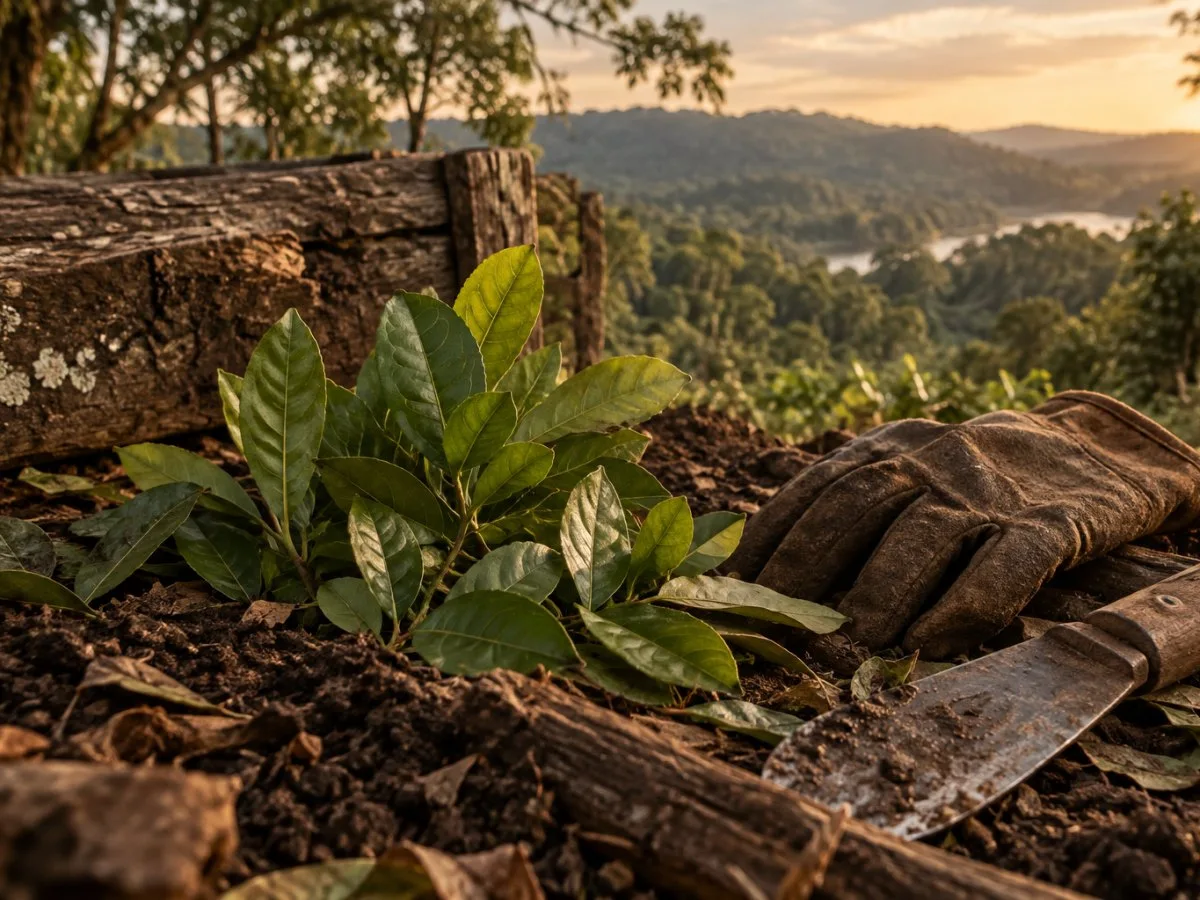
A landscape shaped by production and memory
Yerba mate is more than a drink or a crop. In Paraguay’s Yerba Mate Cultural Landscape nomination, submitted to UNESCO in 2022, it is connected with forests, small farms, production facilities, homes, museums and cultural practices. The proposed landscape brings together four zones that show different relationships between production and territory: historical, artisanal, associated with native forest, and industrial.
This perspective shifts attention from the finished product to the places and people that enabled its circulation. It also requires holding together two dimensions that should not be separated: the continuity of a cultural tradition and the violence of the labor systems that shaped its history.
Four ways of inhabiting and producing
The zones described in the proposal are not successive stages of an evolution or a quality ranking. They are territorial models that may coexist and express different scales and relationships with yerba mate.
| Zone | Characteristic described in the proposal | What it helps us observe |
|---|---|---|
| Historical | Sites and traces from different periods, alongside cultural expressions of traditional populations and Indigenous communities. | The relationship between memory, settlements and production. |
| Artisanal production | Yerba mate in native forest, forest-enrichment practices and artisanal supply chains oriented toward local trade. | Continuity between vegetation, labor and nearby markets. |
| Production associated with native forest | Cultivation or gathering in the forest, products from Indigenous and peasant communities, industrial processing and regional trade. | The coexistence of local practices with broader processing and distribution systems. |
| Industrial production | Intensive plantations, generally open-air, industrial processing and national and international markets. | The scale of production oriented toward wide distribution. |
The nomination states that the minimum geographic boundary is the municipality, which constitutes the buffer zone; final boundaries would be defined at a later stage. The four zones therefore help explain the territorial approach, but should not be read as a definitive map of established boundaries.
Everyday architecture matters, too
Vernacular housing has a significant place in the landscape description. It mentions compact, single-family wooden houses with ceramic-tile roofs and bright colors. The nomination notes that fewer are being built today and links this decline to the social association between wooden architecture and poverty, alongside a preference for renovating or replacing these homes with ceramic-brick masonry.
This observation raises a design question: what is preserved when a house is transformed? It is not only a building system that changes. The visible presence of a local tradition and the way a community recognizes its own landscape may also change. This interpretation does not make one form of housing a universal solution; rather, it invites us to consider material choices alongside their social meanings.
The proposal also relates architecture and gastronomy to municipal identity, although it does not describe every building or culinary practice. It is therefore more accurate to understand them as dimensions of the everyday landscape than as an exhaustive inventory of styles or recipes.
A history the landscape cannot soften
The nomination places the use of yerba mate in Indigenous communities and connects it with Guarani heritage. It describes how extraction and trade expanded during the colonial period, and how the encomienda and other forms of coercion subjected Indigenous and Creole workers to forced labor. After independence, production remained an important source of income; following the War of the Triple Alliance, large tracts of state land were sold and large estates consolidated.
From 1886 onward, the proposal situates yerba mate exploitation in the east of the country, especially in the territories of Itakyry and Tacurú Pucú, linking it to La Industrial Paraguaya S.A. and the mensúes, described as workers bound by debt. The company’s administrative and logistical center forms part of a territorial memory that persists beyond the gradual disappearance of its main structures.
This history makes it impossible to present the productive landscape as a bucolic image of harmony between nature and culture. The consumption tradition and Guarani heritage have cultural value, but their expansion also relied on exploitative relationships. Telling both parts of the story is essential to a responsible reading of heritage.
Museums, objects and spaces of memory
In Hernandarias, the Tacurú Pucú Historical Museum holds objects related to regional history, including items belonging to yerba-mate and timber workers, as well as materials connected with the Chaco War. A revitalization project reported in 2024 included plans for exhibition design and cataloging the collection. The museum’s history also illustrates a practical challenge: its collection moved from place to place, and some pieces were lost before it found a home at the premises of the Union of Veterans of the Chaco War.
In Itakyry, Paseo El Mensú is located in the city center and extends for eight blocks. Its graphic trail recounts the lives of the mensúes and the history of Itakyry. The former headquarters of La Industrial Paraguaya, which once functioned as a museum, represents another kind of memorial space. A 2018 report described the wooden building as being in precarious condition and at risk of disappearing amid a dispute over its ownership. That information reflects the situation at the time the report was published and does not establish the building’s current condition.
These places show that preserving memory depends on more than keeping a building intact. It also means caring for objects, documents and accounts; identifying them; and providing the context needed to understand who worked there and under what conditions. Museum cataloging, an urban walking route and architectural conservation are distinct practices, but each can help keep visible a history that might otherwise become fragmented.
Forest, cultivation and conservation
Yerba mate is endemic to the Interior Atlantic Forest, an ecosystem threatened by land-use change, according to the nomination. The document states that the species is included as a conservation element in some management plans for protected areas in Paraguay’s Upper Paraná Atlantic Forest ecoregion. Remnants of vegetation and yerba mate remain in those areas as part of the biodiversity being conserved.
At the same time, current production includes plants originating in native forest, small family or community farms, and industrial plantations located inside or outside the forest. No single image of production represents all these relationships. The interpretive challenge is to observe how the landscape changes with the scale and form of cultivation and its relationship to the forest, without confusing diverse production models with an automatic guarantee of conservation.
A nomination, not a definitive designation
Paraguay submitted the Yerba Mate Cultural Landscape to the World Heritage Tentative List on April 6, 2022. Inclusion on a tentative list documents a proposed nomination; by itself, it is not equivalent to definitive inscription as a World Heritage property.
Viewed through the lens of design, the proposal invites us to recognize that a landscape consists of visible places as well as historical relationships: the house, the road, the museum, the forest, the plantation and the labor. Yerba mate connects them, but does not erase their differences. Understanding this web requires preserving cultural and material expressions, while also clearly naming the exploitation that was part of it.
At a glance
Scope
Editorial perspective; this is not a site visit or a technical assessment.
Sources and references
Yerba Mate Cultural Landscape - UNESCO World Heritage Centre ↗14/11/2026 UNESCO World Heritage Centre, “Yerba Mate Cultural Landscape”, Paraguay Tentative List, submitted April 6, 2022.
La última casa de los mensú está olvidada - Última Hora | Noticias de Paraguay y el mundo, las 24 horas. Noticias nacionales e internacionales, deportes, política. Noticias de último momento. ↗14/11/2026 Última Hora, “La última casa de los mensú está olvidada y a punto de desaparecer”, February 24, 2018.
Paseo El Mensú, un encuentro con la historia de la yerba mate en Itakyry ↗14/11/2026 InfoNegocios, “Paseo El Mensú, un encuentro con la historia de la yerba mate en Itakyry”, September 30, 2021.
El Museo Tacurú Pucú conserva la memoria regional de Alto Paraná - Última Hora | Noticias de Paraguay y el mundo, las 24 horas. Noticias nacionales e internacionales, deportes, política. Noticias de último momento. ↗14/11/2026 Última Hora, “El Museo Tacurú Pucú conserva la memoria regional de Alto Paraná”, August 25, 2024.
Tacuru Pucú: Getting To Know The Hernandarias Museum ↗14/11/2026