





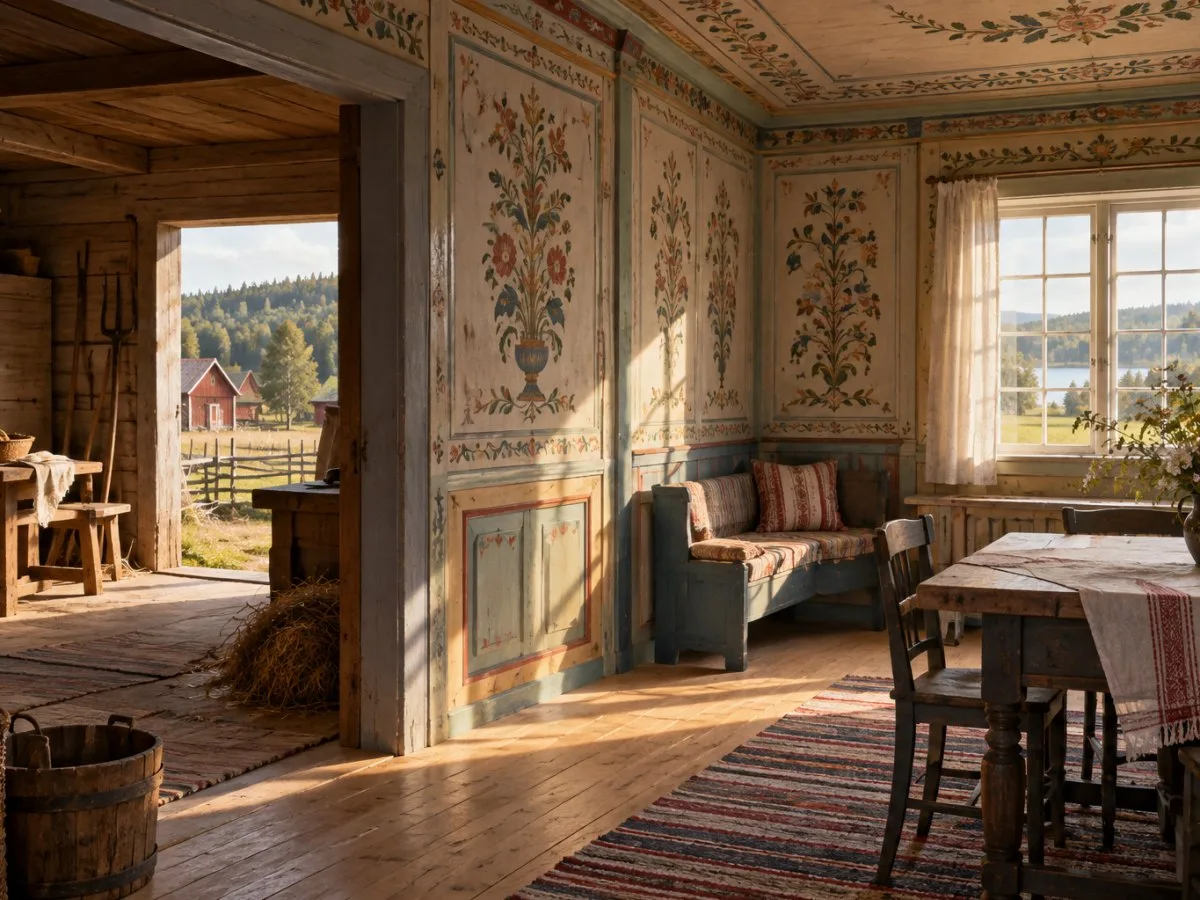
In Hälsingland, in eastern Sweden, the farmhouse was more than a place to live and work. At some farms, a separate house or several rooms in the main house were set aside for parties, gatherings and special occasions. These spaces also concentrated the most elaborate decorations: painted walls and ceilings, textiles and panels, and motifs that combined local traditions with styles associated with the well-to-do classes of the time.
Seven listed timber farmhouses represent this tradition at its most developed. They form part of a landscape that preserves more than a thousand timber structures, mostly from the 18th and 19th centuries, within a regional building tradition with medieval roots. Their significance lies not only in their ornament, but also in how the festive rooms were integrated with the house, farm buildings and agricultural setting.
A home with spaces for public life
The celebration rooms were used infrequently: they were opened for important events such as weddings, gatherings and other community festivities. Some occupied a separate house, known as a herrstuga; others were inside the main house. The division between everyday life and ceremony was thus built into the organization of the farmstead.
The contrast between the ordinary use of the house and the exceptional character of these spaces helps explain their design. The festive rooms could be the most richly decorated parts of the farmstead, but they were not isolated interiors: they belonged to a working farm made up of dwellings and outbuildings, set in a landscape of fertile valleys and taiga forest.
Folk painting and prestigious styles
Paintings could be applied directly to wooden walls and ceilings or mounted on canvas and textiles. Subjects included biblical scenes, although the figures were often dressed in contemporary fashion. The visual language brought together regional folk art and references to Baroque, Rococo and the Gustavian style.
Owners commissioned local painters or itinerant artists from the neighbouring province of Dalarna. The movement of these craftsmen helped techniques and motifs travel between communities. The result was not a uniform form of decoration: each farmstead has its own approach to the arrangement of rooms and the character of its interiors.
At Gästgivars, for example, painter Jonas Wallström worked with stencils and developed a style that spread to other parts of Sweden. At Kristofers, Anders Ädel’s floral paintings offer a different register. These examples show that decoration could be an expression of individual artistry as well as a sign of prosperity and social standing.
Prosperity transformed into architecture
During the 19th century, independent farmers used income from agriculture and cattle raising, along with activities related to flax and forest resources, to build spacious homes and improve their farmsteads. The decorated houses make that prosperity visible, but also express an aspiration: to receive guests, gather together and turn domestic space into a setting for celebration.
Timber architecture and painting are not separate layers. Together, they express a material culture in which local building, artists’ work and the prestigious styles of the time came together. The farmhouses are therefore best understood as ensembles: the festive room gains meaning in relation to the dwelling, the outbuildings and the land that sustained agricultural life.
Seven farmhouses, differences within a tradition
The seven properties in the site are spread across a broad region. Six are in Hälsingland Province and one, Bortom åa, is in Dalarna, although its surroundings formed part of Hälsingland’s cultural sphere in the 19th century. They include examples with different layouts and decorations: Jon-Lars has two dwellings built for two brothers; Bommars combines wallpaper inspired by manor houses with folk painting; and Bortom åa has an especially well-documented family history.
The variety matters as much as the shared features. Considered together, the farmhouses show how a regional tradition could adapt to different households, artists and circumstances while maintaining the connection between agricultural life and spaces intended for celebration.
Preserving a house means preserving its relationships
The value of these interiors depends on small details and their context. Conservation concerns more than painted surfaces: the relationship between the festive rooms, the rest of the farmstead and the landscape that makes its agricultural function legible also matters. Heritage documentation records that repairs and restoration have mostly used traditional materials and techniques; it also notes that some roofs were replaced with more modern materials to protect the decorated interiors.
Most of the properties are privately owned, and five remain directly associated with farming. In the other cases, the agricultural surroundings have been retained. This continuity shows that a historic house is not merely an architectural object: it is part of a territory and of practices that have changed over time.
The farmhouses of Hälsingland make it possible to read a home as more than shelter or a tool of work. Here, timber, painting and the arrangement of rooms make celebration a visible part of architecture: a way to express prosperity, belonging and community life.
At a glance
Scope
Editorial overview; this is not a visit or a technical assessment.
Sources and references
Decorated Farmhouses of Hälsingland ↗18/11/2026 Decorated Farmhouses of Hälsingland — UNESCO World Heritage Centre.
Hälsingland Farms - halsingegardar.se ↗18/11/2026 Hälsingland Farms — Region Gävleborg.
UNESCO World Heritage Centre - Decision - 36 COM 8B.40 ↗18/11/2026 Decision 36 COM 8B.40 — UNESCO World Heritage Centre.
Decorated Farmhouses of Hälsingland - halsingegardar.se ↗18/11/2026