





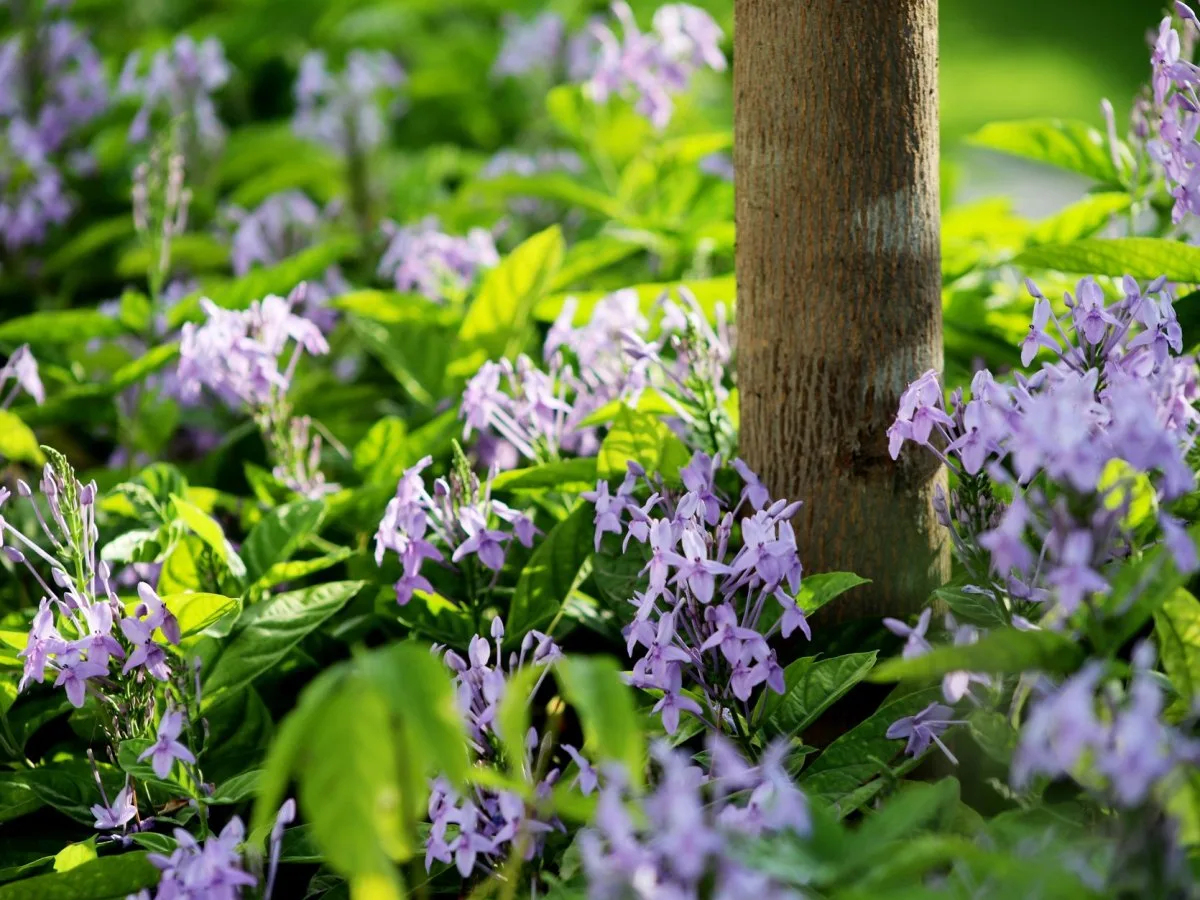
A space shaped by the canopy
The ground beneath a tree may look like a single shady corner, but its conditions vary. The canopy reduces light, while roots can compete for water and nutrients. Foliage density and height, the season and the site’s aspect also play a part. Planting beneath a tree is therefore not simply a matter of choosing species labelled “for shade”: what matters is the kind of shade and how much moisture the soil retains.
A deciduous canopy lets in more light before its leaves develop in spring. Beneath an evergreen canopy, or one that is low and spreading, shade may remain denser. That difference can guide the design: seasonal planting can take advantage of early light, while a space that stays dark invites an emphasis on foliage and texture.
Read the site before choosing plants
Observing where direct light reaches during the day and where it is filtered helps distinguish light, dappled and deep shade. Moisture matters too. Tree roots can leave the soil dry, and the lighter side of a canopy may offer better conditions than its darker, drier side. These are general tendencies, not guarantees that a plant will thrive in a particular garden.
Trees with low or spreading branches can restrict the available planting space; in those cases, it may make more sense to concentrate vegetation around the edge of the canopy. Establishing plants beneath conifers is often especially difficult: year-round shade, dry soil, and an accumulation of needles and plant debris create a demanding combination.
Compose with layers and rhythms
Plant choices can be organised by form, not just by flowers. Bergenia’s large, glossy leaves contrast with the fine shape of a fern; ground-cover plants can create a continuous base, while shrubs add taller structure. In areas with more favourable light and moisture, bulbs and perennials can add seasonal flowers.
Plants suggested for these settings include hardy cyclamen (Cyclamen hederifolium), bergenia (Bergenia), epimedium (Epimedium), lilyturf (Liriope muscari) and some ferns. They are not a universal recipe: the specific conditions and the characteristics of each plant matter. Bergenia, for example, can grow in shade, though it may not flower in deep shade.
Common ivy (Hedera helix) can also be considered as ground cover in shady places. Its autumn flowers provide nectar and pollen for insects, and its berries feed various birds. Ivy uses trees for support as it climbs, but has roots of its own and is not parasitic. If you want a trailing ground cover, distinguish between species and cultivars: some forms of ivy can spread invasively.
Establish a planting without erasing its context
Planting in autumn gives plants time to establish before the tree’s foliage appears in spring. Adding well-rotted organic matter and covering the soil with mulch are measures described for preparing and maintaining a planting. During the first growing season, watering through dry spells can be important; subsequent needs will depend on local conditions and the plants chosen.
Rather than trying to turn every spot beneath a tree into a lush bed, it may be more successful to leave some soil visible, group plants where conditions are better, and accept areas with more open coverage. The result does not depend on filling the whole space, but on making the composition respond to the canopy, the available light and water.
At a glance
Scope
Editorial overview; it is not a site visit or a technical assessment.
Sources and references
Photograph · Photo by Sharath G. on Pexels · Pexels License · Sources and references · Centred crop to 4:3, resizing and conversion to JPEG for House Angle.