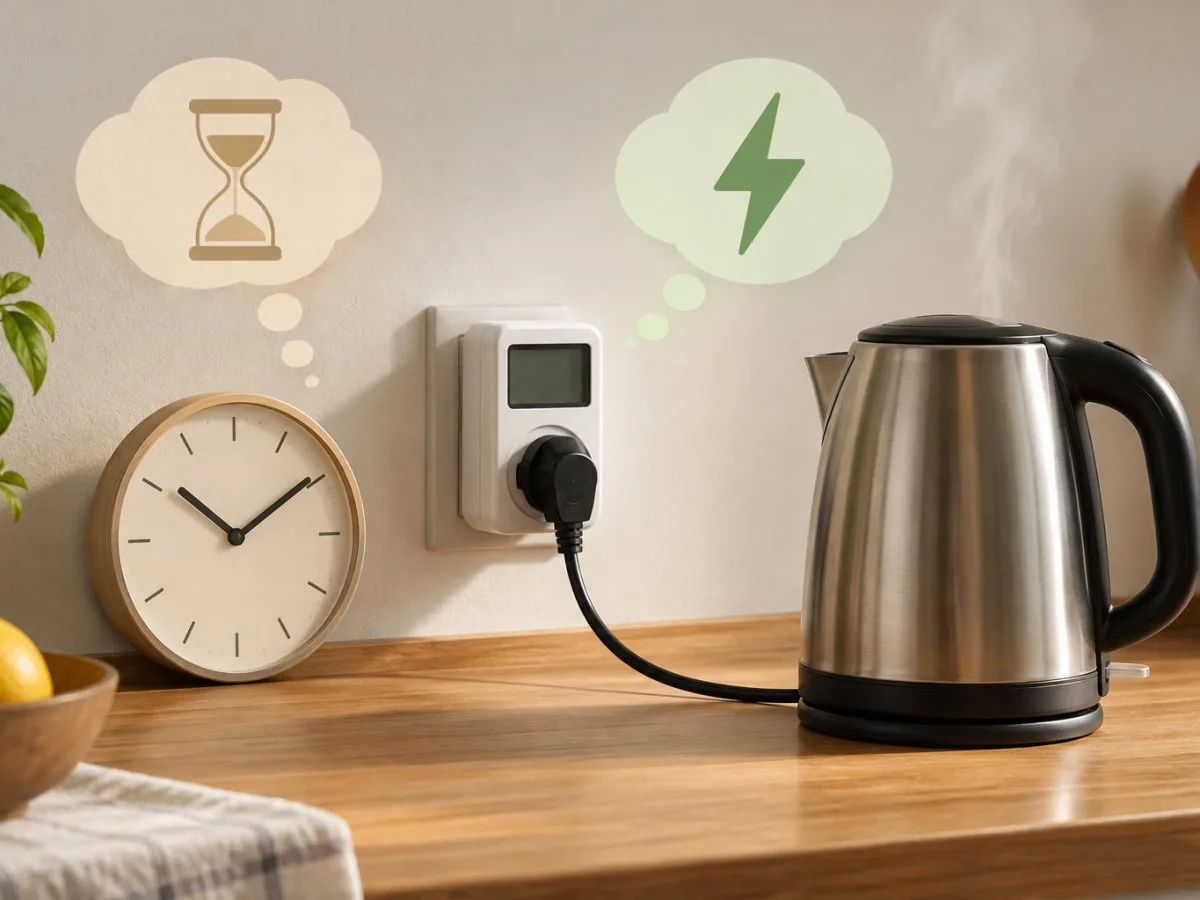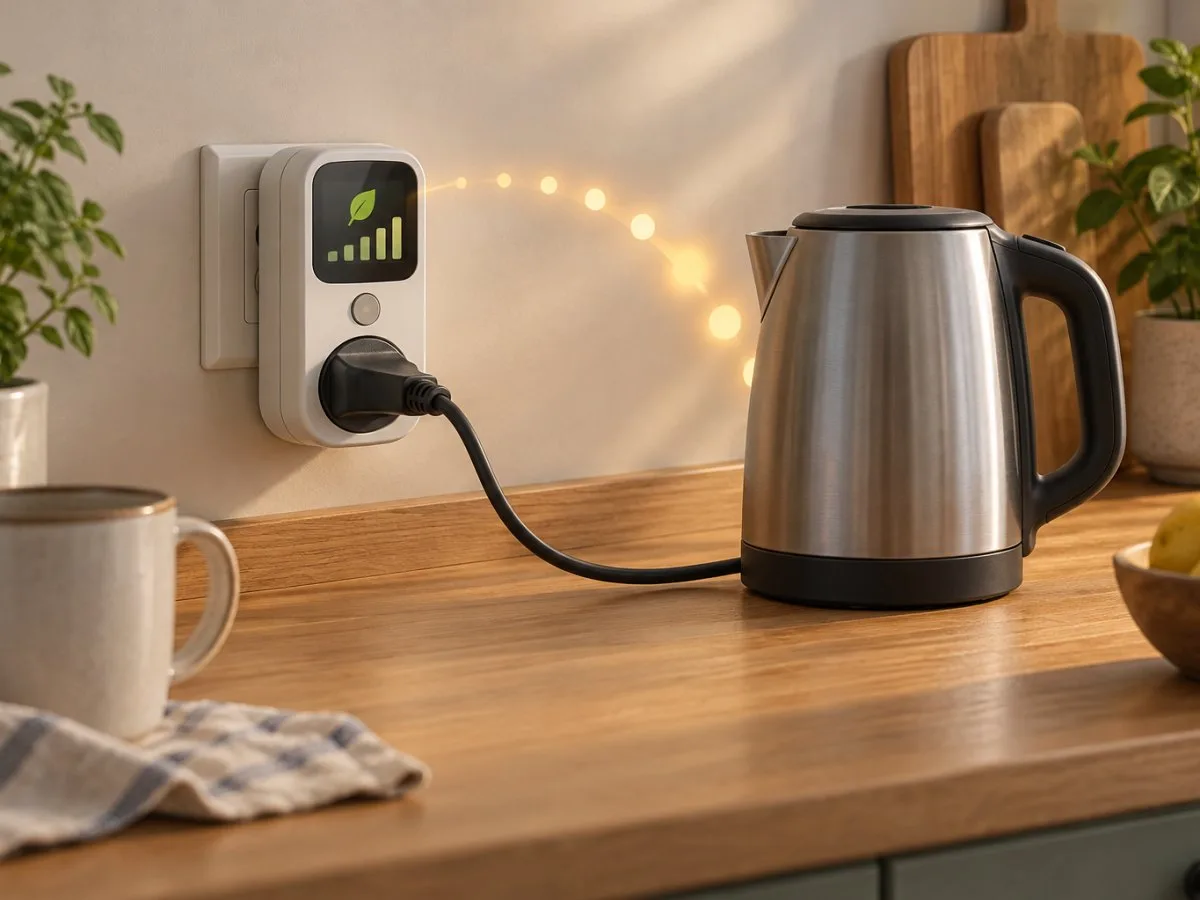
A plug-in energy meter records the energy an appliance uses over a period. It connects between the power outlet and the appliance. To interpret the reading, distinguish between power, expressed in watts (W), and accumulated energy, measured in kilowatt-hours (kWh).
This guide explains how to plan a measurement, estimate the cost and compare results cautiously. It does not describe a local meter-lending service or replace the instructions for your meter or appliance.
What you need and what you can measure
Before you begin, decide what you want to find out: a refrigerator’s consumption over several days, a complete washing-machine cycle, or an appliance’s standby consumption. Check the meter’s instructions to make sure it is suitable for the appliance and intended use. A plug-in meter is for appliances connected by a plug; it is not the right method for equipment wired directly into the electrical installation.
Do not open appliances or handle the electrical installation to take a measurement. If the appliance does not connect to a power outlet, this method is not appropriate; consult a qualified person.
You can ask a consumer advice centre, an energy or climate agency, or an energy supplier in your area whether it lends meters and what conditions apply. Availability depends on the organisation and location. You can also buy one. In either case, check that the meter displays accumulated energy in kWh and that its instructions cover your intended use.
Step-by-step measurement
- Choose an appliance and a goal. If you connect several devices to a power strip, the meter will record their combined consumption, not the consumption of each device separately.
- Record the conditions. Note the start date and time and the operating mode. For a washing machine or dishwasher, also note the programme and load.
- Prepare the reading. Reset the kWh counter according to the meter’s instructions, or note the initial value so you can calculate the difference later.
- Connect the appliance and use it normally. If you want to know its typical consumption, try not to deliberately change your habits during the measurement.
- Read the final value and note the time. If you did not reset the meter, subtract the initial reading from the final one. Make sure the energy reading and the time relate to the same interval.
- Estimate consumption and cost. Project the result only if the measurement period is a reasonable basis for typical use. To calculate the cost of the energy, apply the price per kWh in your tariff.
| Appliance or use | Measurement guidance | How to estimate annual consumption |
|---|---|---|
| Refrigerator or freezer | Measure for seven days to obtain a reference for consumption during that period. The result is not guaranteed to represent the whole year. | Measured kWh ÷ days measured × 365 |
| Washing machine, dishwasher or tumble dryer | Measure one complete cycle. To compare programmes, try to keep conditions similar, such as the load. | kWh per programme × programmes per week × 52; use a weekly frequency representative of the year. |
| Router or another regularly used appliance | Choose a period that reflects the use you want to assess. | Measured kWh ÷ days measured × 365, if usage remains similar. |
| Standby mode | Measure this mode separately; if consumption fluctuates, observe it for a sufficiently long period. | If power remains constant: W × hours per day × 365 ÷ 1,000. |
For a refrigerator, a single reading may not represent consumption over a longer period. A seven-day measurement allows you to calculate an annual estimate from that interval, but the result may vary depending on actual use. To compare washing programmes, record each complete cycle under similar conditions and use a representative frequency of use for the annual projection.
From kWh to cost
To calculate the cost of the measured energy, multiply the kWh by the price per kWh in your tariff. To estimate an annual cost, first project consumption over a year and then apply that price. The calculation described here includes the cost of the energy used by the appliance; it does not include other components of the bill.
Illustrative example: If a refrigerator uses 2.8 kWh in seven days, the projection would be 2.8 ÷ 7 × 365 = 146 kWh per year. At an assumed price of 0.30 euros per kWh, that would equal 43.80 euros per year. This is an illustrative calculation, not a measurement of a specific appliance or a tariff offer.
If you know the power and it remains constant during the period under consideration, you can estimate the energy using this formula:
Consumption (kWh) = power (W) × hours of use ÷ 1,000
For example, 5 W for 24 hours a day, every day of the year, would equal 43.8 kWh. If the appliance switches between modes, it is preferable to use the accumulated energy shown by the meter rather than assume that power remains constant.
With a dynamic tariff, the actual cost also depends on when electricity is consumed. Applying a constant average price to all consumption is only an approximation.
How to interpret the result
Estimated annual consumption is not the same as potential savings. A refrigerator still needs to keep food cold, and switching off a router can interrupt functions you need. A measurement alone does not show that changing a setting or habit is worthwhile.
If you want to compare two options, try to make sure they perform the same function and keep the other conditions as similar as possible. For example, you can measure two washing-machine programmes with comparable loads and change only the programme. Also check that the washing result is suitable for you. The difference between readings can help estimate potential savings, but it does not guarantee them: usage and electricity prices can vary.
Unexpectedly high consumption does not in itself prove that there is a fault. Before drawing conclusions, check the measurement period and conditions, including any connected appliances and the operating mode. If the appliance behaves unusually or the reading still seems abnormal, consult its instructions and seek technical advice if necessary.
High consumption also does not automatically mean you need to buy a new appliance. Before deciding, consider whether you can continue using or repair the appliance, the cost of a new one and how long you expect to use it. The measurement is only one part of that decision.
Common mistakes to avoid
- Confusing watts with kilowatt-hours. Watts indicate power; kWh indicate accumulated energy. To estimate cost, you need energy and a price per kWh.
- Extrapolating a single reading. A reading taken in one particular state does not necessarily represent daily or annual consumption.
- Measuring an incomplete programme or using different conditions. To compare washing machines, dishwashers and tumble dryers, record complete cycles and try to keep the load and other conditions similar. Calculate the projection using a representative frequency of use.
- Mixing different time periods. A reading from an app and a duration measured from another point in time do not necessarily relate to the same interval.
- Confusing consumption with savings. The calculation shows the cost of the energy used; it does not indicate how much you could avoid without changing a function you need.
If you do not have a meter
The power stated on the label or in the instructions, together with an estimated duration of use, can be used for an approximate calculation. It is not a measurement and may be inaccurate if the power changes during operation. The home’s main electricity meter records total consumption, but when other appliances are operating at the same time it usually cannot reliably attribute consumption to just one appliance.
If you already have a smart plug with energy measurement, check its instructions to make sure it displays the kWh and the period you need. For an appliance wired directly into the electrical installation, do not use a plug-in meter or handle the wiring: consult a qualified person.
To get started, choose an appliance, note the initial reading and set the end of the measurement period. For a refrigerator, measure for seven days to obtain a reference; for a washing machine, wait until the complete programme has finished and note the conditions so a comparison is useful. Then calculate the cost of the energy using the price per kWh in your tariff, and treat any annual projection as an estimate.
At a glance
Nexo request
- 324
- nexo:broken-link:324:priority:v1
- Stromfresser im Haushalt finden: Strommessgerät richtig nutzen (ausleihen oder kaufen), Messung Schritt für Schritt und typische Verbrauchswerte
- de
- Sin equivalente en House Angle (era el servicio de préstamo de medidores de consumo de los Stadtwerke de Erlangen). Propuesta (de): «Stromfresser im Haushalt finden: Strommessgerät richtig nutzen (ausleihen oder kaufen), Messung Schritt für Schritt und typische Verbrauchswerte», para hogares que quieren medir el consumo de sus aparatos; cubre la función práctica de medir, no el préstamo local.
- https://www.energiewende-erlangen.de/klimaschutztipps/nachhaltige-energieversorgung-und-nutzung/energieeffizienz-energieeinsparung/
- https://www.estw.de/de/Energie-Wasser/Dienstleistungen-Energieberatung/Messgeraete/
- 858bf9db8cb81c31bc8f8950e838559c1ffdaa60bdfcbc149cf872bd1b3233da
Priority authorization
- explicit_owner_instruction
- 324
- highest_native
- 1
- 1
- 1
Required locales
- es
- en
- fr
- it
- de
- pt
Research required
1
Sources and references
Strom sparen im Haushalt: Einfache Tipps | Verbraucherzentrale.de ↗19/11/2026
Stromverbrauch berechnen im Haushalt + aktueller Strompreis | co2online ↗19/11/2026
Stromverbrauch messen: Anleitung und Kostenrechner ↗19/11/2026
So finden Sie den passenden Kühlschrank | Verbraucherzentrale.de ↗19/11/2026
Energiesparen mit kleinem Budget | Verbraucherzentrale.de ↗19/11/2026
Cómo medir el consumo eléctrico de tus aparatos: guía paso a paso y cálculo de costes ↗19/11/2026
Beim Stromsparen hilft jetzt die Bibliothek | Umweltbundesamt ↗19/11/2026
Beim Gefrierschrank den Stromverbrauch im Auge behalten | Umweltbundesamt ↗19/11/2026
Measuring Standby Power | Department of Energy ↗20/11/2026
Kosten-Rechner: Wie viel kostet Sie das neue Haushaltsgerät wirklich? | Verbraucherzentrale.de ↗19/11/2026