





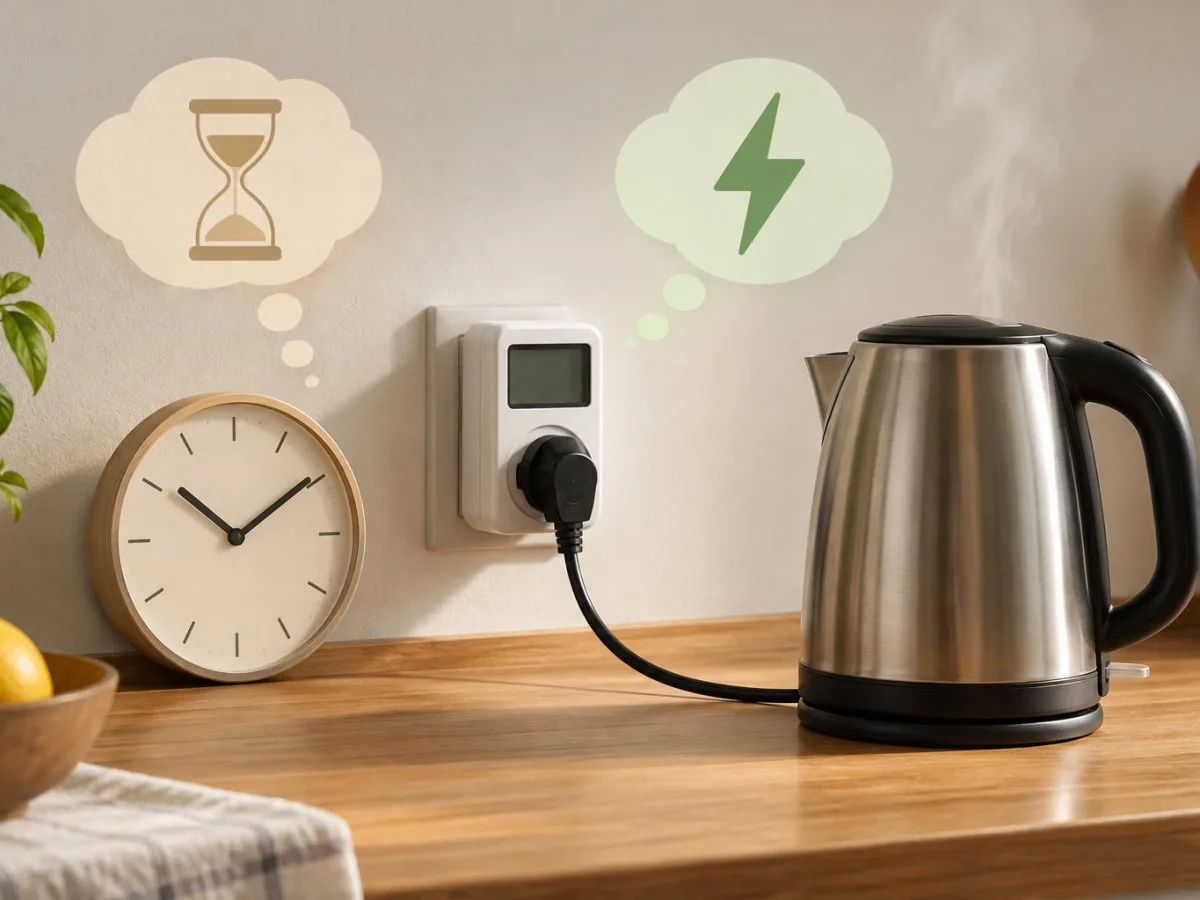
An appliance’s power and the energy it consumes are different quantities. Power is measured in watts (W) and expresses energy used per unit of time. Energy is measured in watt-hours (Wh) or kilowatt-hours (kWh) and represents consumption accumulated over a period. To estimate it, you need a power reference and a period of use; to estimate cost as well, you need the applicable rate.
Distinguishing power from energy
A watt (W) is a unit of power, and 1 kilowatt (kW) equals 1,000 watts. Accumulated energy is expressed in watt-hours (Wh) or kilowatt-hours (kWh): one Wh is the energy used by one watt for one hour, and one kWh is the energy used by one kilowatt for one hour. Electric utilities generally measure consumption in kWh.
For example, a 40 W (0.04 kW) light bulb used for five hours consumes 200 Wh, or 0.2 kWh.
Information to gather for the calculation
Gather the following information for each appliance:
- Power: Look for the wattage on the rating plate—often on the bottom or back—or in the model’s documentation. If only the current in amperes is listed, do not try to measure it yourself; consult a qualified professional.
- Operating time: Record the hours of use. If the appliance operates in cycles, like a refrigerator, or changes modes, separate those periods rather than assuming it draws the stated power for all the time it is plugged in.
- Days of use: Note how many days the appliance is used during the period you want to calculate.
- Electricity rate: If you want to estimate energy cost, check your bill for the applicable price per kWh.
For a motor, current during startup may be higher than during normal operation. Virginia Cooperative Extension’s factsheet indicates that startup current can be about three times higher than current while the motor is running steadily. Therefore, a reading during startup does not necessarily represent the current typically drawn during the cycle. If current needs to be measured with electrical instruments, consult a qualified professional.
Formula and example
For constant power, estimate daily consumption as follows:
(Power in W × hours of use per day) ÷ 1,000 = daily consumption in kWh
Multiply daily consumption by the number of days of use to estimate consumption for the period. To estimate energy cost, multiply the calculated kWh by the rate per kWh. The result does not necessarily represent the full bill, which may include other charges.
Example: A 200 W fan running 4 hours a day for 120 days consumes 96 kWh over that period, according to this calculation:
- Daily consumption: (200 W × 4 h) ÷ 1,000 = 0.8 kWh.
- Consumption over 120 days: 0.8 kWh × 120 = 96 kWh.
- At a rate of 8.5 cents per kWh, the arithmetic calculation for those 120 days is 96 × 8.5 = 816 cents, or $8.16. Virginia Cooperative Extension’s factsheet presents the same amount as an annual cost, although the consumption it calculates in its example corresponds to 120 days. That annual label does not match the stated period; therefore, $8.16 here is the result of applying the cited rate to the 96 kWh consumed over 120 days, not an annual figure supported by that calculation. The result depends on the applicable rate and currency and is not a universal cost.
The result is an estimate: it depends on whether the selected power rating and hours represent the use you want to calculate.
Cycles, modes, and standby use
The stated power rating does not necessarily mean the appliance draws constant power for the entire time it is plugged in. A refrigerator, for example, switches its compressor on and off as needed. For this example, Virginia Cooperative Extension suggests dividing the time the refrigerator is plugged in by three to estimate the hours it operates at maximum power. This is not a universal rule for all models or conditions.
Equipment can also consume power when switched off or not performing its primary function. Standby use may maintain functions such as receiving signals, keeping a clock, charging batteries, or connecting to a network. It is not always possible to tell by looking at an appliance whether it is still using electricity; measuring it may be necessary to determine its specific consumption.
If an appliance is used infrequently, unplugging it or cutting its power with a switched power strip can avoid some standby consumption. Do not do this if you need to keep a function active, such as network connectivity or signal reception.
Nameplate values: references, not measurements
The table below gives examples of rated power values published for various appliances. They are reference values, not measurements of equipment in a particular home. The model and operating mode matter.
| Appliance | Stated power (W) |
|---|---|
| Window fan | 55–250 |
| Ceiling fan | 65–175 |
| Microwave oven | 750–1,100 |
| Clothes washer | 350–500 |
| Clothes dryer | 1,800–5,000 |
| Dishwasher | 1,200–2,400 |
| Coffee maker | 900–1,200 |
| Toaster | 800–1,400 |
| Clothes iron | 1,000–1,800 |
| Hair dryer | 1,200–1,875 |
| Computer (CPU, awake / asleep) | 120 / 30 or less |
| Monitor (awake / asleep) | 150 / 30 or less |
| Flat-screen television | 120 |
| Frost-free refrigerator, 16 cubic feet | 725 |
These values are examples from a U.S. extension factsheet and do not guarantee that a particular appliance has that power rating. To compare appliances, check the rating plate and model documentation; to estimate accumulated consumption at home, also consider usage time and modes.
EnergyGuide labels: the scope of the reference
In the United States, the EnergyGuide label gives an estimate of annual cost or efficiency information for certain products, based on U.S. Department of Energy test procedures. It helps compare similar models, but by itself does not predict consumption or cost for a particular household. The available information describes U.S. regulations; it does not support generalizing their requirements to other countries.
Estimating and measuring
A calculation based on power and operating time is an estimate, not a reading of actual consumption. An energy meter can help measure the power or energy of an appliance connected to it. Follow the instructions for the meter and the appliance when taking a measurement.
The House Angle consumption calculator can help you organize these details and produce an estimate. The result is only as representative as the power, operating time, and rate values you enter; the calculated cost is for energy at that rate, not necessarily the total bill.
At a glance
Scope
Educational guide to estimating energy consumption; it does not replace a professional assessment of electrical installations.
Tools
Sources and references
Measuring electricity — US Energy Information Administration ↗15/11/2026
Estimating Appliance and Home Electronic Energy Use — Virginia Cooperative Extension ↗15/11/2026
EnergyGuide labeling FAQs — Federal Trade Commission ↗15/11/2026
Frequently Asked Questions About Standby Power — Lawrence Berkeley National Laboratory ↗15/11/2026