





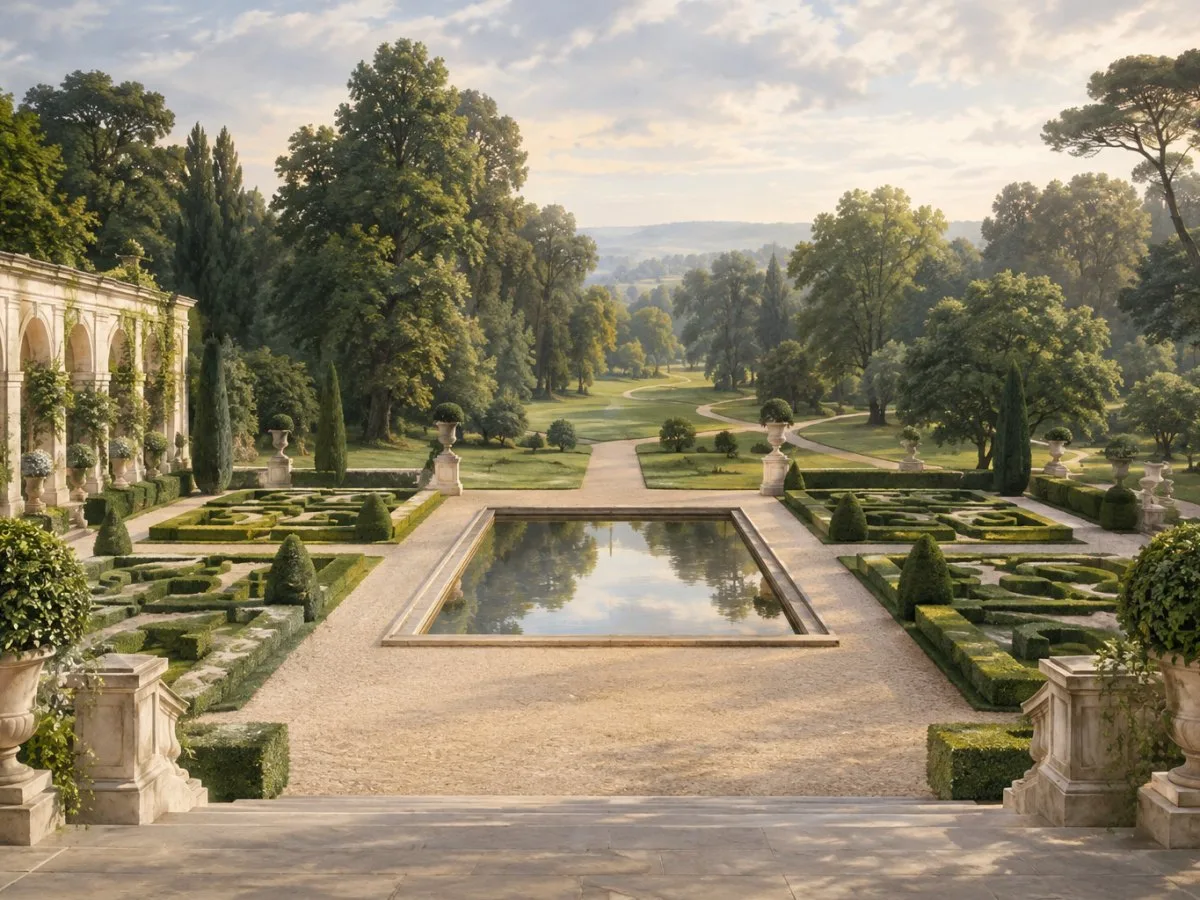
In Kroměříž, the Archbishop’s Castle and two nearby gardens bring together architecture, art collections and landscapes from different eras. The Castle Garden retains a Baroque layout reshaped under the influence of the Romantic landscape garden in the late 18th and early 19th centuries; the Flower Garden has preserved much of its formal composition. Together, they invite us to read design as an arrangement of routes, views and transitions.
A residence between town and landscape
Kroměříž stands beside an old ford across the River Morava, at the foot of the Chriby mountain range. The Baroque castle was built on earlier foundations, and the residence passed through medieval and Renaissance phases before acquiring its present form.
The Baroque building is arranged in four wings around a trapezoidal central courtyard. On the ground floor, the richly decorated sala terrena rooms, with grottoes—one of them imitating a mine—connect the castle to the adjoining garden. This continuity makes it possible to understand the residence and landscape as parts of a spatial sequence, rather than simply as separate elements.
The castle preserves decorated interiors and art collections. The concentration of architecture, ornament and artworks expresses a form of representation associated with a princely residence linked to ecclesiastical authority. The rooms’ connection to the garden extends the building’s composition outdoors.
Two gardens, two ways of ordering space
The Castle Garden was designed with a Baroque layout and later transformed under the influence of the Romantic landscape style of the late 18th and early 19th centuries. It includes exotic trees standing alone or in groups, along with several architectural features. These include the Pompeian Colonnade, built in 1846 to house sculptures from Pompeii, and three elegant cast-iron bridges—the Silver Bridge, the Vase Bridge and the Lantern Bridge—made using iron produced at the archiepiscopal foundry.
The Flower Garden, also called the Pleasure Garden, offers a formal contrast. Its geometric composition, rooted in the Italian tradition, begins with a 244-metre-long arcaded gallery decorated with statues and busts, leading to an octagonal rotunda. Symmetrical parterres, low hedges, mazes and flower beds are arranged around it. Farther on, two low mounds with arbours and two rectangular basins are laid out on either side of the main axis. A spiral path leads towards the aviary and greenhouses.
The difference between the gardens is also a difference in how they organize space. The Castle Garden incorporates later landscape changes over a Baroque foundation; the Flower Garden has largely retained its formal 17th-century composition. In one, trees, structures and routes are integrated into a broad landscape; in the other, axes, symmetry and successive enclosures make the geometric order visible.
Water, architecture and movement
In the Flower Garden, rectangular basins are positioned symmetrically on either side of the main axis. Their arrangement shows how water participates in the composition and reinforces its axial structure. The Baroque ensemble also demonstrates a virtuoso use of water; this general description does not specify how each installation works.
Thresholds shape movement in different ways. In the Flower Garden, the arcaded gallery marks the entrance and the rotunda serves as the composition’s focal point; the parterres and basins distribute elements on either side of the axis. In the Castle Garden, bridges and other structures sit within a broader landscape. As a way of reading the space, this contrast invites questions: does a route lead towards a recognizable centre, or does it encourage the gradual discovery of points of interest?
These questions help us observe how spaces relate to one another, but they are not instructions for reproducing a historic garden. The scale, history and conservation conditions of Kroměříž are not equivalent to those of a courtyard or domestic garden. What can be carried over is an attentiveness to transitions, the organization of routes and the role of distinctive elements within a composition.
Conservation through change
The coherence of the place does not depend on everything having remained untouched. The Castle Garden was transformed under the influence of the Romantic landscape style in the late 18th and early 19th centuries, while the Flower Garden has largely retained its Baroque appearance and layout. The castle’s design and decoration have also preserved many of their original characteristics, although the building has undergone changes and restorations.
Heritage documentation states that the two gardens are regaining their original appearance through restoration and rehabilitation based on in-depth technical studies. The available description does not specify the current scope of the interventions in each garden. The ensemble’s history shows that conservation does not necessarily mean erasing its distinct layers.
The relationship between the castle and the two gardens makes it possible to read design as a link between purpose, movement and time. A residence can extend into the landscape; a geometric composition can remain legible for centuries; and a garden can change its language without losing all connection to its earlier layout. In Kroměříž, Baroque composition, landscape design and the architecture that links them coexist within one ensemble.
At a glance
Scope
Editorial reading; this is neither a visit nor a technical assessment.
Sources and references
Gardens and Castle at Kroměříž ↗16/11/2026 UNESCO World Heritage Centre, Gardens and Castle at Kroměříž.
Gardens and Castle in Kroměříž ↗18/11/2026 Gardens and Castle in Kroměříž, ensemble website.
National heritage institute - The National Heritage Institute ↗18/11/2026 National Heritage Institute, National Centre of Garden Culture in Kroměříž.
National heritage institute - Project NCGC ↗18/11/2026 National Heritage Institute, Project NCGC.
Gardens and Castle at Kroměříž - Národní památkový ústav ↗18/11/2026 Národní památkový ústav, Gardens and Castle at Kroměříž.