





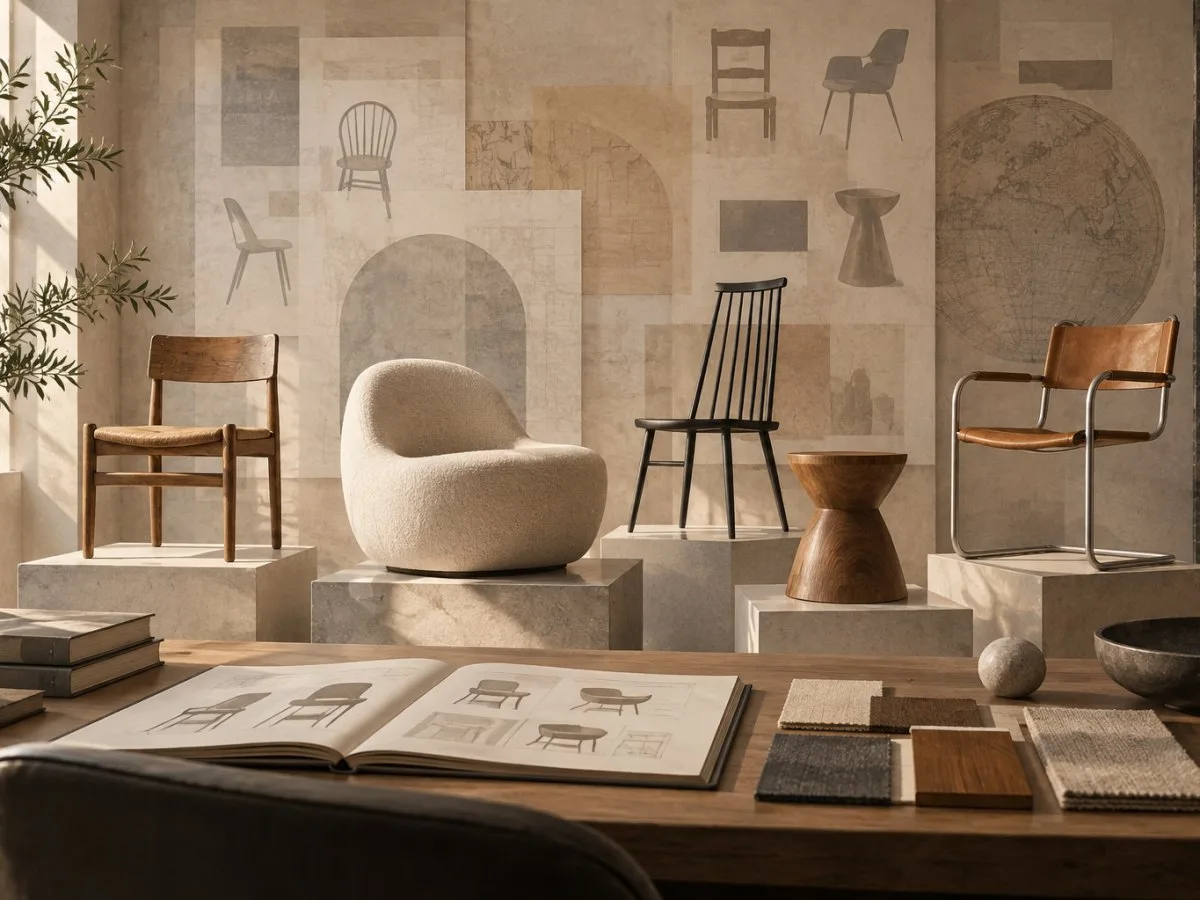
An encyclopedic reference on modern furniture
Published by the Vitra Design Museum in November 2019, Atlas of Furniture Design is one of the most extensive reference works devoted to the history of modern furniture design. More than 1,000 pages long, the book is not simply a catalogue: it is a research tool documenting 1,740 objects by more than 540 designers. Its more than 2,800 illustrations range from photographs of objects and design sketches to patents, brochures, works of art, architecture, and portraits of designers.
The book is the product of more than 20 years of research. Its structure makes it possible to approach furniture history from several perspectives: as a selection of iconic designs, a chronicle of changing styles, a history of objects, or a narrative about domestic habits. The Atlas spans the period from the beginnings of industrialization to the digital era, offering an overview of key stages in design history.
The collection as a primary source
Unlike publications that rely on secondary archives, Atlas of Furniture Design draws directly on the Vitra Design Museum’s collection. The collection comprises more than 20,000 artefacts, around 7,000 of them pieces of furniture. It is among the largest of its kind in the world and has been carefully assembled over the past three decades to give a comprehensive impression of furniture design over the last two centuries.
Physical access to these objects was important to the research. Editors and authors could examine details that are often lost in digital reproductions or conventional written descriptions, including upholstery seams, fabrics, structural joints, and manufacturers’ marks. This approach made it possible to correct inaccuracies and errors found in earlier bibliographic sources and to establish a more reliable factual basis for scholarly research into furniture design.
Selection criteria and the structure of the book
The selection of the 1,740 objects in the Atlas involved a complex set of criteria. The main aim was to illustrate major trends in furniture design from the nineteenth century to the present. This meant giving prominent designers adequate representation, from indisputable modernist classics to contemporary figures.
The book is organized across several levels of detail:
- Contextual essays: In-depth texts describing the sociocultural and historical context of four distinct periods.
- Object analyses: More than 550 detailed texts examining key designs and pioneering objects.
- Information graphics: Visualizations offering new perspectives on design history, including timelines of global development and the evolution of specific furniture types, such as the cantilever chair and the Monobloc.
- Appendices: Designer biographies, bibliographies, glossaries of manufacturers and materials, and keyword indexes.
This structure allows the book to serve both as a quick reference for enthusiasts and as a rigorous resource for collectors, scholars, and experts.
From the nineteenth century to the digital era
The Atlas documents furniture’s passage through a range of styles and materials. It includes nineteenth-century pieces made of bentwood and metal, as well as designs associated with Art Nouveau and the Secession. Particular attention is given to leading figures of modernism, including Le Corbusier, Gerrit Rietveld, Charlotte Perriand, Marcel Breuer, and Eileen Gray.
The book also covers post-war design, postmodernism, and contemporary work, documenting designs by Charles and Ray Eames, Eero Saarinen, Gae Aulenti, Finn Juhl, Ettore Sottsass, Philippe Starck, Hella Jongerius, Jasper Morrison, and Konstantin Grcic. This chronological breadth makes it possible to see how technical innovations and social change have influenced the form and function of furniture over 230 years.
A large-scale collaborative project
The creation of Atlas of Furniture Design was a collective undertaking coordinated by Mateo Kries, director of the Vitra Design Museum and co-editor of the publication. More than 70 international authors and experts contributed. Their collaboration brought recent academic research into the book, questioned established knowledge, and gave specialists from different disciplines a platform.
The publication had a long gestation: the idea of creating an encyclopedic book on furniture design had existed within the museum team since the 1990s. The project reflects the Vitra Design Museum’s commitment to rigorous documentation of design history and its aim of providing a resource for both the academic community and the wider public interested in design.
Publication details
For collectors and bibliophiles, the book’s physical characteristics are part of its value as a design object. Atlas of Furniture Design comes in a generous format that allows readers to appreciate the breadth and depth of its subject.
| Feature | Details |
|---|---|
| Binding | Hardcover |
| Format | 31 x 23.5 x 7.5 cm |
| Number of pages | 1,028 |
| Available languages | English or German |
| Publisher | Vitra Design Museum |
| Year of publication | 2019 |
Value for collectors and scholars
Atlas of Furniture Design is positioned as an essential resource for people who work or conduct research in design. Its scholarly approach and breadth distinguish it from other publications in the field. By providing a solid factual foundation, the book helps readers identify objects, understand their historical contexts, and assess their significance within design history.
For design enthusiasts, the book offers the opportunity to explore not only famous pieces but also lesser-known objects that have been part of many people’s everyday lives. This combination of academic rigour and accessibility makes the Atlas a reference work that goes beyond collecting, becoming a tool for ongoing learning and discovery.
At a glance
Scope
Editorial reading; it does not constitute a visit or a technical evaluation.
Sources and references
Atlas of Furniture Design | Official Vitra® Online Shop ES ↗23/10/2026
Atlas of Furniture Design ↗23/10/2026
The Atlas of Furniture Design | Official Vitra® Website LP ↗23/10/2026