





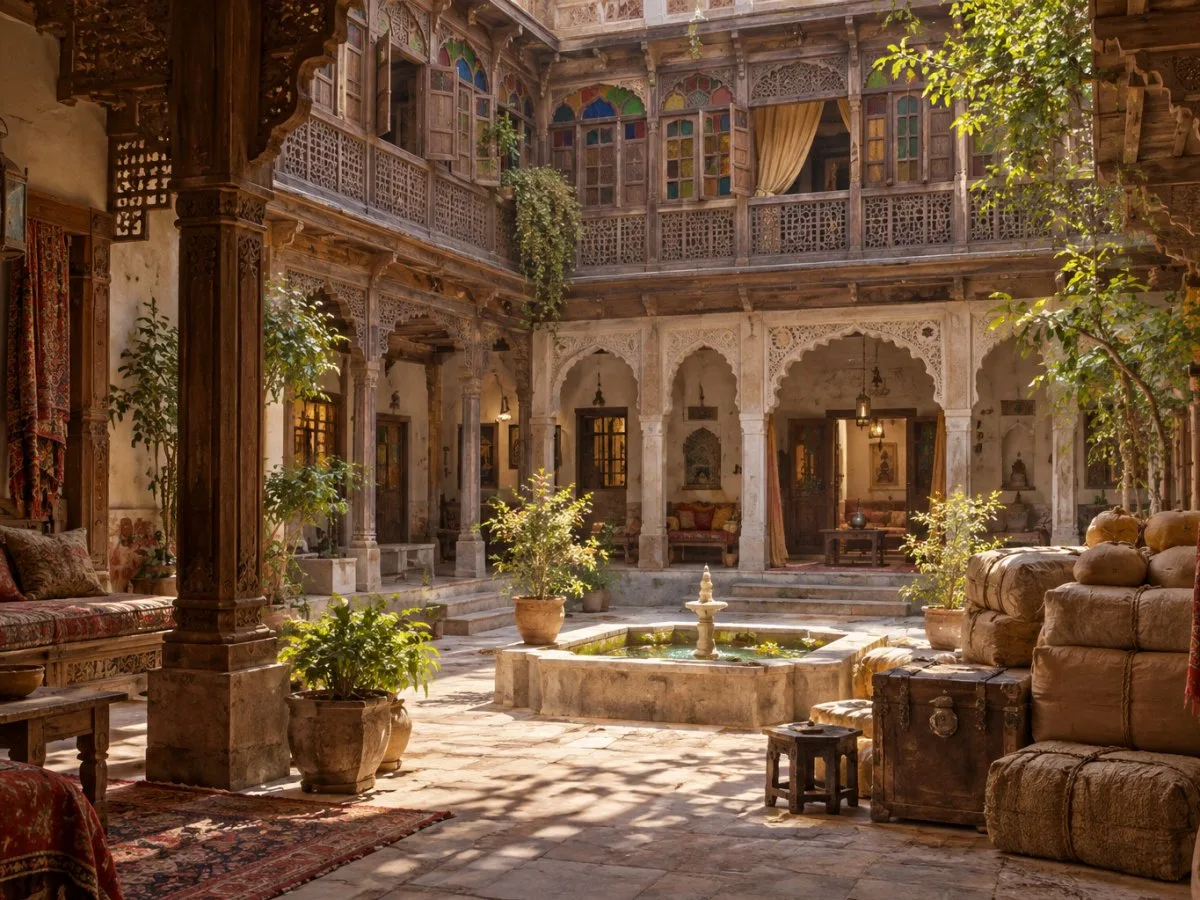
Karim Buksh Sethi House stands in Peshawar’s old Sethi quarter, inside the historic city walls and a short distance from the main bazaar. Its strategic location made it a meeting point for local merchants and the trade routes linking the subcontinent with Central Asia.
Origins and evolution
Built and expanded during the 19th century, as the Sethi family became one of the region’s leading merchant dynasties, the house reflects the prosperity of transcontinental trade. The building has changed through the Durrani, Sikh and British political periods, each leaving traces in its structure and decoration.
Architecture and interior design
The haveli combines traditional South Asian house forms with Persian and colonial elements:
- Façade: carved wooden doors, stained glass, ornate balconies and decorative stucco.
- Plan: several floors arranged around inner courtyards, ventilated basements and terraces suited to the hot climate.
- Circulation: planned staircases, screened corridors and separate service areas allow commercial and private spaces to coexist.
Artistic details
The interior features:
- Carved wooden ceilings and painted panels.
- Cheenidaan (mirror-inlaid alcoves).
- Tarseem bandi (finely crafted wooden fretwork).
These elements bring together local techniques and artistic ideas introduced through merchants and travellers.
Historical and cultural value
Sethi House offers tangible evidence of how a merchant family managed family life, business and social interaction within the same complex. Its conservation makes it possible to study privacy, gender practices and spatial organization in 19th-century commercial households in the subcontinent.
Recent conservation
Restoration work has addressed structural problems and deterioration while seeking to preserve the authenticity of traditional materials and techniques. The work has included roof stabilization, anti-termite treatment and stained-glass repairs.
At a glance
Scope
Editorial reading; this is not a site visit or a technical assessment.
Sources and references
Sethi House - UNESCO World Heritage Centre ↗24/10/2026 UNESCO World Heritage Centre, “Sethi House” (Tentative List, 2026)
Pakistan - UNESCO World Heritage Convention ↗24/10/2026
Centro del Patrimonio Mundial - ↗24/10/2026