





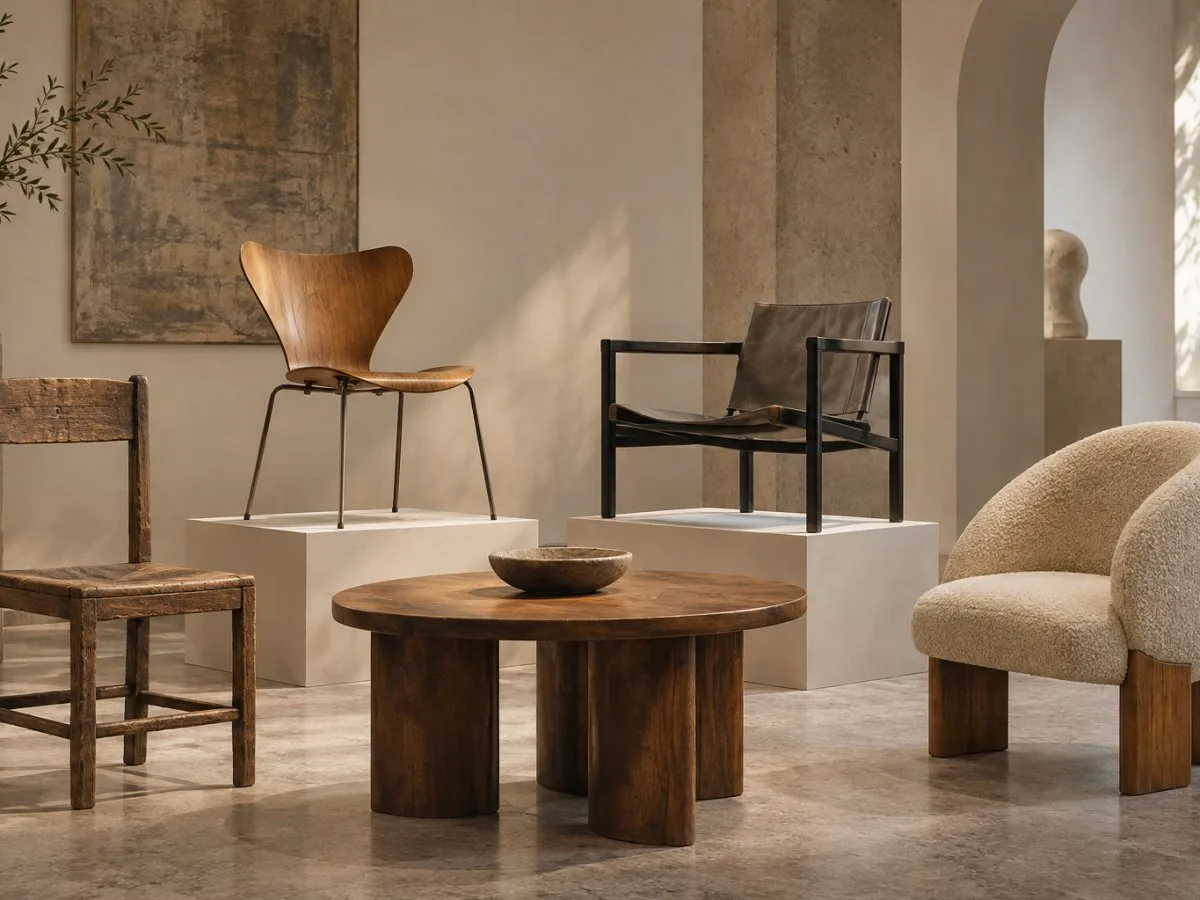
Furniture design cannot be understood only through the pieces in our living rooms or at our desks. Behind every chair, table, or sofa lies a history of materials, techniques, social contexts, and aesthetic choices stretching across two centuries. Published by the Vitra Design Museum in November 2019, Atlas of Furniture Design offers a comprehensive perspective on that evolution. It is not simply a catalogue of iconic objects, but a reference work intended to provide a solid factual foundation for academic research and general interest.
A reference work built around a physical collection
The Atlas began not with a digital library or a selection of archive images, but with the Vitra Design Museum’s physical collection. That collection contains more than 20,000 artefacts, including around 7,000 pieces of furniture, and served as the publication’s primary source.
Mateo Kries, the museum’s director and the book’s editor, has described direct access to the objects as essential. It allowed researchers to study not only the pieces’ overall forms but also details such as upholstery seams, fabrics, joints, and manufacturers’ marks. This close examination is central to the Atlas’s approach: studying the patina, aura, and material qualities of actual objects across two centuries of history.
More than 20 years of research and 70 experts
The Atlas was the result of more than 20 years of research and collaboration. The Vitra Design Museum team had been considering an encyclopaedia of furniture design since the 1990s. More than 70 authors and experts from around the world contributed to the project.
The book documents 1,740 objects by more than 540 designers. It includes over 2,800 illustrations, ranging from photographs of objects and design sketches to interiors, patents, brochures, artworks, architecture, and portraits of designers. This visual breadth reflects the complexity of furniture history: it encompasses not only a product’s final form, but also its development and cultural context.
Structure and content: from the nineteenth century to the digital age
The Atlas covers a period from the beginnings of industrialisation to the digital age. Its structure offers information at several levels:
- Detailed texts: More than 550 texts examine key designs and provide specific information about individual objects.
- Contextual essays: In-depth essays on four distinct eras describe the objects’ sociocultural and historical contexts.
- Infographics and timelines: Informative graphics offer new visual perspectives on design history, including timelines of the development of design around the world and of innovative furniture types such as the cantilever chair and the Monobloc.
- Appendices: Designer biographies, bibliographies, glossaries of manufacturers and materials, and a keyword index.
The 1,740 objects were selected according to several criteria. The primary aim was to illustrate major trends in furniture design from the early nineteenth century to the present. The selection also sought to represent prominent designers adequately, including canonical figures, while explaining particular materials, structural forms, and typologies. It includes objects that have become part of many people’s everyday lives, as well as some surprises that challenge familiar expectations of what counts as iconic design.
Designers and styles represented
The publication includes work by significant designers from the past 230 years. It documents all the major stages of design history, including:
- Nineteenth-century furniture made of bentwood and metal.
- Designs in the Art Nouveau and Secession styles.
- Iconic designs by leading modernists such as Le Corbusier, Gerrit Rietveld, Charlotte Perriand, Marcel Breuer, and Eileen Gray.
- Post-war, postmodern, and contemporary furniture by designers including Charles and Ray Eames, Eero Saarinen, Gae Aulenti, Finn Juhl, Ettore Sottsass, Philippe Starck, Hella Jongerius, Jasper Morrison, and Konstantin Grcic.
This chronological and stylistic breadth helps readers understand how furniture design has evolved in response to technological, social, and cultural change. Rather than simply listing famous names, the book connects objects through lines of influence, innovation, and context.
A resource for collectors, scholars, and enthusiasts
Atlas of Furniture Design is conceived as an informational resource for collectors, scholars, and experts, as well as a carefully edited book for design enthusiasts. Its hardcover format (31 × 23.5 × 7.5 cm) and 1,028 pages make it a reference work that can be approached in different ways: as a selection of iconic designs, a history of styles, a chronicle of evolution or revolution, a history of objects or images, or a narrative of domestic habits or individual designers.
Paola Antonelli, Senior Curator of Architecture and Design at the Museum of Modern Art (MoMA), calls it “a treasure trove” offering definitive information about beloved landmarks in design history alongside new, fresh, and often unexpected perspectives. Her assessment points to the Atlas’s dual purpose: consolidating existing knowledge while opening new avenues for research and appreciation.
The importance of factual precision
One explicit aim of the Atlas was to correct inaccuracies and errors that the research team had repeatedly encountered in earlier books and other sources. Permanent access to the physical collection enabled the editors to verify details and produce new research findings. Its effort to provide a reliable factual basis for academic research into furniture design is a defining feature of the book.
At a time when digital information is abundant but often superficial, the Atlas represents an investment in depth and precision. It is not intended as a quick read, but as a reference that invites close exploration and careful study of objects and their contexts.
Conclusion: a view of the history of everyday design
Atlas of Furniture Design is not only a book about furniture; it is a work about the history of everyday life. The objects it documents belong to our daily surroundings, and understanding their evolution helps us appreciate the complexity of the design decisions around us. Drawing on the Vitra Design Museum’s physical collection and more than two decades of research, the Atlas offers a comprehensive and rigorous view of a field often perceived as superficial or purely aesthetic.
For those interested in design, art history, or material culture, the Atlas is an important resource. It documents the past and provides a framework for understanding the present and future of furniture design, in an era when digitalisation is increasingly influencing the creation of physical objects.
At a glance
Scope
Editorial overview; it is not a visit or a technical evaluation.
Sources and references
The Atlas of Furniture Design | Official Vitra® Website LP ↗23/10/2026 Vitra, “Three Questions for Mateo Kries, Director of the Vitra Design Museum.”
Atlas of Furniture Design | Official Vitra® Online Shop ES ↗23/10/2026
Atlas of Furniture Design | Official Vitra® Website UN ↗23/10/2026 Vitra, Atlas of Furniture Design product page.
Atlas of Furniture Design ↗24/10/2026 Vitra Design Museum, “Atlas of Furniture Design.”