





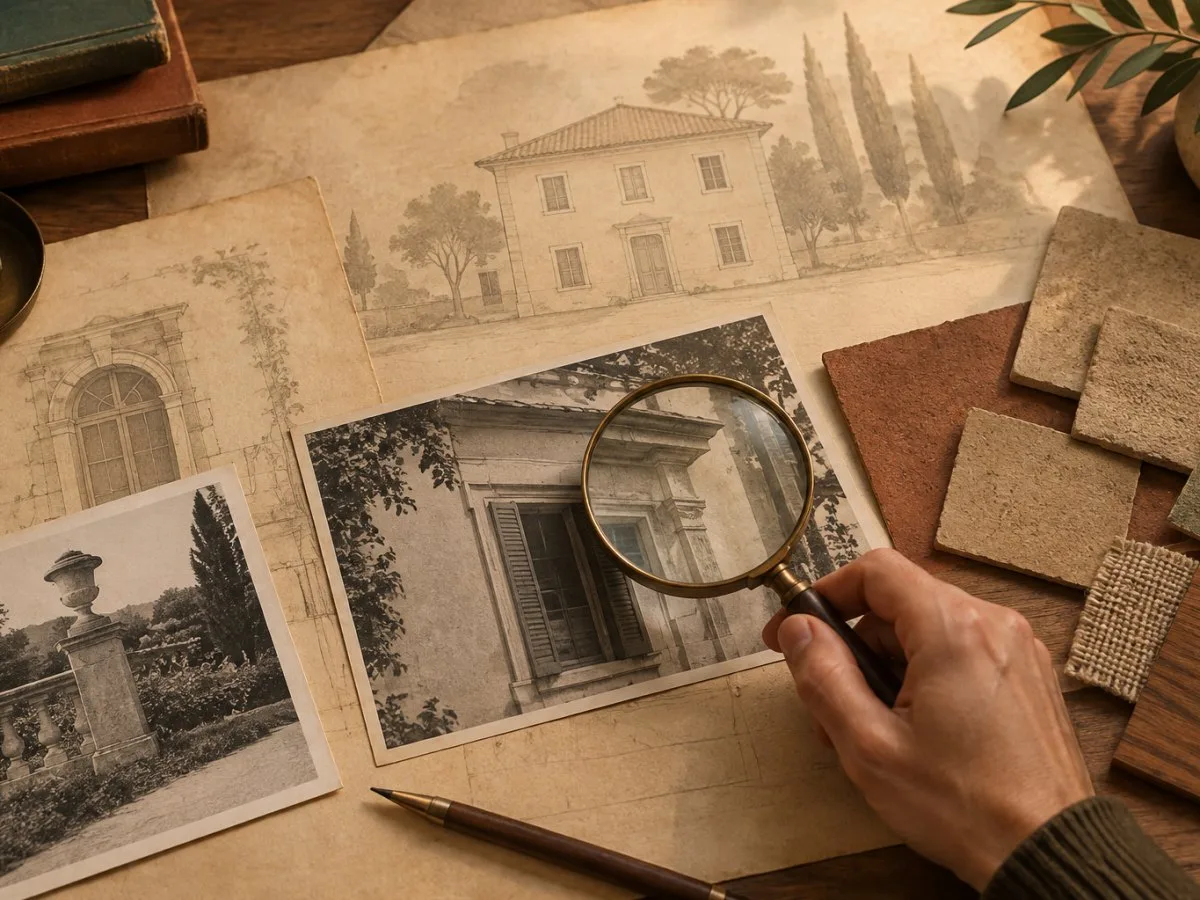
Researching the history of a house does not necessarily begin with a floor plan. You may need to identify the architect, locate a related file, or reconstruct changes to the property through drawings, photographs, and written records. In Italy, architectural archives preserve materials of this kind, but their organization, digitization, and access arrangements vary. The Archivio Progetti at Iuav University of Venice offers a concrete example of how to begin a search and move from an online catalogue to consulting original documents.
Start with the building and define a focused search
Before approaching an archive, gather the details you already know: the current address and, if available, an earlier one; the architect’s or owner’s name; the town or city; approximate dates; changes of use or renovations; and possible historical names for the building. Not all these details will appear in a catalogue, but they can help you test variations and describe your research clearly to archive staff.
It helps to frame a manageable question. For example: are there drawings of a renovation attributed to a particular architect? Is documentation preserved for a house or public building in a particular town? What materials document someone’s professional career? A search for an architect may provide leads, but it does not by itself prove that the archive holds the project for a specific house.
The Iuav Archivio Progetti: catalogue, collections, and access
The Archivio Progetti at Iuav University of Venice preserves collections related to architecture, urban planning, landscape, design, photography, and other design disciplines. Its collections include the archives of architects, engineers, urban planners, designers, graphic artists, and photographers, as well as models, drawings, and photographs. The online catalogue adds descriptions as arrangement, inventory, and reproduction work progresses; where digital copies are available, it may provide images of documents, especially drawings and photographs.
The catalogue is a first step, not necessarily a comprehensive inventory of everything preserved. The archive indicates that it can facilitate access to collections still being arranged and not yet listed in the catalogue, after checking that the materials are accessible. If a search returns no results, ask the archive before concluding that no relevant documentation exists.
From a digital search to an in-person consultation
When documents have not been digitized, original materials can be consulted by reservation and appointment. Send a request in advance by email, stating the subject of your research and/or providing a detailed list of the materials you want to consult. In-person consultation is intended for researchers; except for introductory visits, people requesting access present a research plan, which is assessed by the person responsible for the archive.
The consultation service is open Monday to Friday, from 9:30 a.m. to 2:00 p.m., and closes during the Christmas holidays and in August. Access is by appointment. Since hours and conditions can change, check the institution’s current information before travelling.
In-person access also depends on the user category and the nature of the research. Some people affiliated with academic institutions have access under the conditions specified by Iuav; others may need authorization. For professional needs or justified study and research, the institution also allows requests from people resident or domiciled in the Municipality or Province of Venice. Check the current rules for your specific situation.
Consultations are assisted by archival staff. Some documents, units, or parts of collections may be restricted for reasons of data protection, preservation, or agreements with the people who deposited or own the collections. If an original cannot be consulted because of its condition, access to a reproduction may be offered. You may photograph documents yourself for personal and research use, subject to conditions: this must not involve handling the documents or using stands or lighting equipment. Photocopying requires case-by-case authorization.
A useful example for shaping a search: Giorgio Wenter Marini
The Giorgio Wenter Marini collection shows why archival research can extend beyond building plans. Wenter Marini was an architect and painter. He worked on the restoration and adaptation of monuments and historic buildings, designed interiors and gardens, and pursued artistic and teaching activities. His collection comprises his private archive and personal library. The archival documents—including drawings, architectural projects, and other documentary materials—are held at the Archivio Progetti. His personal library, consisting of monographs and periodicals, is deposited at Iuav and consulted in the library’s reserved reading room.
If you are researching a building associated with his work, the collection may offer a lead to relevant materials. But the existence of a personal collection does not confirm that it contains documentation about a particular address or project: that connection must be checked in the finding aids or with the archive. The example also shows that reconstructing a building’s history may require combining archival records with other sources about the property.
For anyone researching a renovation or planning a rehabilitation
Historical documents can help you ask questions about how a building has changed, but they do not replace checking its present condition or obtaining the technical documentation needed for an intervention. A drawing preserved in an archive does not, by itself, prove that the work was carried out as designed, that the document relates to the building under investigation, or that it records the building’s current configuration.
A practical research route:
- Define the property and your question. Note the address, name variations, town or city, approximate dates, and possible architects or owners.
- Search by people and collections. Try the architect’s, owner’s, or other professionals’ names, as well as terms related to the location or type of work.
- Check what each result represents. Distinguish a collection description from the identification of a specific project, and a digital image from complete documentation.
- Ask about uncatalogued materials. Send the archive a specific question and a list of the information or documents you are looking for.
- Plan your visit. Confirm the appointment, access requirements, opening hours, restrictions, and reproduction conditions directly with the institution.
- Cross-check the documentation. For a building history or intervention, relate archival documents to the available evidence about the property and its current condition.
Municipal archives and other collections
Municipal archives may be another place to look for documentation about buildings in a particular town or city, but their collections, finding aids, and access arrangements vary. Identify the relevant municipality and contact its archive or documentation service to ask what materials exist and how to access them. Do not assume that an architectural project will be held there.
The Portale Archivi Nazionali offers a broader starting point for finding descriptions of collections preserved in Italy, guides and inventories, record-producing bodies, and places of preservation. Its research pathway on architecture and urban planning focuses on the archives of twentieth-century architects and engineers and, for some collections, provides access to detailed inventories and images of graphic documents. The portal can help identify possible collections; it does not replace consulting the specific finding aids or, by itself, confirm that an archive holds documents about a particular building.
The next step is to check the catalogue and consultation information for the Iuav Archivio Progetti, or search the national portal by person, organization, or place. If the results are incomplete, contact the relevant archive. A search with no online results is not enough to rule out the existence of relevant materials.
At a glance
Nexo request
- 526
- nexo:broken-link:526:priority:v1
- archivi di architettura in Italia, dove consultare progetti e disegni di architetti del Novecento (Archivio Progetti Iuav, MAXXI, archivi comunali), per chi studia la storia degli edifici o ristruttura una casa storica
- es
- Artículo en italiano: archivi di architettura in Italia, dove consultare progetti e disegni di architetti del Novecento (Archivio Progetti Iuav, MAXXI, archivi comunali), per chi studia la storia degli edifici o ristruttura una casa storica.
- https://www.retegeostorie.it/node/122
- http://www.iuav.it/homepage/ap/
- c9ceb9705ec6d408c2a2dbb589984180ee0236ca237bc6028cef54d715cfca17
Priority authorization
- explicit_owner_instruction
- 526
- highest_native
- 1
- 1
- 1
Required locales
- es
- en
- fr
- it
- de
- pt
Research required
1
Sources and references
Archivio Progetti - Cataloghi dedicati - IUAV ↗19/11/2026
Archivio Progetti | Università Iuav di Venezia ↗19/11/2026 Università Iuav di Venezia, “Archivio Progetti”.
Consultazione | Università Iuav di Venezia ↗19/11/2026 Università Iuav di Venezia, “Consultazione”.
Giorgio Wenter Marini | Università Iuav di Venezia ↗19/11/2026 Università Iuav di Venezia, “Giorgio Wenter Marini”.
Home - Portale Archivi Nazionali ↗19/11/2026 Portale Archivi Nazionali, institutional portal.
Il Genio civile di Roma – Archivio di Stato di Roma ↗19/11/2026