





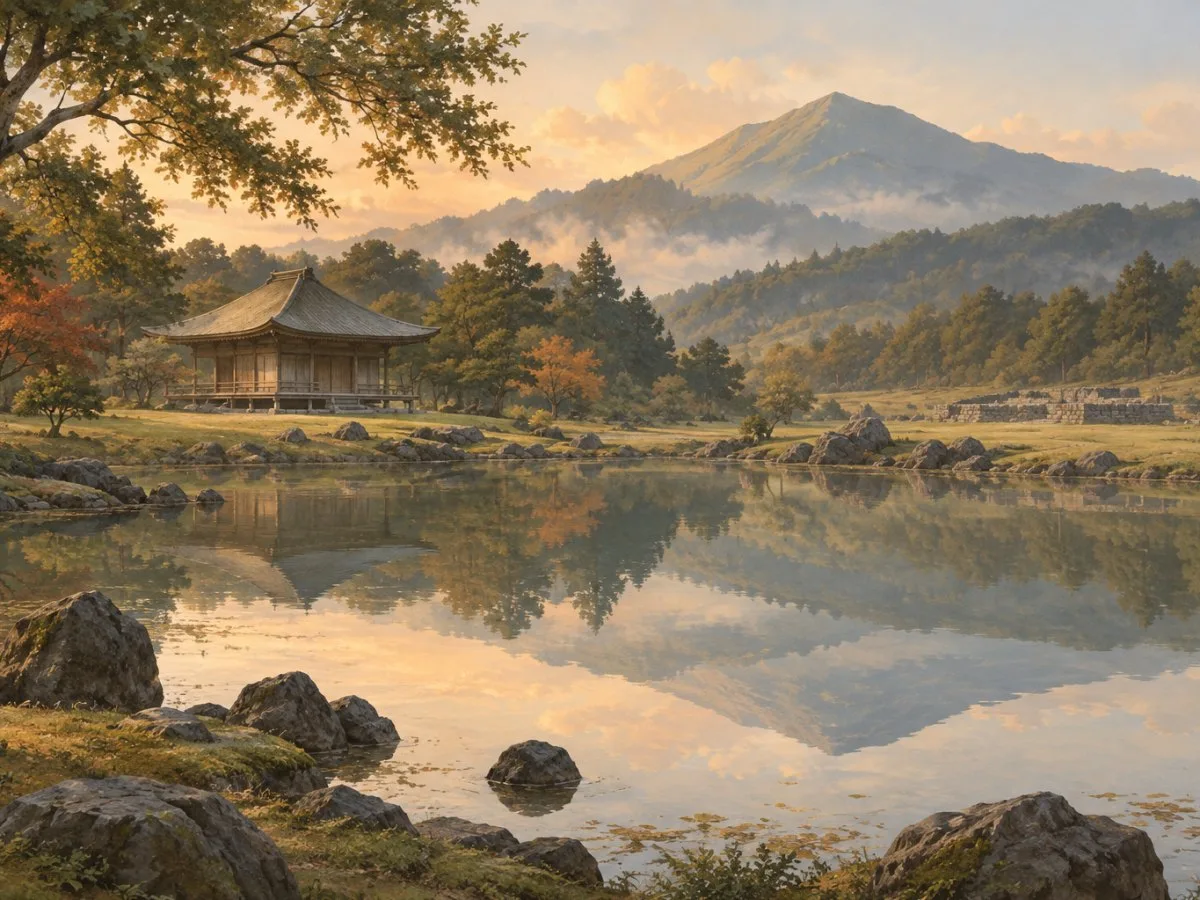
Hiraizumi is best understood as a relationship between places rather than as an isolated building. The property comprises five sites, including the sacred Mount Kinkeisan. Its gardens and religious complexes express the cosmology of Pure Land Buddhism: the realm aspired to after death and an image of peace for life in the present.
During the 11th and 12th centuries, Hiraizumi was the political and administrative centre of northern Japan and rivalled Kyoto. The Ōshū Fujiwara family created four Pure Land gardens, conceived as symbolic manifestations of that ideal on earth. The placement of temples in relation to ponds, trees and the peaks of Mount Kinkeisan made the landscape part of the composition.
A garden conceived as a whole
Mōtsū-ji offers a concrete way to observe this relationship. Its Pure Land garden brings the temple, garden and pond—Oizumi ga Ike—together as a single unit. Doyama Hill lies to the north; around the water, the design incorporates a peninsula-shaped shore, rocky sections, large stones protruding above the surface, bridges, mountainous features and an inlet stream.
The design follows principles set out in the Sakuteiki, an ancient Japanese treatise on garden-making. Its arrangement connects water, architecture and the surrounding terrain. It can be read as a spatial evocation of the Pure Land, although that interpretation does not determine what every person necessarily experiences.
The temple grounds retain foundations and other remains of Dōtō Monastery, built during the Heian period. Centred on Oizumi ga Ike, the garden also provides clues to the form of the landscape in that era. Excavation and restoration have helped recover aspects of the historic garden. Across Hiraizumi, two of the four gardens have been reconstructed with details recovered through excavation; the other two remain buried.
The distance between an idea and what has survived
Hiraizumi’s preservation does not mean that all its buildings have survived intact. Much of the city was destroyed in 1189, when it lost its political and administrative position. Chūson-ji preserves the Konjikidō, a 12th-century temple and the only building from that period to survive within the property. A concrete enclosure surrounds the building. This structure has compromised, to some extent, the authenticity of its relationship with the landscape, while conservation of the Konjikidō maintains the authenticity of its materials and construction.
What can be seen from one site to another matters, too. Visual connections with Mount Kinkeisan survive at several locations; at Muryōkō-in, houses and other structures have a negative effect on those connections. Views linking the temples and the mountain cross buffer zones and areas outside the inscribed property. Protecting the landscape therefore means more than caring for ruins within each compound: it also requires sustaining the spatial relationships that make the ensemble legible.
Water, mountain and memory
Hiraizumi’s rise and rapid fall inspired poets. In 1689, the haiku poet Matsuo Bashō wrote: “Three generations of glory vanished in the space of a dream…”. The quotation is part of that history of poetic inspiration; its specific meaning is not established here.
Looking at Hiraizumi through design draws attention to several layers: the religious idea that organised the space, the tangible relationship between ponds, temples and mountains, and the discontinuities created by destruction, reconstruction and pressures from the surrounding environment. The landscape is not a decorative backdrop: it contributes to the meaning of the ensemble, and its legibility depends in part on maintaining those spatial relationships.
At a glance
Scope
Editorial reading; this is not a visit or a technical assessment.
Sources and references
Hiraizumi – Temples, Gardens and Archaeological Sites Representing the Buddhist Pure Land ↗21/11/2026 UNESCO World Heritage Centre, Hiraizumi – Temples, Gardens and Archaeological Sites Representing the Buddhist Pure Land.
Journey through the Cultural Treasures of Aomori and Iwate | Japan Cultural Expo - Nihonhaku - | Exploring Arts of Japan from Antiquity to the Present ↗21/11/2026 Japan Cultural Expo, Journey through the Cultural Treasures of Aomori and Iwate.
Guide to the Temple Grounds │ Motsuji Temple ↗21/11/2026 Mōtsū-ji Temple, Guide to the Temple Grounds.