





Architecture as a record of everyday life
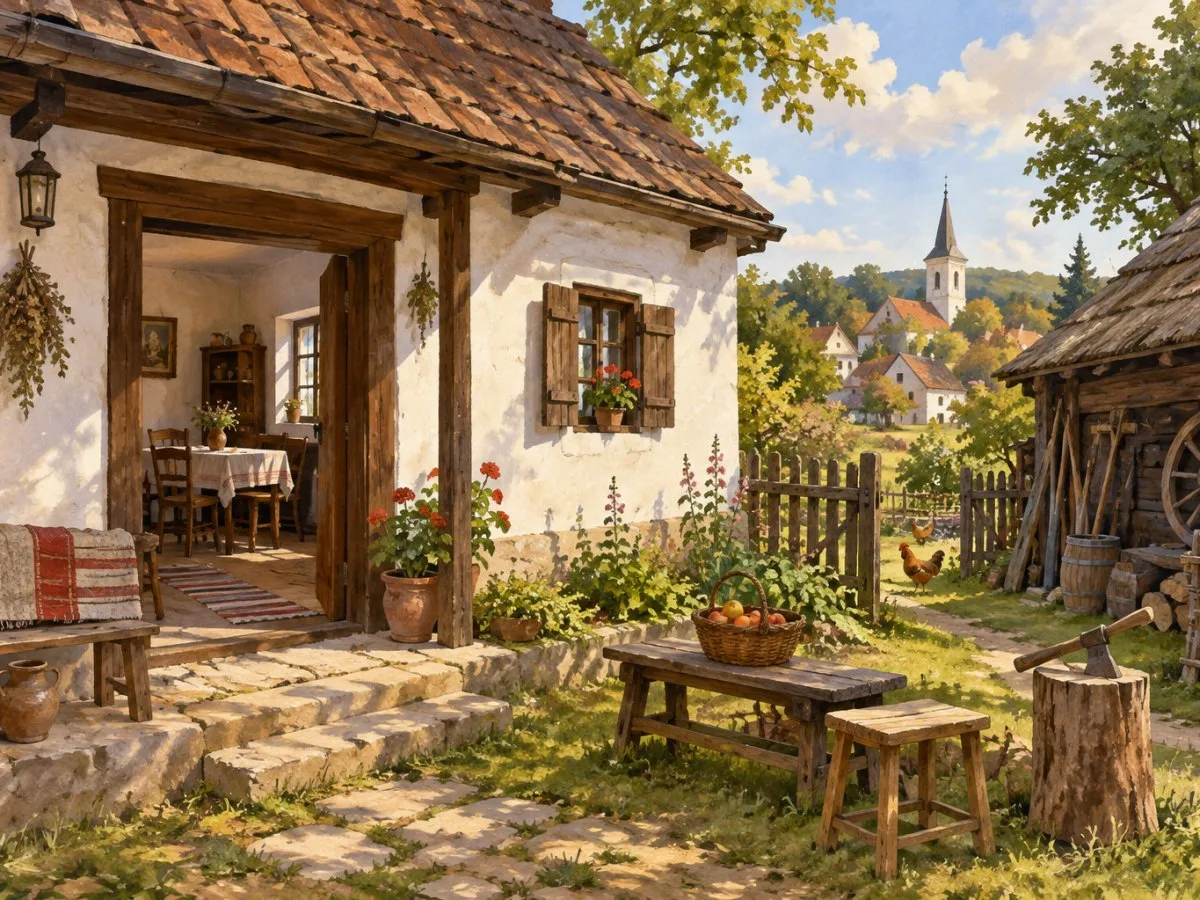
A traditional rural house is understood not only through its form, but also through the arrangement of its rooms, the objects associated with daily tasks and the relationship between the dwelling and its auxiliary buildings. The Hungarian approach presents these elements together, in buildings preserved at their original locations.
The nomination describes vernacular architecture as a tradition that stopped producing new works following social and economic changes in village life. The surviving buildings offer material evidence of techniques, practices and ways of dwelling that are no longer reproduced in the same way.
The house and its outbuildings
The approach is not simply to gather objects in an exhibition room. It seeks to preserve buildings where they were constructed and show them with their surroundings and associated features. Depending on the case, a complex may include dwellings, farm buildings, workshops or other simple facilities connected with production.
At least one characteristic room in each house is presented with original objects gathered in the local settlement. In this way, the space communicates through several layers: the building’s structure and exterior, the arrangement of its rooms and the objects that help explain their uses. The nomination also describes the rehabilitation and adaptation of buildings as part of their conservation and presentation.
The houses function as open-air ethnographic collections. They do not necessarily all contain the same elements, and the documentation does not establish a uniform inventory for the network. Where present, workspaces extend the interpretation beyond domestic life.
Regional differences and cultural exchange
The network brings together buildings associated with different regions, ethnic groups, occupations and social conditions. Hungarian vernacular architecture developed in interaction with the traditions of other peoples of the Carpathian Basin; its construction and ornamental solutions also show connections with features of more prestigious architecture.
This diversity encompasses more than styles and decorative details: it includes building methods and different responses to natural and social conditions. The nomination places its principal examples between the 18th and 20th centuries and presents them as part of a material culture transformed through contact among communities.
The buildings are geographically separated, but can be read as parts of a whole because they make it possible to compare local responses to diverse needs. The network’s coherence rests on this shared interpretation and on common selection and presentation criteria, not on the houses being identical.
Conservation and community activities
The proposal connects conservation with public use. Restored houses can host intergenerational gatherings, educational and training activities, and programmes for transmitting traditional crafts. Their cultural role can therefore extend beyond exhibiting objects to include community activities.
The historical sequence described begins with the renovation of the Schumacher House in Nagyvázsony in 1960. There, a method of comprehensive reconstruction of a historic rural site was applied, and a house preserved and furnished in its original location was opened to the public. Other rural houses were established afterward. A ten-year nationwide programme began in 1974, and by 1984 the number of rural houses in Hungary had exceeded two hundred. The network aimed to show vernacular architecture from different regions, including those of national minorities.
This development reflects an approach to conservation that brings buildings, objects and activity together. The figures refer to the historical development described in the nomination, not to a current count of spaces in operation.
What it means to form a heritage network
The nomination submitted in 2017 distinguishes between the wider network of rural houses and the buildings that could be part of the proposed series. The latter had to meet requirements concerning both the building and its interior, and to have individual protection as historic sites.
The document estimates that 145 buildings, ensembles or groups could meet the system of requirements if, in addition to the 109 sites with museum licences, another 36 obtained them. This is an estimate in the nomination, not an updated figure or confirmation of inscription on the World Heritage List.
The proposal also raises the possibility of a cross-border extension, noting similar conservation practices in other Central European countries and mentioning the possible participation of Romania, Slovakia, Austria, Serbia and Ukraine. Such an extension should not be understood as having taken place.
A way of reading the spaces
The network can be read at the scale of everyday life: how rooms connect, how they relate to auxiliary buildings and which objects are preserved in them. It is also useful to distinguish between what the building materially preserves and what the museum presentation interprets about its uses.
These spaces embody a tension inherent in conservation. The buildings preserve evidence of a transformed material culture while also being able to sustain public and community functions. Their interest lies in presenting architecture, objects, practices and local memory without reducing regional variety to a single model of a rural house.
Scope and documentary status
The proposal was submitted on 31 August 2017 and appears on Hungary’s Tentative List. A Tentative List records properties that a State Party intends to consider for nomination; it is not equivalent to inscription on the World Heritage List. Hungary’s country page includes this network among the properties on its Tentative List.
The nomination describes the concept and selection criteria. The information summarized in this article does not establish the current status of each house or its particular access or conservation conditions. The observations suggested here are interpretive: they do not constitute a visit or a technical assessment.
At a glance
Scope
Editorial reading; it does not constitute a visit or a technical assessment.
Sources and references
The Network of Rural Heritage Buildings in Hungary - UNESCO World Heritage Centre ↗09/11/2026
Hungary - UNESCO World Heritage Convention ↗09/11/2026
UNESCO - Search - UNESCO World Heritage Center ↗09/11/2026
Museum history - Szabadtéri Néprajzi Múzeum: Skanzen - Szentendre ↗11/11/2026
The permanent exhibition - Szabadtéri Néprajzi Múzeum: Skanzen - Szentendre ↗11/11/2026
About us - Magyarországi Tájházak Központi Igazgatósága ↗12/11/2026