





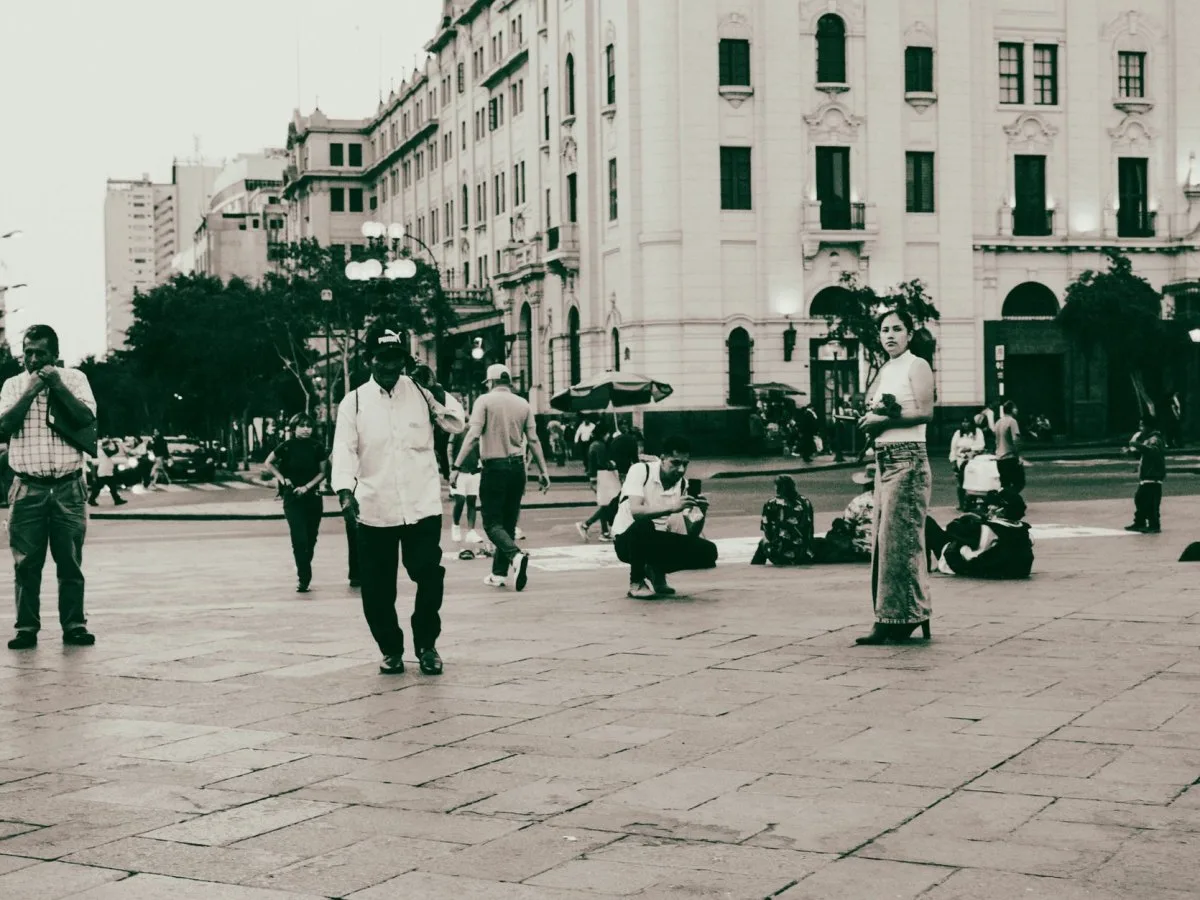
Urban transformation and the role of public space
Cities are changing through both densification and outward expansion. Open spaces—private as well as public—are converted to buildings and infrastructure, while new parks, plazas, playgrounds and natural areas emerge. Together, these spatial structures influence the cultural, social, economic and political life of cities.
Public space can help create social and economic value for neighbourhoods, cities and regions. Its planning and design are therefore part of sustainable urban development, not simply matters of appearance. Where informal settlements and unplanned expansion lack well-distributed, good-quality public places, residents may also have fewer opportunities for social and economic activity. In dense, mixed-use areas, quality of life often depends on public places that are inclusive and accessible.
This makes public space a consequential part of urban growth: it can support the everyday connections and access that allow density to work for a wider range of residents. But urbanization also puts public space under pressure. Its continued existence depends on recognizing its value alongside competing demands for land, buildings and infrastructure.
Density, mixed use and the urban advantage
By 2050, approximately two thirds of the world’s population is projected to live in urban areas. Rapid urbanization brings opportunities as well as challenges, including greater vulnerability to climate change, spatial inequality, migration and conflict pressures, and the difficulty of promoting inclusive prosperity and economic development.
One response is to plan for compact growth, absorbing population increases through greater urban density rather than relying only on outward expansion. Concentrating people and activities can help cities innovate, generate wealth and accommodate more residents. The urban advantage is also associated with lower resource use and emissions per person than other settlement patterns. These potential benefits depend on how growth is planned and shared; density alone does not guarantee an inclusive or sustainable outcome.
Planning strategies can make that distinction concrete by combining:
- Public space with density and mixed land use, so that compact neighbourhoods include accessible places to gather and move through.
- Social inclusion and equitable access to land, including attention to tenure security.
- Formal and informal urban systems, which need to be considered together rather than treated as unrelated parts of the city.
- People-centred processes, such as participatory planning, alongside appropriate technology and cross-sector collaboration.
- Inclusive criteria, taking account of human rights, gender, age and other aspects of identity.
These considerations apply in different national contexts. They give urban managers and other stakeholders a framework for addressing urbanization proactively, rather than treating public space as an afterthought once development has taken place.
Urban design, services and quality of life
The look and feel of a city, its public spaces and its public infrastructure are connected to quality of life and social development. Appealing cities may be better positioned to attract a creative, skilled workforce and investment, supporting the urban economy. Yet design can be deprioritized when funding or capacity is limited, particularly when urgent needs such as basic services demand attention.
That tension matters: public-space investment cannot substitute for essential services, but planning can connect decisions about space with service provision and available financial capacity. A phased, problem-focused approach can begin with access to basic urban services, including water and sanitation, while linking longer-term plans to what can be funded and delivered.
Growth also takes place beyond individual city boundaries. Urban areas often develop along infrastructure corridors and can become regional centres of growth. If that development is unplanned or poorly coordinated between cities, regions may miss social, economic and environmental opportunities. Coordination is therefore relevant not just within a neighbourhood, but across connected urban areas.
The planning needs of intermediate cities
Intermediate cities—those with populations between 100,000 and 500,000—account for more than 60 per cent of the global urban population and are experiencing rapid growth. Yet national and regional authorities may overlook them, and they may lack the financial and technical influence available to larger cities.
That combination makes early planning important. Delaying it can leave a larger and more costly set of problems to address later. Planning capacity, policy attention and investment in public space and infrastructure need to reflect the scale of growth these cities are experiencing, not only the prominence of the largest metropolitan areas.
Urban regeneration and land value
Urban regeneration can bring underused assets back into use and redistribute opportunities, with the aim of improving urban prosperity and quality of life. It is often a complex, long-term undertaking. It can also carry risks: regeneration may contribute to gentrification in private areas or the privatization of public space.
For regeneration to support local residents, affordability, access to services and resident involvement need to be part of the approach. Public space can be a central element of interventions, alongside efforts to reduce environmental impacts and greenhouse-gas emissions. Preserving and reusing historic and cultural heritage can also contribute to regeneration.
Economic activity shifting towards the outskirts has left some central areas facing unemployment, poor-quality services, declining housing conditions and deteriorating streets and public places. Residents can consequently be excluded from opportunities in more prosperous districts, while city centres lose potential to contribute to urban prosperity.
Regeneration can draw on several approaches, including:
- redeveloping underused or previously developed land;
- increasing density and intensifying land use;
- diversifying economic activity;
- preserving and reusing heritage;
- reactivating public spaces; and
- strengthening the provision of services.
These approaches are not interchangeable, and no single intervention resolves every problem. Their relevance depends on local conditions and on whether the project protects access and affordability while involving the people who live in the area.
Implementation may require collaboration among public authorities, residents, experts, civil-society organizations and other partners. Spatial plans, legal tools for participatory land readjustment and financial mechanisms for capturing land value are examples of frameworks that can support regeneration projects. Their purpose is to connect plans to the legal and financial means of carrying them out; the choice and application of any mechanism depends on the project context.
Regulation and national urban policy
A major obstacle to effective urban planning can be the absence of adequate frameworks and legislation at national or subnational levels. In many places, national planning frameworks do not align well with local needs.
Orderly expansion requires regulatory frameworks to accompany planning. A national urban policy can provide an overarching structure for coordinating responses to urgent issues linked to rapid urban development. It can also guide sectoral ministries and urban service providers, support legislative and institutional reform, and create opportunities to consult urban stakeholders.
Coordination does not remove the need to respond to local circumstances. Rather, it can help connect local plans and priorities with the laws, policies and service systems that shape what can be delivered.
Public space and sustainable mobility
Parks, green areas and streets all form part of the public realm, and their design affects how a city functions. Well-designed public spaces can improve the city’s visual character, support economic activity and contribute to urban functionality.
In dense neighbourhoods, adequate public space, infrastructure and public transport can encourage walking, cycling and other forms of non-motorized mobility. These options can reduce carbon emissions and reliance on fossil fuels. Pedestrian-friendly streets and shared facilities—such as sports, recreational and cultural centres—can also create places for residents to meet, strengthening social connection and diversity.
These outcomes depend on the wider urban system: public places, transport, infrastructure and services need to work together. Low-emission strategies and climate resilience can be incorporated into urban development plans, linking everyday mobility and public-space decisions with broader environmental goals.
Planning resources and tools
Urban planning and design involve complex groups of stakeholders. Collaboration, expert consultation, co-production and participatory processes can help develop shared guidance and support innovation. Capacity-building can take place through practical work, training events and carefully designed materials for both local and international practitioners and decision-makers.
The following resources address different parts of urban planning and inclusive design:
- Our City Plans: A step-by-step, participatory toolbox for urban planning.
- Urban Planning Law for Climate Smart Cities: An urban-law module within a law and climate-change toolkit.
- Cities for Girls, Cities for All: A technical report.
- Her City: A guide to sustainable and inclusive urban planning and design with girls, third edition.
- International Guidelines on Urban Territorial Planning: A report covering 2018–2020.
- Settlement Profiling Tool: A tool for profiling settlements.
These resources are intended to help city, regional and national governments improve policies, plans and designs for cities that are more compact, socially inclusive, connected and integrated, and resilient to climate change.
Participation and reported reach
Participatory planning and spatial data collection have been used in nearly 100 cities to support social cohesion among migrant, displaced and host communities. More than 50 countries were at different stages of improving national urban policies through approaches intended to be inclusive and participatory. Digital tools were used to involve girls and young women in urban planning in 17 cities through the Her City toolbox.
These figures describe the reported reach of particular planning activities; they do not, on their own, establish the outcomes of every project or show that the same approach will work in every setting. Collaboration across public agencies, local and national governments, civil society, academia and professional organizations can help align regeneration, renewal and heritage projects with wider urban-development commitments. Technical and advisory support may also help governments develop the spatial, legal and financial frameworks needed to implement projects.
At a glance
Scope
Editorial reading; this is not a site visit or a technical assessment.
Sources and references
Developing Public Space and Land Values in Cities and Neighbourhoods | UN-Habitat ↗21/10/2026
Urban Planning | UN-Habitat ↗21/10/2026
Urban Regeneration | UN-Habitat ↗23/10/2026