





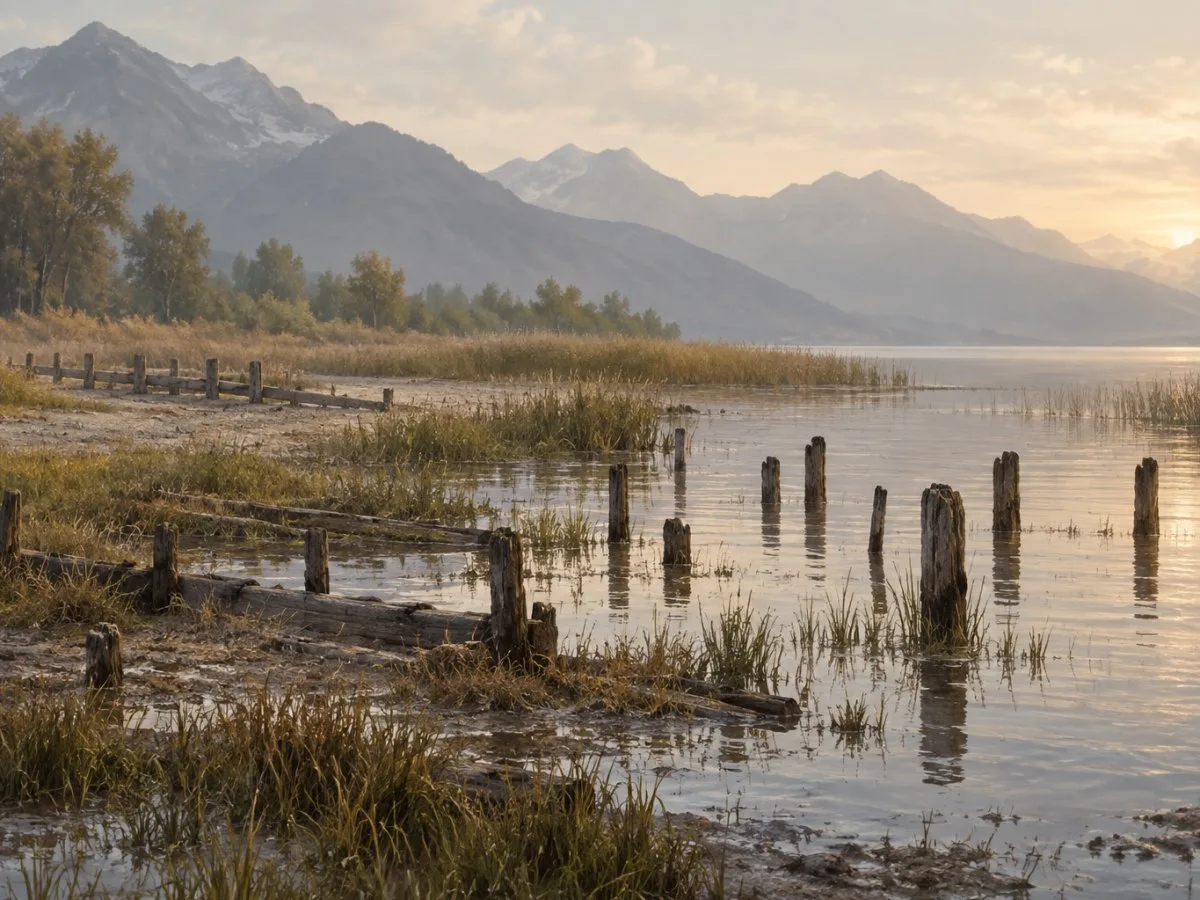
Architecture shaped by place
Between approximately 5000 and 500 BC, prehistoric communities built settlements in the Alpine and sub-Alpine regions, beside lakes and rivers, and in wetlands. The World Heritage property brings together 111 sites in six countries: Switzerland, Austria, France, Germany, Italy and Slovenia. They are a selection from more than a thousand known sites; 56 of the inscribed sites are in Switzerland.
The word “pile dwelling” may suggest a house raised on stilts and separated from the ground by water. Yet the archaeological remains do not support a single image for every settlement. The sites include underwater contexts, locations beside shores and wetlands, and buildings that varied according to place. This architecture is better understood as a localized response than as a universal model of a lakeside house.
Everyday life preserved in waterlogged ground
At many of these sites, waterlogged conditions helped preserve organic materials such as wood, textiles and plant remains; bones have also survived. This material record broadens what can be learned about early farming societies: not only the layout of houses, but also aspects of agriculture, animal husbandry, technology and the relationships between communities and their environment.
Wood is particularly valuable for reconstructing architecture. Dendrochronological dating—using tree rings—can date construction elements with great precision. Research has made it possible to trace the construction and spatial development of settlements over long periods, rather than limiting study to an isolated form. The remains therefore allow questions about how settlements were organized and how they changed over time, although excavations have taken place at only some sites.
Finds also place these communities within wider networks. Evidence has been documented for the movement of flint, shells, gold, amber and pottery across the Alps and the plains. Dugout canoes and wooden wheels provide evidence of transport. These objects do not describe a dwelling on their own, but they help show domestic life as part of a connected economic and social world.
More than an image of houses on stilts
Popular reconstructions of houses on raised platforms do not necessarily represent every type of building. The history of interpretation matters, too: nineteenth-century artistic images, inspired by pile dwellings in other parts of the world, helped establish an idealized view. Later discoveries, including wooden floors and hearths on shores and in wetlands, also led researchers to consider settlements built at ground level.
The evidence therefore points to a variety of architectural solutions. Settlements may now lie underwater, beside a shore or on wet ground; their present location alone is not enough to reconstruct what the landscape or the dwellings were like when they were inhabited. Interpretation depends on the surviving remains, their context and archaeological research.
A domestic landscape that is difficult to see
Much of the evidence remains submerged or buried, so the heritage is not always visible at the site. Its context—the relationship with lakes, rivers and wetlands—is essential to imagining where settlements stood, but urbanization can alter that reading at some sites. Museums and interpretive resources offer ways to engage with heritage whose value lies in the objects as well as in the relationships between dwelling, settlement and landscape.
Conservation is also tied to the conditions that made it possible to preserve organic materials. Uses of lakes, agricultural intensification and urban development are among the pressures that can affect some sites. The property is therefore not only a source for studying ancient architecture: it also highlights the need to maintain and monitor fragile remains that cannot always be shown directly.
Reading these pile dwellings as everyday spaces means avoiding an overly uniform reconstruction. What is known comes from an exceptionally rich but uneven body of evidence: only some sites have been excavated, and not all remains are visible. This combination of materials, locations and documentary limits supports a more precise conclusion than the image of a village suspended above the water: these were communities that built and reorganized their spaces in close relation to diverse Alpine environments.
At a glance
Scope
Editorial reading; it is not a site visit or technical assessment.
Sources and references
Prehistoric Pile Dwellings around the Alps ↗16/11/2026 Prehistoric Pile Dwellings around the Alps — UNESCO World Heritage Centre.
home - palafittes.org ↗18/11/2026 home - palafittes.org — information about the transnational pile-dwelling property.
Prähistorische Pfahlbauten um die Alpen - Pile Dwellings ↗18/11/2026 Prähistorische Pfahlbauten um die Alpen - Pile Dwellings — description of the property and interpretive materials.
FAQ - Pile Dwellings ↗18/11/2026 FAQ - Pile Dwellings — questions about chronology, construction and reinterpretations of the settlements.