





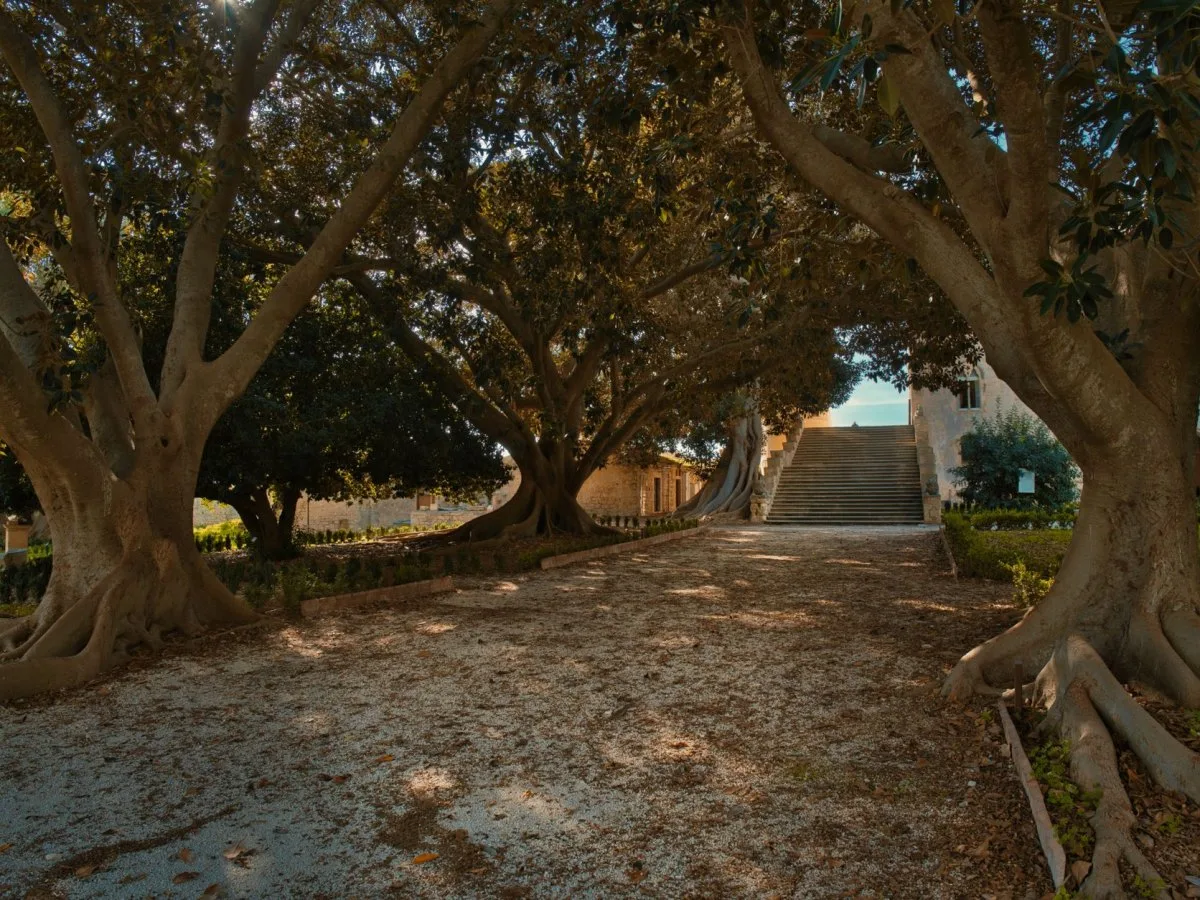
What landscape planning involves
Landscape planning is not simply a matter of designing gardens or arranging elements in a space. It involves studying how the territory, its natural conditions, historical traces and ways of life that have shaped it relate to one another. This reading brings together fields such as history, geography, natural and cultural heritage, and the observation of human activities over time.
Reading a historic landscape means reconstructing relationships: between buildings and fields, roads and settlements, water and landform, vegetation and uses. It also means distinguishing what can be observed today from hypotheses that require documentary or specialist research.
A five-step approach
1. Define the place and its scale
Start by specifying the space you will observe: a garden, a villa and its grounds, a stretch of rural landscape, or the relationship between a settlement and the countryside. Note the boundaries you are using, and broaden your view if the elements under study depend on a wider context.
For example, a villa may be better understood by looking at its access routes, open spaces and relationship with its surroundings as well as the building itself. In a rural landscape, consider how plots, settlements and routes connect, without assuming that an administrative boundary coincides with the landscape as experienced.
2. Describe before interpreting
Record what is visible in concrete terms: landforms, water, vegetation, buildings, roads, boundaries and open spaces. Separate observations from explanations. “There is a line of trees beside the road” describes a feature; assigning it a date or function requires further evidence.
An initial description helps prevent an aesthetic impression from becoming a historical conclusion. If possible, compare different viewpoints and note which aspects cannot be verified during a visit.
3. Look for historical layers
Present-day forms may combine traces of different periods and uses. To reconstruct them, compare observations with relevant documentation, such as maps, archives, historical studies or research materials. An isolated feature is not enough to date a transformation or prove that a layout has remained unchanged.
The Fondazione Benetton Studi Ricerche defines its field of work through landscape and heritage studies, including history, geography, natural and cultural heritage, and people’s ways of life over time. Its documentation centre brings together a library, archive and map collection. These resources can guide research, but the existence of a collection does not by itself confirm that it contains documents about a particular place.
4. Read relationships, not just objects
Ask how the observed elements connect. How are the garden and villa related? What is the relationship between roads and productive spaces? What role do water, landform or vegetation play in organizing the place? What changes in use might explain its present arrangement?
These questions help develop an interpretation; they do not establish one as fact. Answers should be supported by local evidence and, where that evidence is lacking, presented as hypotheses that still need to be tested.
5. Make the limits explicit
A brief reading can identify features and raise questions, but it does not replace archival consultation, historical research or technical analysis when a case calls for them. State which documents you consulted, what period they cover and what remains unresolved. If the aim is to intervene in a place, landscape research does not replace any studies or authorizations that may be required.
Applying the approach to three types of landscape
| Setting | What to observe | What to verify before drawing conclusions |
|---|---|---|
| Historic garden | Layouts, vegetation, routes and relationships with buildings and surrounding spaces. | Whether the visible arrangement belongs to a particular historical phase or reflects later transformations. |
| Venetian villa and surroundings | Building, access routes, open spaces and connections with the rural territory. | Which relationships can be documented and which are interpretations of the present configuration. |
| Rural landscape | Plots, roads, settlements, landform, water and observable changes in use. | Which local sources can help reconstruct its development and what dates they refer to. |
The table is an observation guide, not a description of any specific villa or place. Each case requires its own documentation.
Resources for further research
The Fondazione Benetton Studi Ricerche maintains a section devoted to landscape and culture projects and research, as well as a project archive. Its work combines research and public communication with initiatives for meeting and discussion.
The Giornate internazionali di studio sul paesaggio have been held annually since 2004. Each edition addresses changing themes; documented topics include historic gardens, soil, sound and the underground landscape. The event pages and publications offer starting points for exploring subjects and lines of research. The availability of specific materials should be checked in each case.
The Fondazione also publishes calls for study grants in landscape and garden culture and the care of places. The thematic areas listed for the 2026/2027 edition are landscape project, landscape theories and policies, and nature and the garden. The conditions and deadlines apply to that specific call and should be checked on its page before using it as a reference for future editions.
The resources gathered here belong to a foundation; this guide does not provide a directory of universities or confirm that university documentation about a particular place exists. To research a specific site:
- Identify the area and the questions left open by observation.
- Look for maps, archival documents and studies related to the territory; ask relevant institutions what materials they hold.
- Compare the sources with what you can observe and describe.
- Record dates, gaps and differences between evidence and interpretation.
- Check the scope, date and access conditions of each resource before relying on it.
At a glance
Nexo request
- 528
- nexo:broken-link:528:priority:v1
- what landscape planning is and how to read a historic landscape (gardens, Venetian villas, rural landscape), with resources from foundations and universities for further research
- en
- Article in English: what landscape planning is and how to read a historic landscape (gardens, Venetian villas, rural landscape), with resources from foundations and universities for further research.
- https://www.retegeostorie.it/node/122
- http://www.fbsr.it/fbsr.php/fondazione/fbsr.php/il_paesaggio/paesaggio
- 916a933308407e3bfba4037f949bbad56abbd6de391840fd040fbda360169cdb
Priority authorization
- explicit_owner_instruction
- 528
- highest_native
- 1
- 1
- 1
Required locales
- es
- en
- fr
- it
- de
- pt
Research required
1
Sources and references
Progetti e Ricerche sul Paesaggio e La Storia del Gioco | Fondazione Benetton Studi Ricerche ↗19/11/2026
Giornate di studio sul paesaggio - Fondazione Benetton Studi Ricerche ↗19/11/2026
Borse di Studio per Neolaureati | Fondazione Benetton Studi Ricerche ↗19/11/2026
Bando borse di studio sul paesaggio 2026-2027 | Fondazione Benetton Studi Ricerche ↗19/11/2026
Photograph · Photo by Tom Swinnen on Pexels · Pexels License · Sources and references · Centred crop to 4:3, resizing and conversion to JPEG for House Angle.