





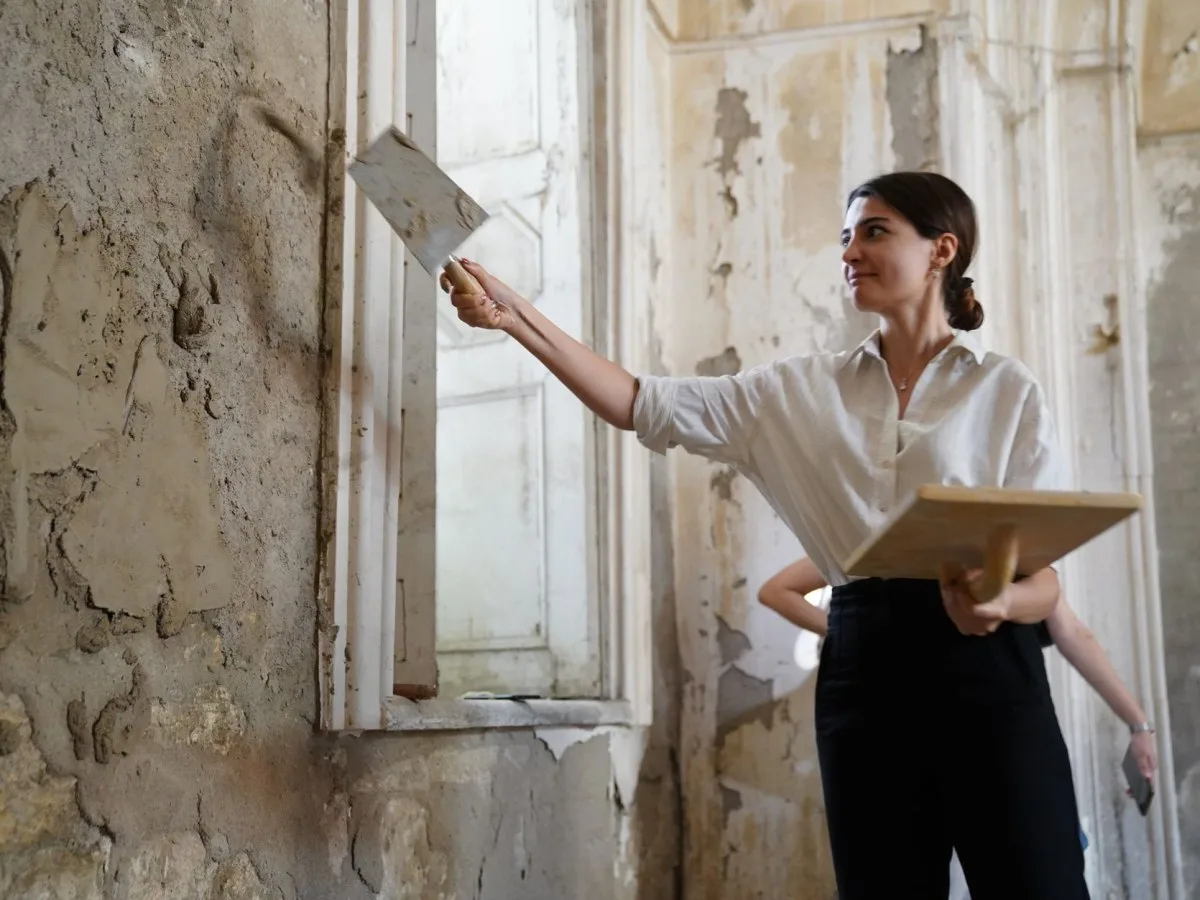
Conserving a historic house is not simply a matter of repairing whatever has deteriorated. Walls, finishes, stone features and wooden elements may form part of a building’s historic value; any intervention requires an understanding of the materials and techniques present, the damage they have sustained and which changes are compatible with their conservation.
This guide provides a practical framework with a defined scope. The information about permits and institutions applies to Bavaria, Germany: authorities, rules and procedures differ in other jurisdictions. It is not a diagnosis of a property and does not replace consultation with the competent authority or qualified professionals.
Before repairing: identify the building and seek advice
If you do not know whether the property is protected, first check its status in the Bayerischer Denkmal-Atlas, Bavaria’s monument atlas. The map includes architectural monuments and ensembles, but an object’s status may still be under review; therefore, if doubts remain, a search should not be treated as definitive confirmation.
In Bavaria, changing an architectural monument requires a heritage-protection permit. The application is submitted to the Untere Denkmalschutzbehörde, the local heritage-protection authority for the district or independent city. The Bayerisches Landesamt für Denkmalpflege (BLfD) generally provides a technical opinion before this authority makes its decision. A heritage-protection permit may be required even when the work does not require a building permit.
Practical first step: before commissioning or starting work, describe the proposed intervention and consult the competent local authority. The BLfD provides free technical advice to monument owners in Bavaria. Its role includes guidance on specialist matters, while the permit is issued by the local authority.
What conservation and restoration involve
Conservation and restoration study and protect historic materials and surfaces, and help define suitable measures to maintain them. In the field of buildings, work may include inspection and assessment, developing intervention plans, technical monitoring and documentation. The aim is not to erase the marks of time or assume that everything should be renewed; it is to preserve the property as a historic record while also addressing the needs of its use.
The relevant specialties depend on the elements present. In Bavaria, the BLfD’s restoration workshops work, among other areas, with architectural surfaces and mural painting, stone, furniture and wooden elements, sculpture, and painting. For a house, it helps to describe the specific element—for example, a painted finish, a stone surface or historic joinery—instead of requesting a generic solution to “restore” the entire building.
Walls, mural painting and architectural surfaces
Surfaces may include mural paintings, stucco, plaster and historic finishes, both indoors and outdoors. Their condition can be affected by moisture, climatic fluctuations, light, salts in the wall or structural movement. Possible damage includes cracks, loss of cohesion, detachment and material loss.
The appearance of a stain or crack alone is therefore not enough to identify its cause. For historic surfaces, a specialist approach seeks to understand the material and the causes of deterioration before deciding how to intervene; treating only the symptom may leave the underlying problem untouched. Assessment should consider the surface together with the surrounding building conditions.
Stone and stone features
Stone conservation may cover natural stone, artificial stone and ceramics, as well as sculptures, façades, fixtures and stone outdoor spaces. Assessment is based on the observed damage and may lead to a programme of measures and longer-term planning. In particularly difficult cases, conservation work may be carried out in a workshop.
The appropriate measure depends on the object and its condition. The treatment it needs cannot be inferred from the appearance of a façade or object alone: deciding requires a specific assessment of the material and damage.
Wood and historic finishes
Historic buildings may contain exposed wood or surfaces that are painted, gilded, varnished or otherwise finished. Specialist work may address architectural and furnishing elements such as furniture, altars, sculptures and joinery. Conservation depends on understanding both the wood and the carving and finishing techniques present.
The approach may also include advice, preparation of conservation plans and, where appropriate, measures to address pests or contamination. Removing a finish or replacing an element should not be assumed to be a harmless repair: its significance, composition and degree of deterioration must first be identified.
How to find the right specialist
Several people with different responsibilities may be involved in work on a monument in Bavaria:
| Need | Who to contact in Bavaria |
|---|---|
| Check whether the property is listed as a monument | Bayerischer Denkmal-Atlas; if questions remain, ask the competent local authority |
| Get technical advice about a monument | The regional representative (Gebietsreferentin or Gebietsreferent) at the Bayerisches Landesamt für Denkmalpflege |
| Apply for heritage-protection permission to make a change | Untere Denkmalschutzbehörde for the district or independent city |
| Work on mural painting or architectural surfaces | A conservator-restorer with relevant experience; the Verband der Restauratoren (VDR) has a specialist group dedicated to this field |
| Define treatment for stone or other materials | Consult the relevant conservation specialty and coordinate the scope with the heritage authority |
The VDR has a Fachgruppe Wandmalerei und Architekturoberflächen, a professional network devoted to the conservation and restoration of mural painting, architectural surfaces and architectural colour. The existence of this specialty can help identify the relevant field, but it does not in itself certify a particular person or constitute a recommendation for a specific project.
When looking for a conservator-restorer, explain which element is affected, where it is and what changes are being considered. Ask what inspection and documentation are needed, what experience the person has with comparable materials and techniques, and how the work will be coordinated with the competent authority. The intervention and its scope must be tailored to the specific property; this guide is not an official list of professionals and does not guarantee the suitability of any provider.
Training: what can be stated and what needs checking
The documentation available here describes areas of work and specialties, but does not establish a complete training pathway, qualification requirements or professional eligibility criteria for practising conservation and restoration. These requirements should not be inferred from membership of an association, a subject specialty or the presentation of a project.
If you need to check someone’s training, ask about their background and experience with the type of material or surface in your property, and verify the applicable requirements directly in your jurisdiction. In Bavaria, for the specific question of work on a monument, also consult the BLfD and the Untere Denkmalschutzbehörde: their roles are different and should not be confused.
A prudent sequence for planning the intervention
- Check the heritage status. Search for the property in the Bayerischer Denkmal-Atlas and ask for clarification if there are doubts or incomplete information.
- Describe the problem without presuming a solution. Note which element is affected and what changes or uses are being considered; do not assign a cause to the damage without an assessment.
- Contact the local authority before starting. In Bavaria, ask the Untere Denkmalschutzbehörde what permission the intervention requires. If the property is a monument, also seek technical advice from the BLfD.
- Identify the relevant specialty. A painted surface, a stone feature and a wooden element may call for different expertise.
- Agree on assessment, measures and documentation. Decide with the people involved what will be examined, how the work will be coordinated and what record of the intervention will be prepared.
- Check financial assistance before starting work. The BLfD states that financial assistance for conservation and intervention must be coordinated before the measure begins; check the conditions applicable to the specific project.
Scope and next step
The institutional framework described here is specific to Bavaria and should not automatically be applied to other German states or countries. Nor is it possible to choose a treatment without knowing the property, its materials and the causes of the damage. If the house is in Bavaria, the useful next step is to identify the local heritage-protection authority and provide a specific description of the planned intervention before work begins.
At a glance
Nexo request
- 1106
- nexo:broken-link:1106:priority:v1
- German article on the restoration of historic buildings and their materials: what conservation and restoration involve (material analysis, mural painting, stone, wood), how conservators-restorers are trained, and whom to contact when renovating a protected house.
- es
- German article on the restoration of historic buildings and their materials: what conservation and restoration involve (material analysis, mural painting, stone, wood), how conservators-restorers are trained, and whom to contact when renovating a protected house. It would replace the link to the chair of Restoration, Art Technology and Conservation Science at TU Munich, whose page no longer exists.
- https://www.baudenkmalpflege.eu/links.html
- http://www.ar.tum.de/institute/institut-fuer-baugeschichte-kunstgeschichte-und-restaurierung/restaurierung-kunsttechnologie-und-konservierungswissenschaft/
- 96a9654fcf889bda6e1a0c9b1a480ddbb1fedfa2390994ce15a5da0bc40f2cb8
Priority authorization
- explicit_owner_instruction
- 1106
- highest_native
- 1
- 1
- 1
Required locales
- es
- en
- fr
- it
- de
- pt
Research required
1
Sources and references
Restaurierung in der Bau- und Kunstdenkmalpflege ↗19/11/2026
Informationen für Denkmaleigentümer ↗19/11/2026
Wandmalerei und Architekturoberflächen - Verband der Restauratoren VDR ↗19/11/2026
BayDSchG) Vom 25. Juni 1973 (BayRS IV S. 354) ... ↗20/11/2026
Änderungen im Denkmalschutz 2026 (FAQ) ↗20/11/2026
Photograph · Photo by Tahir Xəlfəquliyev on Pexels · Pexels License · Sources and references · Centred crop to 4:3, resizing and conversion to JPEG for House Angle.