





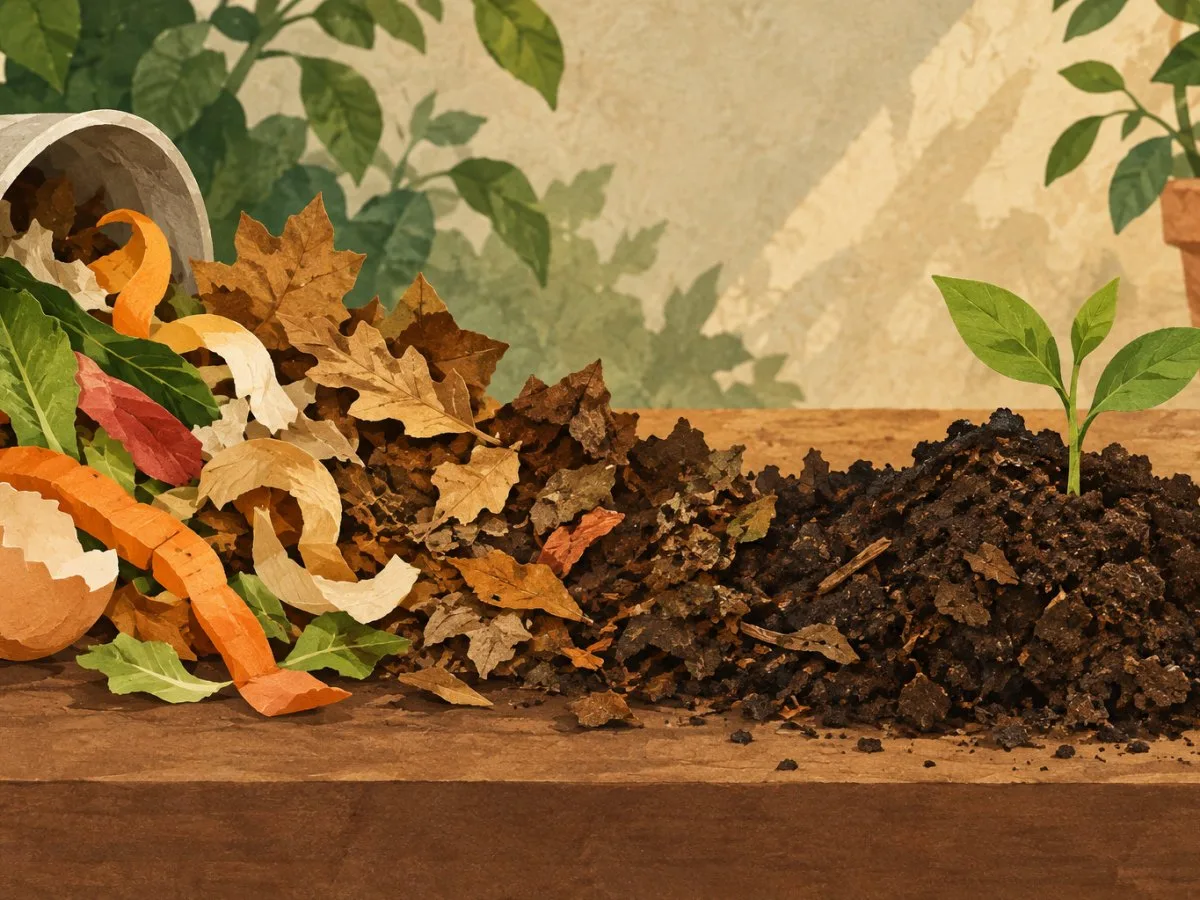
Home composting transforms organic scraps into a stable soil amendment through biological decomposition. In conventional composting, microorganisms work with oxygen, water, carbon, and nitrogen. The result is not simply shredded or dried matter: it is a dark, earthy material that can be added to soil.
Composting returns some organic matter to the soil and reduces the waste that is discarded.
Choose a system based on your space
| System | Where it can work | What it requires | What it produces and what to bear in mind |
|---|---|---|---|
| Pile or compost bin | Garden or patio | Mixing dry and moist materials, monitoring moisture, and allowing aeration | Compost that matures over time. The process may be slower in small spaces. |
| Vermicomposting | Protected indoor area or small space | Opaque, ventilated container; moist but not waterlogged bedding; and worms suitable for composting | Solid vermicompost. Worms need protection from heat and frost; the material is not turned like a pile. |
| Community collection or composting | If a municipal service or accessible community drop-off point is available | Separating scraps and following the service’s or site’s rules | Accepted materials and conditions depend on the local program. |
For a garden: A pile or compost bin is a practical option if you have room to access it, add scraps, and remove the compost. Choose a convenient location and check that the system allows the necessary aeration and drainage.
For a balcony: You could consider vermicomposting in a protected, ventilated spot. Your choice depends on the space available, the scraps you produce, and how much attention you can give it.
For an apartment: Vermicomposting lets you process vegetable scraps in a compact container, but it requires attention to feeding and temperature. If you do not have space to compost, check whether a municipal or community program accepts organic scraps.
What to add and what to leave out
The terms greens and browns describe functions, not exact colors. Greens generally provide nitrogen and moisture; browns provide carbon. For a home garden compost pile, the US EPA guideline is to use at least two or three times the volume of browns as greens. This is a visual guide, not a chemical carbon-to-nitrogen ratio or a universal rule; it applies to garden compost piles, not vermicomposting.
| Material | Examples | Guidance |
|---|---|---|
| Greens | Fruit and vegetable scraps, coffee grounds with paper filters, tea leaves without staples, grass clippings | Add them mixed with browns. Avoid putting grass clippings in a thick, compacted layer. |
| Browns | Dry leaves, stems and twigs, non-glossy paper, cardboard without wax coating or tape, untreated wood chips | Chop up large materials. |
| Best left out of simple home composting | Meat, fish, bones, dairy, eggs, fats, pet waste, plastic, painted or treated wood | They can cause hygiene, odor, or pest problems, or may not break down properly. |
| Add with caution or avoid when starting out | Diseased plants, aggressive or seeding weeds | For simple home composting, leave out diseased plants and problematic weeds. |
These exclusions apply to a simple home pile or compost bin, not to the rules of an industrial facility. Follow the requirements of the system or service you plan to use. Do not assume that an item labeled compostable will break down at home; check whether your facility accepts it.
Setting up a pile or ventilated container
- Choose a convenient location. For a garden pile, choose a spot suited to local conditions; shade can help retain moisture. Adjust the location to the method you are using. Make sure you have access to water and room to work around the container.
- Prepare the container. Check the ventilation and drainage according to the system’s design. For a worm bin, follow the specific instructions for its model for managing moisture and any collected liquid; not all designs work the same way.
- Chop up the scraps. Smaller pieces mix more easily. There is no need to turn them into purée.
- Alternate and mix. Add greens and browns without compacting them. For a home garden compost pile, the US EPA guideline is to use at least two or three times the volume of browns as greens. Adjust the mix according to moisture and odor, without treating this ratio as a universal rule or applying it to vermicomposting.
- Adjust moisture according to the system. In a pile, keep the contents moist without letting them become soaked. If they are too wet, add dry material and gently aerate. In a worm bin, keep the bedding moist but without puddles; follow the system’s instructions.
- Check and aerate. In an active pile, mix or turn it from time to time to encourage airflow. For a worm bin, check the instructions for your model’s ventilation and handling. Do not automatically apply the turning method used for a garden pile: follow the system’s instructions, including not shaking or stirring it when specified.
Moisture, aeration, and maturation
In an active pile, adequate moisture and oxygen help decomposition. If the contents are dry, moisten and mix them; if they are too wet or compacted, add dry browns and aerate.
Slow composting works too: a balanced mix can break down with less turning, although it takes longer. Volume, materials, climate, and care all affect the timing. The calendar alone does not show that the compost is ready.
Vermicomposting requires a different routine. Use an opaque, ventilated container, following the instructions for the specific design for setup and liquid management. Prepare a bed of shredded paper that is moist but has no puddles. Add small amounts of vegetable scraps, cover them with bedding, and wait for the worms to consume the previous food before feeding them again. Use species suitable for composting and protect the container from extreme temperatures.
How to recognize mature compost
- It is dark in color and has a loose or crumbly texture.
- It smells earthy, not rotten or like recognizable food scraps.
- Most of the original materials are no longer distinguishable.
- The pile has stopped heating up after it is mixed.
These are indicators, not a complete test of maturity on their own. Follow the maturation instructions for the specific system and allow more time if the batch is still unstable; there is no single timeline for all systems or uses.
Common problems and adjustments
| What you observe | Likely causes | What to try |
|---|---|---|
| Unpleasant or rotten smell | Too much moisture, too little air, or too many greens together | Add dry browns, mix gently, and check that the material is not soaked. |
| The material is dry and barely changing | Lack of moisture or insufficient mixing | Moisten gradually and combine the materials; avoid waterlogging. |
| Decomposition is slow | Too little moisture, poor aeration, large pieces, or too little suitable material | Check moisture and mixing, chop large pieces, and add suitable materials. Cold weather and system size can also have an effect. |
| Flies appear | Fresh scraps left exposed or unsuitable materials | Mix exposed scraps with other materials and remove anything that is not appropriate for the system. |
| Rodents are present | Access to food scraps or an uncovered container | Protect the pile or container according to the system’s design and avoid materials it does not accept. |
| The worm bin is too wet | Too much water or too many soft scraps | Add dry bedding and adjust moisture according to the system’s instructions. |
Correct the system’s balance before turning to products: check moisture, materials, and container protection.
How to use it in pots, vegetable gardens, and gardens
Mature compost is used mainly as a soil amendment: mix it into the soil or apply it as mulch. In ornamental gardens, it can improve soil structure and help retain moisture. As mulch, spread it over the soil surface.
Garden compost and potting mix are different materials: the former is used to improve soil; potting mixes are prepared for growing plants in containers and can contain a variety of ingredients.
Community options and municipal collection
If you cannot compost at home, check whether community composting, separate collection of organic scraps, or a local facility is available. Programs may operate in community gardens, parks, schools, or other shared spaces; they do not all accept the same materials.
Ask your local government or environmental agency which waste materials it accepts, how they should be separated, whether specific bags are required, and what the drop-off hours and conditions are. Rules in another municipality do not automatically apply to yours. You can also ask whether local guidance or training is available.
Sources and references
US EPA — Composting At Home ↗United States · Consultado el November 11, 2026 · 14/11/2026 US EPA — Composting At Home.
Brisbane City Council — Compost at home ↗Australia · Consultado el November 11, 2026 · 14/11/2026 Brisbane City Council — Compost at home.
Royal Horticultural Society — Composting ↗Reino Unido · Consultado el November 11, 2026 · 14/11/2026 Royal Horticultural Society — Composting.
US EPA — How to Create and Maintain an Indoor Worm Composting Bin ↗United States · Consultado el November 11, 2026 · 14/11/2026 US EPA — How to Create and Maintain an Indoor Worm Composting Bin.
US EPA — Community Composting ↗United States · Consultado el November 11, 2026 · 14/11/2026 US EPA — Community Composting.
Miami-Dade County — Home Composting ↗United States · Consultado el November 11, 2026 · 14/11/2026 Miami-Dade County — Home Composting.
Royal Horticultural Society — Worm composting ↗Reino Unido · Consultado el November 11, 2026 · 14/11/2026 Royal Horticultural Society — Worm composting.
NC State Extension — Extension Gardener Handbook: Composting ↗United States · Consultado el November 11, 2026 · 14/11/2026 NC State Extension — Extension Gardener Handbook: Composting.
Oregon State Extension — Do the Rot Thing ↗14/11/2026 Oregon State Extension — Do the Rot Thing.
Pennsylvania DEP — Leaf and Yard Waste Reduction ↗14/11/2026 Pennsylvania DEP — Leaf and Yard Waste Reduction.