





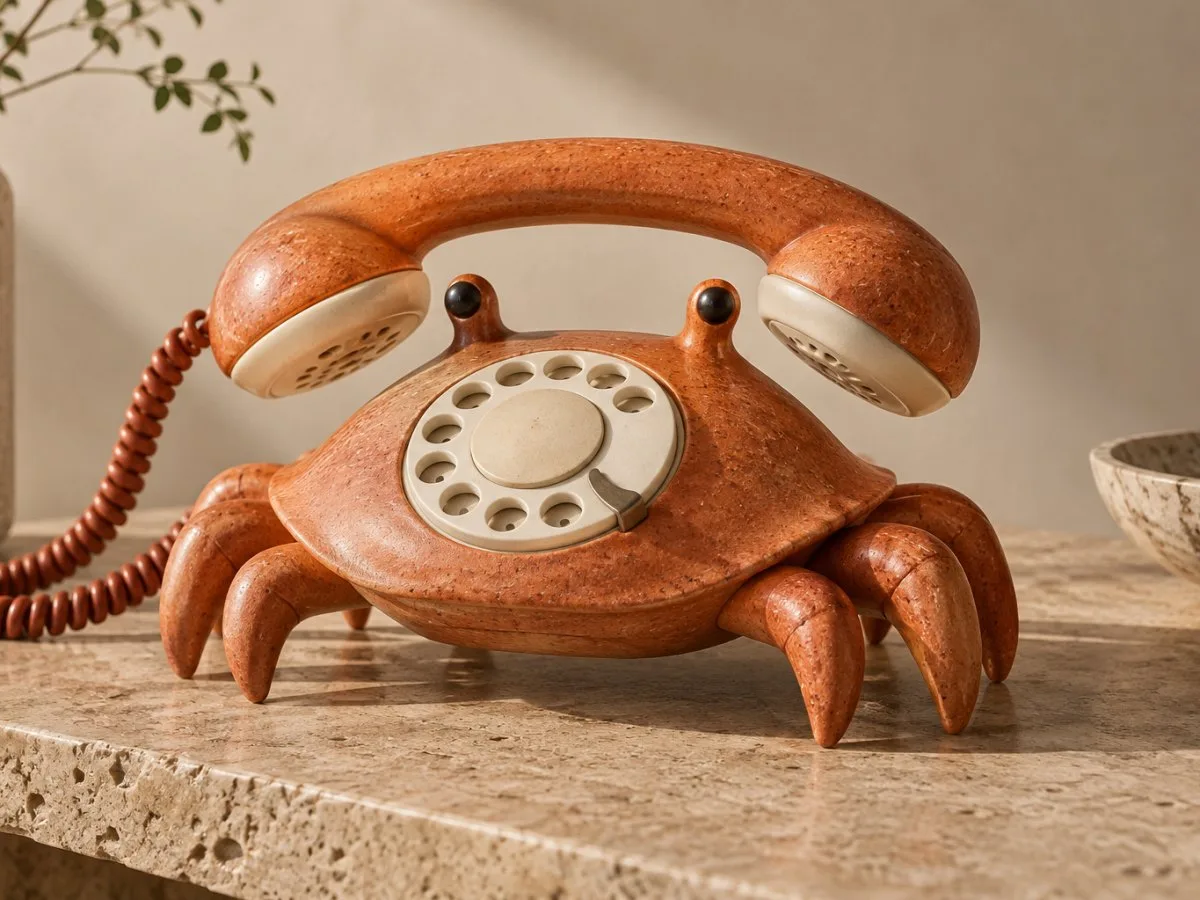
When an object stops seeming neutral
A telephone shaped like a lobster retains the recognizable identity of a household device, but introduces an unexpected association. This friction between the familiar and the unusual offers one way to understand the encounter between Surrealism and design: an object can remain recognizable while changing how we see it.
The relationship is not limited to dream imagery. It also appears in fashion and interiors, where forms, materials, colours and symbols alter expectations. Rather than treating design solely as a practical response, this perspective makes room for humour, surprise and personal associations.
The illusion that transforms a garment
The “Tears” dress, created by Elsa Schiaparelli in collaboration with Salvador Dalí and made in February 1938, brings this tension into clothing. Its trompe-l’œil print depicts tears in an evening dress; the matching veil has real cuts, lined in pink and magenta. The difference between the depicted and material tears makes the garment oscillate between appearance and reality.
The ensemble was part of Schiaparelli’s Circus Collection for summer 1938. The collaboration connected fashion and Surrealist art, but the dress’s effect also depends on a specific design choice: using print to suggest a torn surface and the veil to give that image a physical dimension. The garment does not merely represent an idea; it creates a visual tension between what appears torn and what actually is.
This kind of trompe-l’œil shows how a graphic device can change the way we read a familiar form. Clothing remains clothing, but the motif disrupts its customary appearance and opens up other associations, even unsettling ones.
Found materials, unexpected associations
Eileen Agar brought this play of associations to a hat made in Great Britain in 1937. For Ceremonial Hat For Eating Bouillabaisse, she used a cork bowl she had picked up in Saint-Tropez and covered it with marine objects: coral, shells, fish bones and a sea urchin. An earlier version also included a lobster tail.
The hat brings together pieces that usually belong in other contexts and makes them part of an object to wear. Agar wore it on television in 1948 and walked through the streets of London in it. The combination of marine elements and ceremonial form brings together humour, found material and public gesture without ceasing to be a hat.
The contrast with Schiaparelli’s dress is revealing. In one, a print creates the illusion of torn fabric and the veil introduces real cuts; in the other, found objects are assembled on a cork base. Both show that surprise can arise from representation as well as from the choice and combination of materials.
Space as a composition of symbols
Strangeness does not belong only to isolated objects. The Cosmic House, associated with architect Charles Jencks, is a home that explores time, the seasons and galaxies through ornament, artworks, colour and symbolism. In this reading, the interior is not a neutral backdrop: its references and decorative elements help construct a spatial narrative.
This does not mean that every space has to be exuberant. Rather, it invites us to consider how pieces relate to one another and what associations they create. An interior can communicate an idea through the repetition of motifs, contrast, or the presence of objects that draw attention away from what is expected.
A way of looking at the everyday
As an exercise in observation, we can ask which element draws the most attention, which combination feels unexpected, and what story the relationship between the pieces suggests. These are interpretive questions, not a technical assessment or a formula for decorating.
It also matters not to call every peculiar object Surrealist. In the examples described here, surprise rests on identifiable choices: a familiar form altered, a print that simulates tears, actual cuts in a veil, marine materials assembled together, or an interior organised through symbols. Looking at these devices helps distinguish an isolated oddity from a composition with recognizable associations.
From Surrealism to artificial intelligence
Artificial intelligence can prompt questions about how images and design ideas are generated, but the documentation available for this discussion provides no methods, tools or concrete examples of AI-produced design. These historical works therefore cannot support conclusions about AI’s capabilities.
The useful connection is a question, not an equivalence: when an unexpected combination appears, what associations support it? How might it relate to an object or a space? What intention does it communicate? Surrealism offers examples of how form, material and context can make a familiar thing seem strange. These questions help examine a visual proposal without confusing surprise with meaning.
Looking at design from this perspective means accepting that an object or space can be recognizable and disconcerting at the same time. Surprise does not have to replace function: it can make it more visible and open up new ways of interpreting the everyday.
At a glance
Scope
Editorial reading; it is not a visit or a technical assessment.
Sources and references
Surrealism and Design: From Dalí to AI ↗14/11/2026
A Surrealist day out in London - Design Museum ↗14/11/2026
10 Unmissable Highlights from #ObjectsOfDesire - Design Museum ↗14/11/2026
6 Surrealist Chairs from #ObjectsOfDesire - Design Museum ↗14/11/2026
Ceremonial Hat For Eating Bouillabaisse | Agar, Eileen | V&A Explore The Collections ↗18/11/2026
The Tears Dress | Dali, Salvador | Schiaparelli, Elsa | V&A Explore The Collections ↗18/11/2026