





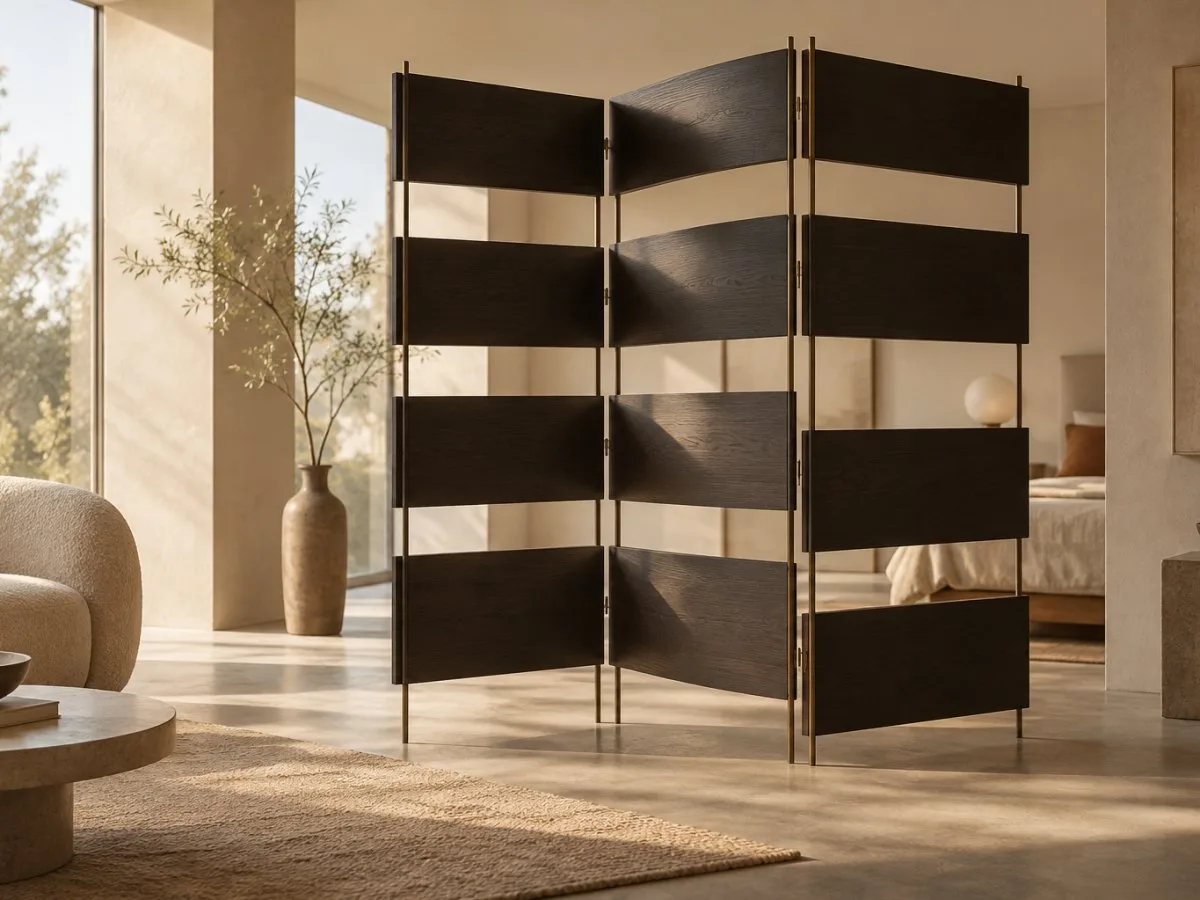
A division that is not a wall
A screen can separate one area from another without fixing a permanent boundary. In Eileen Gray’s 1922 design, this function coexists with a composition that can also be read as sculpture. The object organizes space without enclosing it completely.
The piece is attributed to Gray’s workshop in Paris and is made of lacquered wood and metal rods. It measures 189.2 × 135.9 × 1.9 cm. Its freestanding, movable structure can divide spaces while presenting an abstract relationship between solid forms and voids.
Panels, structure, and rhythm
The screen is described as comprising seven horizontal rows of panels joined by thin vertical rods. The arrangement prevents it from being perceived as a continuous surface: solid elements alternate with open intervals, so the object marks a division while retaining a degree of visual permeability.
This balance helps explain its role in a room. A fixed partition establishes a stable boundary; a screen can be repositioned. In Gray’s work, practical function is not concealed behind decorative form: the arrangement of panels and the spaces between them construct the furniture’s visual expression. It can be interpreted as architecture on a small scale, although it remains a domestic object, not a permanent building element.
The lacquered surface
The lacquered wood gives the piece a visually uniform and precise presence. Gray popularized lacquered furniture in post–World War I Paris, amid a taste for imported materials and those associated with Japanese decorative arts. This connection does not make the screen a reproduction of a Japanese object: its geometric arrangement and its function as a divider are part of its own interpretation of modern furniture.
Other screens by Gray in the Victoria and Albert Museum help place this exploration in context without confusing them with the 1922 piece. The 1923 object, number W.21-1972, has 28 black panels that pivot on steel rods to form a semi-transparent partition. Another screen, number W.40:1 to 8-1977, has an uncertain date: the record describes it in some places as made around 1923 and elsewhere as dating to around 1928; it also notes that one of its panels may have been altered later. It consists of eight panels joined by brass hinges and is decorated with red and black lacquer and silver leaf. These are distinct objects with different structures and finishes. Together, they show how Gray explored various ways of turning a movable screen into a composition of surfaces, joints, and geometric forms.
Between furniture, space, and sculpture
The screen’s mobility invites us to think of domestic space as adjustable. It can define an area without establishing an irreversible separation and, when moved, changes how the interior is read. This possibility follows from the screen’s function and the description of the piece as movable; it does not document a specific use of this example.
The work also brings together two demands of design: meeting a tangible need and sustaining a formal presence of its own. Gray expressed this idea in a sentence recorded on the MoMA gallery label: “Art is not just the expression of abstract relationships; it must also encapsulate the most tangible relations, the most intimate needs of subjective life.” In the screen, the relationship between the abstract and the everyday becomes visible in a structure that serves to divide and, at the same time, invites looking.
The result is neither simply a lightweight wall nor a sculpture placed in a room. It is an intermediate object: it defines a boundary, lets the space remain present, and turns an everyday operation—separating—into a formal decision.
At a glance
Scope
Editorial reading; this is not a visit or a technical evaluation.