





Dieter Rams’s design is often recognized for its visual economy: ordered surfaces, legible controls, and forms that do not conceal how an object works. But this clarity is not limited to appearance. In his work for Braun and Vitsœ, it also shows in the way appliances, furniture, and components are arranged within the home.
His projects trace a thread between industrial design and everyday space: making things understandable and useful, and considering how they coexist.
From craft to Braun interiors
Rams was born in Wiesbaden, Germany, in 1932. His grandfather’s carpentry was an early influence. He began studying interior design in 1947, interrupted his studies to complete a carpentry apprenticeship, and later turned toward architecture. In 1955, he joined Braun as an architect and interior designer, at a time when the company was seeking to modernize its spaces and products.
At first he worked on interiors and exhibitions; gradually, his attention turned to appliances. That transition matters: a product’s design does not necessarily begin and end with its casing. Its place, its relationship to other elements, and how easily someone can understand what it can do also matter.
The SK 4: making its workings visible
In 1956, Rams worked with Hans Gugelot and the Braun team on the SK 4 radio and record player. In contrast to wooden cabinets that concealed sound equipment, the SK 4 had a metal case with pale wooden sides and placed the controls beside the turntable on top. Its transparent lid revealed the mechanism: the metal lid originally planned vibrated during testing and was replaced with transparent plastic at Rams’s suggestion.
The result did not disguise the technology beneath the appearance of traditional furniture. It made the technology visible while integrating its components into a domestic object. The lid earned it the nickname “Snow White’s coffin”; the favorable reception of this solution helped transparent lids become widespread on record players.
This decision can be read as more than a formal gesture. Making the workings visible communicates what kind of object one is looking at, while the arrangement of the controls helps orient its use. This is an interpretation of the project, not a measure of how easy it is for everyone to use.
A family of components, not isolated pieces
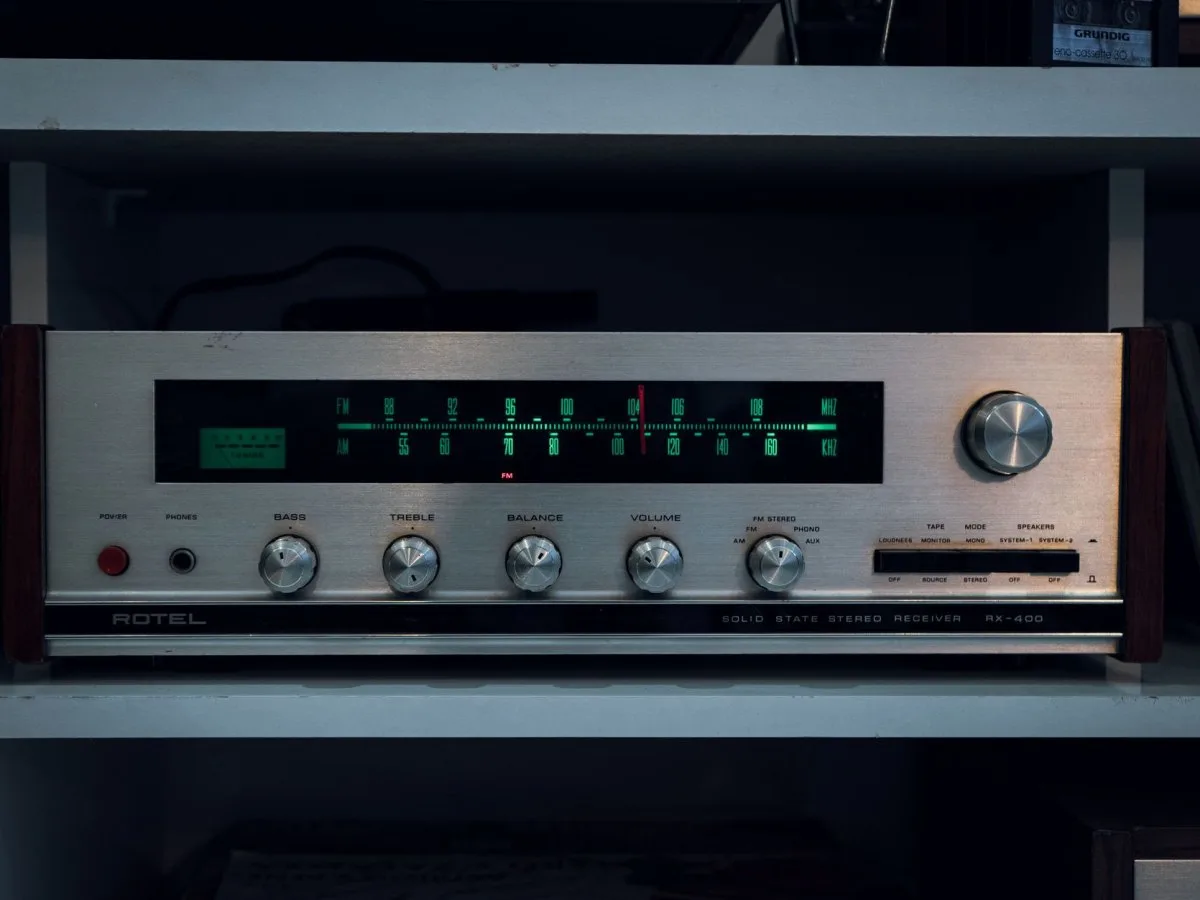
In the following years, Rams and his collaborators developed audio systems with components that could be combined. The Atelier 1 and L1 speakers shared proportions with the SK 4; the receiver could be paired with separate speakers instead of bringing everything together in one unit. Later, transistor technology made smaller audio devices possible, with broad top surfaces where controls could be arranged clearly.
The Audio 1 series was designed to sit on Vitsœ’s 606 shelving system. The relationship was deliberate: an appliance and a storage system could be understood as parts of a domestic ensemble, rather than independent objects that happened to share a room. Some audio components allowed different orientations and wall-mounted configurations; the record player was the exception to the horizontal or vertical arrangements described for the other modular components. Braun equipment was also developed for a specific wall-mounted configuration.
This logic of compatibility also appears in the 606 system. Rams began developing the idea of a shelving system with rails and interchangeable elements in 1957; Vitsœ was founded in 1959, and the 606 wall-mounted system was launched in 1960. The system was conceived with combinable shelves, cabinets, and drawers. Its components can be rearranged, allowing storage to be reorganized without treating each module as a final, isolated piece.
The connection between the 606 and Braun equipment shows a way of thinking about interiors through relationships: compatible dimensions, possible positions, and components that can be brought together or separated. It does not imply that one arrangement suits every home; it describes a structure designed to accommodate different configurations.
Reducing to make things legible
In 1961, Rams became head of design at Braun, a position he held until 1995. His team worked across different product categories, and his own work included radios, record players, flashlights, and projectors, among other things. In audio equipment, coherence was expressed through shared proportions, white or dark gray cases, aluminum lids, and neatly arranged controls. The green switch stood out against a restrained palette.
Repeating conventions helped the devices in a family make sense in relation to one another. Rather than turning each model into a visual exception, the design maintained recognizable patterns. In this sense, clarity was a matter of form as well as organization.
Rams formulated ten principles of good design, including that it should be innovative, useful, aesthetic, understandable, unobtrusive, honest, durable, attentive to the last detail, environmentally friendly, and as little design as possible. These are criteria for assessing decisions, not a recipe that guarantees a result by itself. His well-known summary, “less, but better,” captures the aspiration to remove the superfluous without losing usefulness.
Design changes with technology
Rams’s restraint did not mean maintaining a fixed appearance. In 1965, the Studio 1000 hi-fi system introduced anthracite-colored bases and a darker, more compact visual presence. The controls changed too, adapting to this palette. The form responded to a new stage in audio technology and to the ways its components could be presented in a space.
Other projects posed different challenges. For the LE 1 electrostatic speaker, launched in 1960, the lightweight membranes covering the front made visible an intention to achieve clarity of sound. In the 1968 T2 lighter, the design problem centered on locating the magnetic ignition point so that the thumb could apply pressure. These examples show that a restrained aesthetic does not amount to a uniform solution: each object had to respond to its function and materials.
Rams also continued to use hand drawing as a tool for developing ideas, despite the later expansion of digital technologies. This helps explain his process, but should not be confused with a universal rule about how to design.
Longevity and responsibility
Rams’s career raises a question that remains pertinent to domestic spaces: what makes an object worth keeping? His principles connect usefulness, understanding, and longevity with attention to the environment. In a 1976 speech, he argued that designers had a responsibility in the face of natural-resource scarcity; the concern was not limited to whether a product looked new, but also to what is brought into the world and how long it can remain useful.
The modularity of the 606 offers a formal response to this question: its elements can be combined, and the system allows its arrangement to change. This alone does not demonstrate the material longevity of each component or the environmental impact of its manufacture; it does show how the possibility of reorganizing a system is part of its design.
Rams worked for Braun for four decades and developed furniture for Vitsœ in parallel. His legacy is especially clear when one observes the continuity between the two fields: legible appliances and furniture conceived to give them a place. Rather than imposing a single image of the home, his projects propose a discipline of relationships: each object should have an understandable function, and the whole should not depend on accumulating forms without connection.
At a glance
Scope
Editorial reading; this is not a visit or a technical assessment.
Sources and references
Dieter Rams ↗13/11/2026
Dieter Rams | About us | Vitsœ ↗13/11/2026
Braun designers ↗13/11/2026
Happy Birthday, Dieter Rams. - Stories | Braun Audio ↗13/11/2026
Photograph · Photo by Javier Zari U. on Pexels · Pexels License · Sources and references · Centred crop to 4:3, resizing and conversion to JPEG for House Angle.