





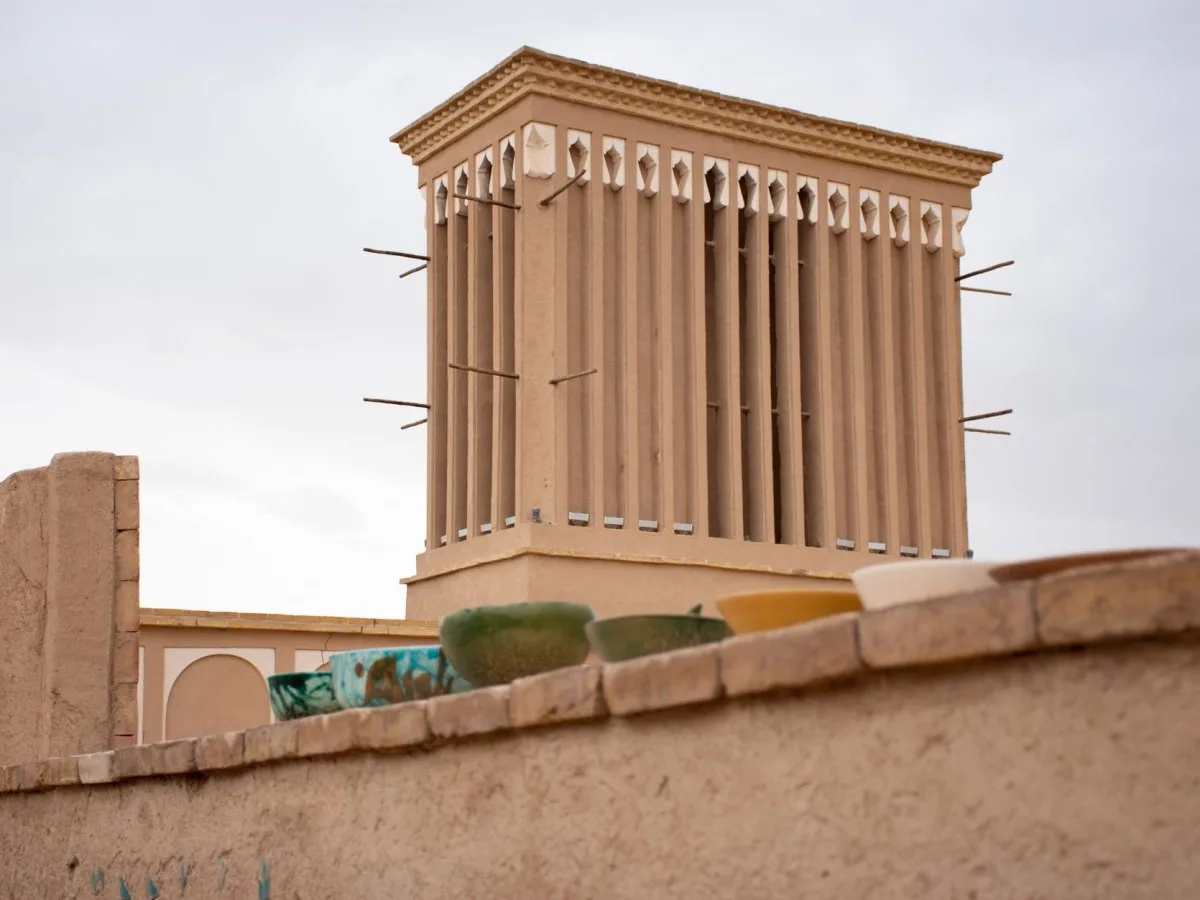
A city shaped by limited resources
On the Iranian plateau, close to the historic Spice and Silk Roads, Yazd shows how water, earth and shade shape both buildings and the life between them. Its historic fabric retains traditional neighbourhoods and a network of qanats—conduits that carry underground water into the city. Each neighbourhood is built on a qanat and has a communal centre.
Earth is not merely the material of the walls here: it is also used in vaults and domes, and forms part of an architecture of courtyards and underground spaces. Many houses have courtyards below ground level and rooms beneath the surface. Taken together, these forms suggest a close relationship between construction, water and ways of living; on their own, they are not a universal formula for designing in hot climates.
Air and shade as part of the space
Windcatchers—known as bādgīr—stand out on Yazd’s skyline. Their operation can vary with conditions: they channel air captured by their openings downwards to ventilate and cool rooms, while when there is little or no wind, air can rise through the tower and help draw air out of courtyards and basements. In Yazd, these towers vary in form and size. Their presence makes it possible to understand ventilation as part of architectural composition as well as a response to heat.
Courtyards, thick earthen walls and underground spaces help create a pleasant microclimate. In the streets, partially covered passages, called sabats, and arches crossing some alleyways provide shade. The urban experience is thus shaped by a sequence of open and sheltered spaces: lanes, squares, courtyards and neighbourhood centres.
This invites us to consider architecture not only through façades or monuments, but also through transitions: where one moves from sun into shade, how homes connect to shared spaces, and how each neighbourhood relates to water. These are questions for interpreting the place, not a description of a visit.
Neighbourhoods, uses and coexistence
Yazd’s historic landscape includes bazaars, public baths (hammams), cisterns, mosques, synagogues, Zoroastrian temples and the historic Dolat-abad Garden. The variety of these spaces makes visible a city associated with the traditions of Islam, Judaism and Zoroastrianism. The built heritage coexists with social and religious practices, celebrations and pilgrimages; it is not simply a collection of old buildings.
The city remains inhabited and continues to change. The bazaar is still in operation, and some restored structures have new uses, including accommodation, restaurants and university spaces. This continuity involves change: conserving a living urban fabric does not mean freezing it, but addressing how buildings and public spaces can adapt without losing their material and social characteristics.
Conserving a living fabric
Yazd was inscribed on the World Heritage List in 2017. The decision recognises its earthen architecture and the interaction between the settlement and the desert environment. Heritage documentation also records urban changes from the 1930s, when some wider commercial streets and modern housing were built, mostly outside the historic core.
Conservation poses challenges identified in the documentation, including earthquake preparedness and the need for guidelines on the use and maintenance of historic earthen buildings, including their interiors. It also points to the importance of studying the relationships between the social, cultural and religious dimensions of each neighbourhood and physical elements such as qanats, cisterns and religious buildings. These issues matter because Yazd’s architecture depends as much on its materials and forms as on the water networks, institutions and everyday uses that give them meaning.
To view Yazd through the lens of everyday design is to attend to an interconnected system: water that links neighbourhoods, earth that shapes walls and roofs, air that moves through windcatchers, and shade that accompanies streets and courtyards. Its significance lies not in any single solution, but in the way these elements connect with urban life and the specific conditions of the desert.
At a glance
Scope
Editorial reading; it is not a visit or a technical assessment.
Sources and references
Historic City of Yazd ↗06/11/2026
Historic City of Yazd ↗06/11/2026
Historic City of Yazd ↗06/11/2026
Historic City of Yazd ↗06/11/2026
41 COM 8B.18 - Decision ↗06/11/2026
BĀDGĪR - Encyclopaedia Iranica ↗12/11/2026
Photograph · Photo by Behnam Ramezani on Pexels · Pexels License · Sources and references · Centred crop to 4:3, resizing and conversion to JPEG for House Angle.