





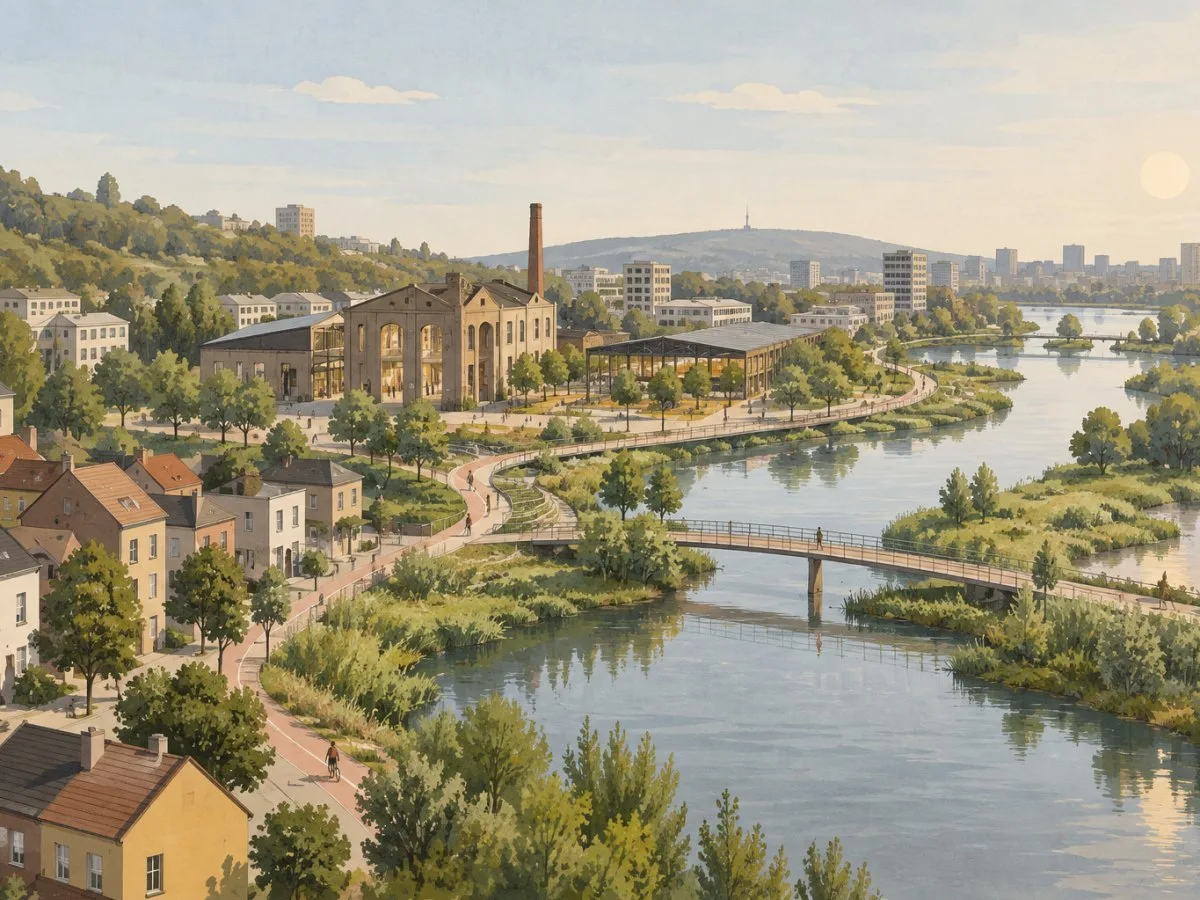
An exhibition that goes beyond displaying buildings
An Internationale Bauausstellung (IBA)—“International Building Exhibition”—is a special format for urban and regional development, used primarily in Germany. It follows no fixed procedure and does not designate a permanent institution: each IBA is organised around the challenges of a particular place and time, concentrates attention and resources over a defined period, and makes its work visible through specific projects.
The word “exhibition” may suggest a display to visit once it is complete. In an IBA, however, the exhibition is part of a process that unfolds over several years. Projects are developed in cities or regions, and the initiative ultimately aims to leave tangible changes for those places and their residents. The exhibition presents that work and opens it to discussion; it does not replace the work itself.
A format that changes with its time
Architectural exhibitions have roots in displays of construction innovations at nineteenth-century world’s fairs. The Mathildenhöhe in Darmstadt in 1901 is often regarded as an early landmark of the independent architecture exhibition. There, the project encompassed everything from urban planning and houses to interiors and everyday objects: not just individual buildings, but a broad vision of life and material culture.
In 1927, the “Die Wohnung” exhibition at the Weißenhofsiedlung in Stuttgart brought together new ideas about housing and design, from domestic objects to urban planning. In Vienna, the 1932 Werkbundsiedlung brought together architects from different countries around newly built housing; Margarete Schütte-Lihotzky was among its participants. These examples show the format’s initial emphasis on architecture and new ways of living.
Over time, the field of action widened. Berlin’s Interbau of 1957 was linked to post-war reconstruction and different ideas about the city of the future. In Berlin, the 1987 IBA worked from two approaches: the critical reconstruction of the city and careful urban renewal, with attention to existing buildings. Later, IBA Emscher Park (1989–1999) addressed the transformation of an industrial region in the Ruhr, while IBA Fürst-Pückler-Land (2000–2010) worked with the Lusatian landscape, affected by lignite mining and its conversion.
This history is not a uniform evolution or a model replicated by every initiative. IBAs have had different themes, scales and structures. What they share is a limited duration and a concentration of effort around a specific programme.
From questions to projects
An IBA usually starts with a challenge that calls for collective attention: how to renew neighbourhoods without displacing their residents; how to reuse industrial buildings; how to respond to demographic or economic change; or how to reconcile urban activity, infrastructure and nature. The initiative’s programme turns these issues into planning questions and into projects that can offer concrete responses.
The scale may be that of a housing complex, a neighbourhood, a city or a region. In Emscher Park, for example, the work comprised more than 120 projects spread across 17 cities and addressed the conversion of an industrial region. Its themes included the recovery of the Emscher River and its landscape, new forms of economic activity, housing and industrial heritage. In Fürst-Pückler-Land, the transformation of the mining landscape included the reuse of industrial buildings, urban transformation projects and the creation of new lakes in open-pit mining areas.
IBA Hamburg (2006–2013) focused on the Elbe islands, where industry, city, transport, port and natural spaces meet. Its programme connected the diversity of urban society, the shaping of the city’s inner edges and responses to climate change. Together, these examples show how an IBA can bring different projects under a common framework without requiring them all to be of the same type or reducing them to new construction.
Dimensions the format can integrate
The format gradually moved away from an exclusively technical and construction-oriented approach. Today, it can combine aesthetic and technological questions with social, economic and environmental dimensions, while also giving attention to the quality of processes and participation.
- Social: housing, living conditions, urban diversity, neighbourhood renewal and participation in decision-making.
- Economic: transformation of local economies, new uses for productive areas and prospects for regions in transition.
- Environmental: restoration of landscapes and waterways, reuse of existing structures and responses to climate change.
- Cultural and spatial: architecture, public space, industrial heritage and new relationships between city and territory.
Not every IBA addresses all these dimensions with the same intensity. Their combination depends on the challenges each initiative sets out to address and on its historical, political, spatial and financial conditions.
Temporality, participation and limits
A defined time frame is central to the format: it makes it possible to concentrate capacity and public attention on an agenda, but it also presents a challenge. The initiative must turn temporary momentum into changes that can endure after it ends. A limited duration, on its own, guarantees neither that projects will be carried out nor that their benefits will reach the population equitably.
Participation matters because the work is not intended only for a specialist audience. Projects affect residents, activities and specific places; the quality of processes and relationships with the population are therefore part of what an IBA can address. However, the IBA label by itself certifies no particular level of participation and does not demonstrate that local conflicts have been resolved. Each initiative and its projects need to be assessed in context.
Nor is there a universal formula for comparing all IBAs as if they were one and the same programme. Their objectives, areas of work, resources and structures vary. It is therefore useful to understand them as temporary laboratories for urban and regional development: not as a permanent authority, a single planning model or a simple directory of buildings. Their value lies in connecting a situated question with projects and processes that can test possible responses.
At a glance
nexo id
168
Sources and references
https://www.iba-wien.at/iba-wien/geschichte-der-ibas ↗15/11/2026
https://www.iba-basel.net/de/iba-basel/geschichte ↗15/11/2026
Internationale Bauausstellung (IBA) Fürst-Pückler-Land 2000 - 2010 - IBA 2010 - What is IBA? ↗15/11/2026
Bundesstiftung Baukultur: Baukultur wagt Experimente, um Leerstand zu beseitigen ↗15/11/2026