





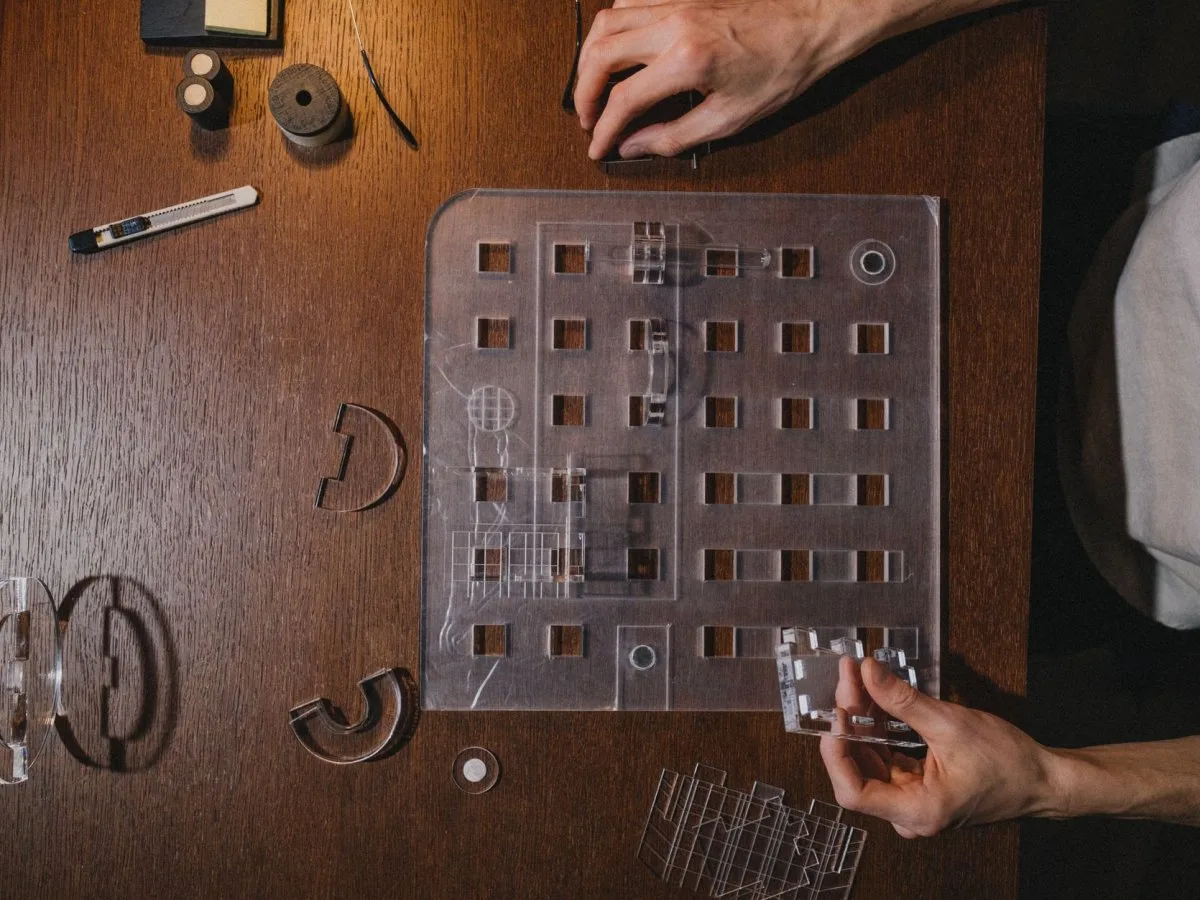
A home is more than a container for furniture. It also organizes routines, separates or combines activities, and expresses ideas about how to live. That is the premise of Home Stories: 100 Years, 20 Visionary Interiors, an exhibition by the Vitra Design Museum conceived to reopen the conversation about the private interior and its evolution. Rather than presenting a linear history of taste, it brings together twenty interiors as vantage points from which to consider social, political, urban and technical change.
The exhibition was arranged in reverse chronological order: it begins with contemporary interiors and moves back to the 1920s and 1930s. Its argument is not that each era neatly replaces the one before it. Instead, different ways of living—standardization and function on one hand, individual expression and ornament on the other—continue to coexist and compete for space in contemporary homes.
From the present back to the origins of the modern interior
The first section addresses recent issues, including the scarcity of urban space and the blurring of boundaries between work and private life. One example is the Yojigen Poketto apartment by elii, presented as a model and described as a compact home with integrated furniture and under-floor storage. The project offers a way to consider how design can respond to a lack of available space; on its own, it does not show that such a solution is suitable for every home.
Granby Four Streets, by Assemble, also features in the exhibition and is associated with the conservation and reuse of houses threatened with demolition in Liverpool. Alongside specific projects, the exhibition points to the influence of IKEA catalogues on domestic culture: commercial objects and the images accompanying them help shape recognizable models of home.
Looking back to the 1960s through the 1980s, the exhibition foregrounds changes in attitudes and visual language. Karl Lagerfeld’s apartment in Monte Carlo, furnished with pieces by the Memphis group, provides a way to consider the use of vivid colours and patterns. Andy Warhol’s Silver Factory, a loft covered in aluminium foil, blurred the boundaries between home, studio, workshop and gathering place. Taken together, these examples suggest that a domestic interior can also be a place of production and sociability, not just a private setting.
Technology, nature and new routines
The section devoted to 1940–1960 examines the relationship between interiors, mechanization and the outdoors. Casa de Vidro, designed by Lina Bo Bardi in 1951 in São Paulo, makes that relationship visible through its glazed façade and uninterrupted views across the city’s green landscape. Finn Juhl’s house, dated 1941, offers another case through which to consider Scandinavian interiors, whose influence grew in the postwar years.
The presence of household appliances and the spread of modern forms into more Western homes are also part of this history. It is not simply a succession of styles: everyday tasks, expectations of comfort and ways of organizing space all change. The exhibition thus connects design decisions with broader living conditions, without reducing any one interior to a single explanation.
The functional kitchen and open-plan space
The section covering 1920–1940 presents concepts that remain present in many homes. The exhibition places the introduction of open-plan layouts in the 1920s; Mies van der Rohe’s Villa Tugendhat is presented as one of the earliest Western residential examples of this arrangement. The Frankfurt Kitchen, designed by Margarete Schütte-Lihotzky, represents an effort to make the domestic workspace more efficient.
That efficiency also has a social dimension. Schütte-Lihotzky’s design sought to rationalize modern life and reduce the burden of women’s work in the home. The history of the interior therefore encompasses not only forms and materials but also questions about who performs domestic tasks and how time is distributed.
Showing interiors without reconstructing them in full
The exhibition brought together furniture, photographs, drawings, documents, films and models, presenting interiors as cases that could be compared and studied. This approach avoids suggesting that a home can be fully reproduced in a museum gallery: objects and images reveal aspects of a space, but they are not equivalent to the everyday experience of living in it.
The display used modular cork stands designed by Space Caviar, with mirrored surfaces. The full-scale installations included the Frankfurt Kitchen and Verner Panton’s inhabitable landscape Phantasy Landscape, presented in the nearby Fire Station building. The Hexacube module by Anja Blomstedt and George Candilis was placed outside the museum entrance.
A history of tensions, not a single trend
Taken as a whole, the selection presents the domestic interior as a meeting point for architecture, product design, visual art and set design. It also questions the repetition of the same icons, palettes and layouts that circulate in images of interiors. Rather than telling the story solely as a succession of trends, these twenty cases invite us to consider the ideas and conditions that make particular ways of living possible.
The question the exhibition leaves open has no single answer: how do we want to live? It brings that question into the present by showing how domestic design has been debated between standardization, functionalism and formal reduction on one side, and individualization and ornament on the other. Reading an interior through this tension makes it possible to consider how ideas about domestic life change with their context, without idealizing the past or assuming that any one solution is universal.
At a glance
Scope
Editorial reading; this is not a visit or a technical assessment.
Sources and references
Home Stories ↗24/10/2026
Home Stories ↗24/10/2026
Home Stories | Official Vitra® Online Shop ES ↗10/11/2026
Home Stories: 100 Years, 20 Visionary Interiors – Vitra Design Museum Shop ↗11/11/2026
Home Stories: 100 Years, 20 Visionary Interiors ↗11/11/2026
Home Stories exhibition looks back at iconic interior design projects ↗11/11/2026
Vitra Design Museum presents Home Stories | Wallpaper* ↗11/11/2026
Photograph · Photo by Ron Lach on Pexels · Pexels License · Sources and references · Centred crop to 4:3, resizing and conversion to JPEG for House Angle.