





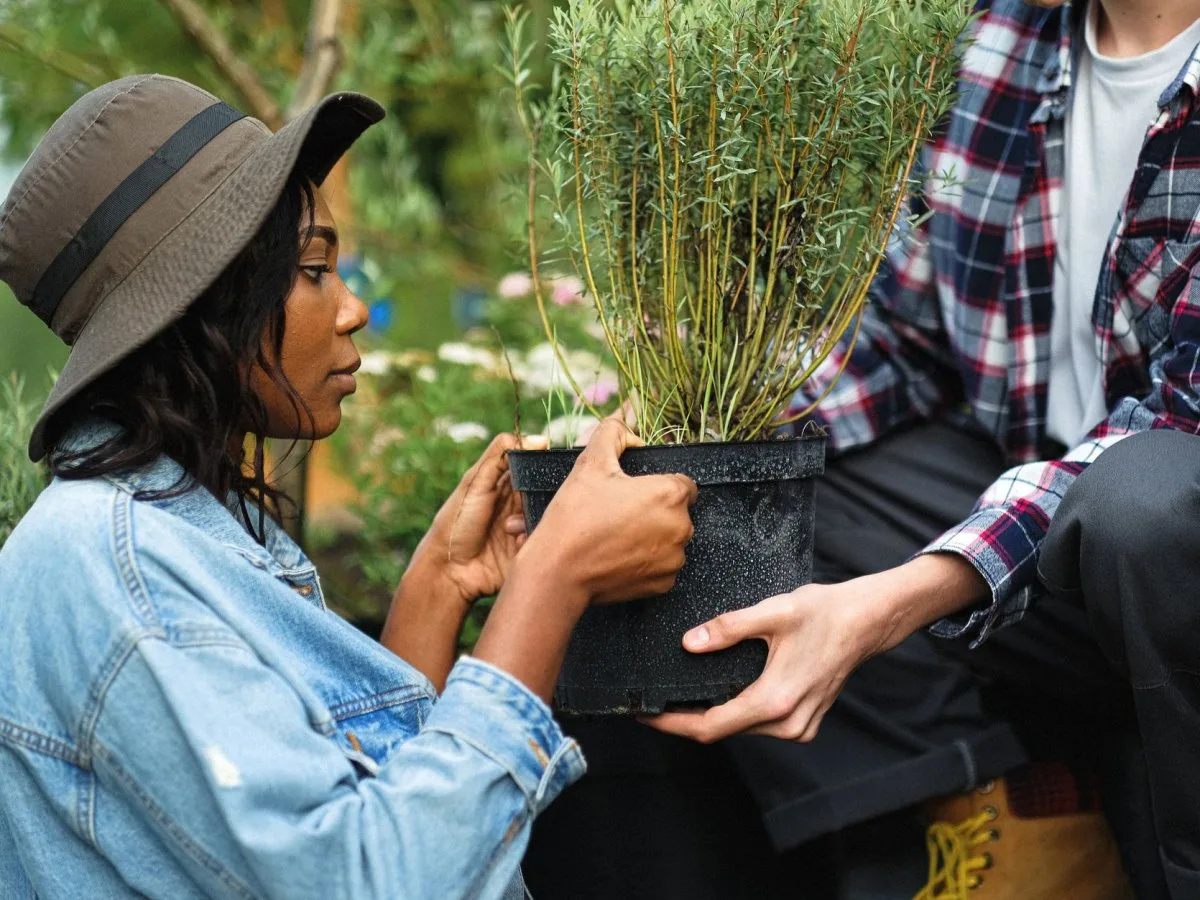
A garden can be a place to rest, but it can also express who has access to nature, which species are valued and how shared life is organised. This broad perspective is the starting point for Garden Futures, an exhibition devoted to the history and future of the modern garden. Its examples connect design, everyday culture and landscape architecture, ranging from outdoor furniture to community gardens, living buildings and vertical urban farms.
The exhibition invites us to see the garden not as a simple fragment of nature set apart from the city, but as a designed space. Its layout and plants express cultural ideas and practical decisions; they can also reveal political and commercial interests. From this perspective, gardening is not merely a private activity: its forms and meanings are connected to the social context in which they take shape.
From enclosed paradise to experimental space
Across cultures, the garden has represented an image of paradise or an enclosure protected from the outside world. This promise of calm exists alongside another history: since the late nineteenth century, gardens have also been understood as places for learning and recreation, while the garden city became part of urban-planning thought. Today, projects connected with urban agriculture and alternative energy production have joined them.
The exhibition brings together everyday objects and landscapes to show how these ideas take shape. An outdoor chair, for example, is not just functional: it contributes to an understanding of the garden as a place for leisure. On a different scale, a community garden raises questions about participation, shared use and food production. The garden thus appears along a continuum from object to domestic space to urban environment.
The histories that also grow in a garden
The image of a personal garden can obscure broader historical processes. Colonial trade helped bring tropical plants to Western gardens; in the nineteenth century, the Wardian case—a portable container for transporting live plants—made their global movement easier. This circulation expanded the plant trade, but it also contributed to the spread of invasive species and the weakening of monopolies over crops such as tea and rubber, benefiting colonial powers.
Gardens, then, are not outside politics or economics. They have also responded to scarcity and the need for self-sufficiency: vegetable gardens, for example, have played a role in times of war and deprivation. Aesthetic preferences, too, do not form in a vacuum; they can be influenced by the commercial promises made for garden tools, fertilisers and furniture.
This perspective changes the usual question about design. As well as considering what a garden looks like or how it is used, we can ask which histories have shaped its plants and models, who takes part in creating it and which interests it reflects.
Nine ways of imagining the landscape
The exhibition presents gardens and practices by makers from the twentieth and twenty-first centuries. Roberto Burle Marx worked with native plants and treated the garden as a landscape laboratory of volume, colour, texture and perspective. Piet Oudolf’s compositions are designed to remain engaging throughout the year. In the Vermont garden of writer Jamaica Kincaid, personal memory is linked with colonial history, repression and cultural appropriation.
Other examples show very different responses to the conditions of each place. Derek Jarman created an artistic garden on the Kent coast, on shingle described as inhospitable. In Kuala Lumpur, the community garden associated with landscape architect Ng Sek San represents grassroots initiatives in a major metropolis. Zheng Guogu’s Liao Garden takes the video game Age of Empires as an aesthetic reference, connecting virtual and real environments.
These are not examples of a single model that can simply be transferred from one place to another. What the projects share is that the garden functions as a form of expression: their makers articulate choices about nature, culture and space. The exhibition thus expands the understanding of gardening as a creative practice at the intersection of visual art, architecture and design.
From bounded plot to ecological system
The contemporary projects included in Garden Futures foreground biodiversity, social justice and sustainability. The formats on display include school and community gardens, vertical forests, floating gardens, rooftop greenhouses, food forests and urban farms. This variety matters: “garden” can describe very different spaces, not just a domestic plot with clear boundaries.
Some examples shift attention to ecological relationships. Pollinator Pathmaker, by Alexandra Daisy Ginsberg, is an artificial-intelligence programme designed to generate planting patterns that maximise feeding opportunities for pollinators. Taken together, these examples show different ways of exploring design in relation to biodiversity and urban environments, without reducing them to a single solution.
The exhibition presents the garden as a place to test ideas for a liveable future, but not as a guarantee that such a future will follow. Design can open up questions and possibilities; by itself, it cannot resolve the climate crisis, inequality or biodiversity loss. The most productive invitation is to consider what relationships each project proposes and who may benefit from them.
A day-to-day way of looking at gardens
Taking this perspective into everyday life does not mean confusing an exhibition with a gardening manual. It can begin with simple questions: which species and histories are present in a space? Who can enjoy or care for it? Is it only for leisure, or also for learning and growing food? What connections does it establish with its wider surroundings?
Taken together, Garden Futures presents the garden as a cultural construction and a design practice, as well as a vegetated space. Its value lies not in offering a universal recipe, but in showing how gardens can bring together memories, material choices and ideas about shared life. Imagining the whole planet as a garden that needs care is a metaphor for responsibility; turning it into action depends on concrete choices and on the social and ecological conditions of each place.
At a glance
Scope
Editorial reading; it does not constitute a visit or a technical assessment.
Sources and references
Garden Futures ↗24/10/2026
Garden Futures ↗24/10/2026
»Garden Futures« Programm zur Ausstellung ↗24/10/2026
Garden Futures: Designing with Nature ↗11/11/2026
Ausstellung: Garden Futures: Designing with Nature – Wüstenrot Stiftung ↗11/11/2026
Garden Futures: Designing with Nature | THE WORLD OF INTERIORS ↗11/11/2026
Garden Futures: Designing with Nature | Official Vitra® Online Shop NO ↗11/11/2026
Photograph · Photo by Anna Shvets on Pexels · Pexels License · Sources and references · Centred crop to 4:3, resizing and conversion to JPEG for House Angle.