





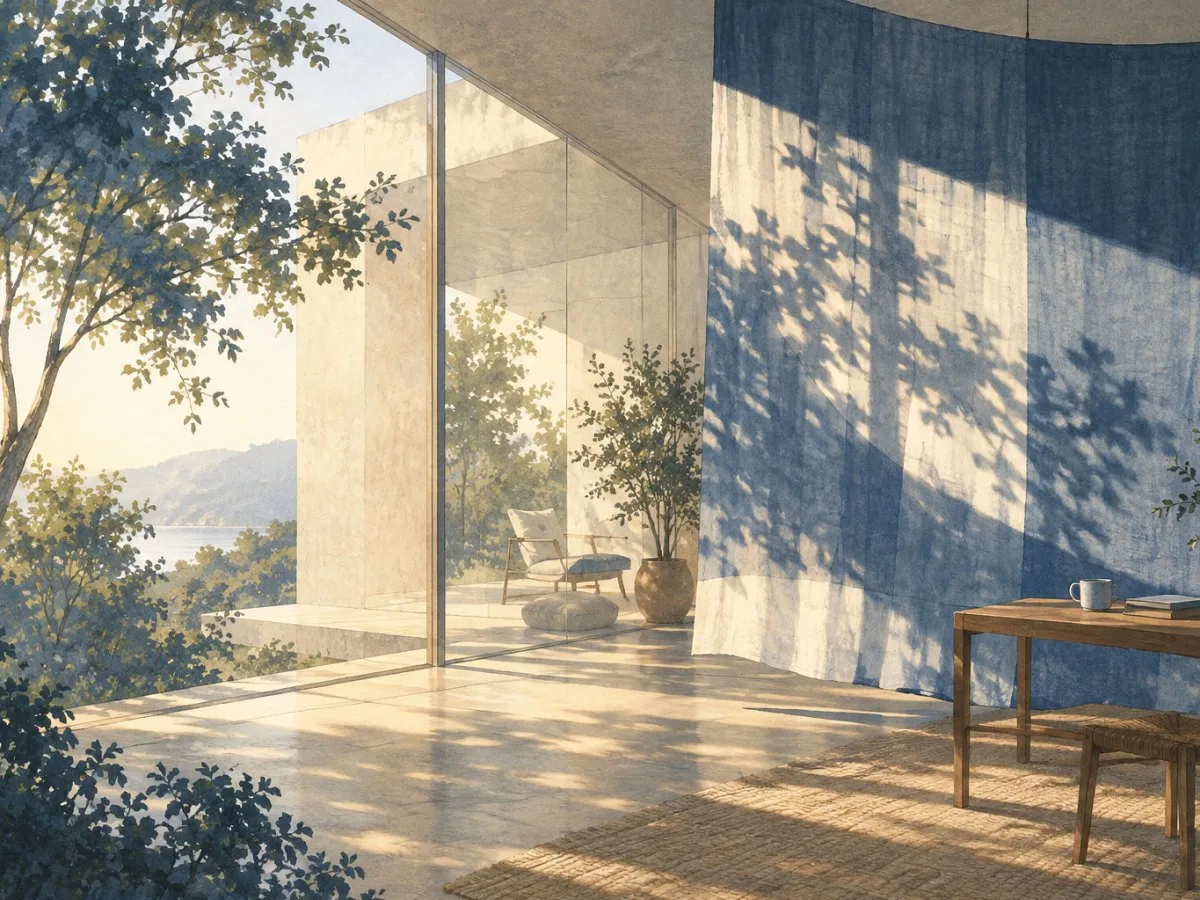
Light is not an addition to the Eames House: it is part of how the house is perceived. In Eames House: Impressions of Light, personal photographs and films by Charles and Ray Eames are brought into dialogue with James Clar’s installation Sunlight Filtered Through the Eames House. The exhibition invites us to see the building as a changing prism, where reflections, shadows, and textures make the space feel different as time passes.
A house designed to accompany life
The Eames House, also known as Case Study House #8, was part of the Case Study House Program, spearheaded by John Entenza from the mid-1940s. Charles and Ray Eames proposed a home for a married couple working in design and graphic arts, whose children no longer lived at home. Charles described their aspiration: “The house would make no demands for itself and would serve as a background for life in work, with nature as a shock absorber.”
The first scheme, known as the Bridge House, was designed by Charles Eames and Eero Saarinen in 1945 using prefabricated components. A shortage of steel delayed its construction. During the wait, Charles and Ray grew attached to the meadow and rethought the scheme: rather than impose the house on the site, they rearranged its components into two structures—the residence and the studio—integrated into the hillside. Construction began in 1949, and the couple moved in on Christmas Eve that year.
That history helps explain why an exhibition about light and landscape suits the character of the house. Its approach goes beyond presenting an isolated architectural object: it considers how the surroundings and everyday life shape the experience of the place. This is an interpretation of the relationship between the house’s history and the exhibition’s theme, not a technical assessment of the building.
The studio as a lens
Clar’s installation uses the studio itself as a lens to create large cyanotype banners. In the work, light passing through and transforming the space becomes an image: a process that condenses variations in light, shadow, and movement onto a surface. The result shifts attention from the building’s fixed form to the conditions that alter it.
The exhibition also revisits photographs and films by the Eameses, including House: After Five Years of Living (1955). By bringing records of life in the house together with a contemporary work, it proposes continuity between observing the space and reinterpreting it. The point is not that the house has one definitive appearance, but that its perception depends on light, materials, and landscape.
From fabric to paper
Clar’s work was made as cyanotypes on Philippine jusi fabric. The Eames Foundation presents two print editions based on the banners, with specifications and prices published on the exhibition page; amounts may change and should not be taken as confirmation of current prices:
| Edition | Run and format | Support | Published price (may change) |
|---|---|---|---|
| Washi | 75 signed prints, 22.5 × 50 inches | Awagami Inkjet Japanese washi paper | $2,000, excluding tax and shipping |
| Matte | 250 signed prints, 14 × 30 inches | LexJet Premium Archival Matte Paper | $250, excluding tax and shipping |
The first edition aims to preserve on paper the distinctive texture of the jusi banners; the second, to reproduce their blue tones. In both cases, the still image captures a work conceived around changing light. According to the edition information, proceeds support the house’s conservation and programming.
A place between architecture and experience
The Eames House was designed for a couple working in design and for a life in which work, play, objects, and nature could coexist. Clar’s installation extends this idea through perception: the studio is not only a workspace, but also a medium for capturing and transforming light.
In this way, the exhibition suggests a way to think about everyday architecture: not only as an arrangement of materials and forms, but as a relationship renewed between its inhabitants, what they do there, and the changing conditions of the surroundings. Light does not replace the structure; it makes its variations visible and turns the landscape into an active part of the experience.
At a glance
Scope
Editorial reading; this is not a visit or a technical assessment.