





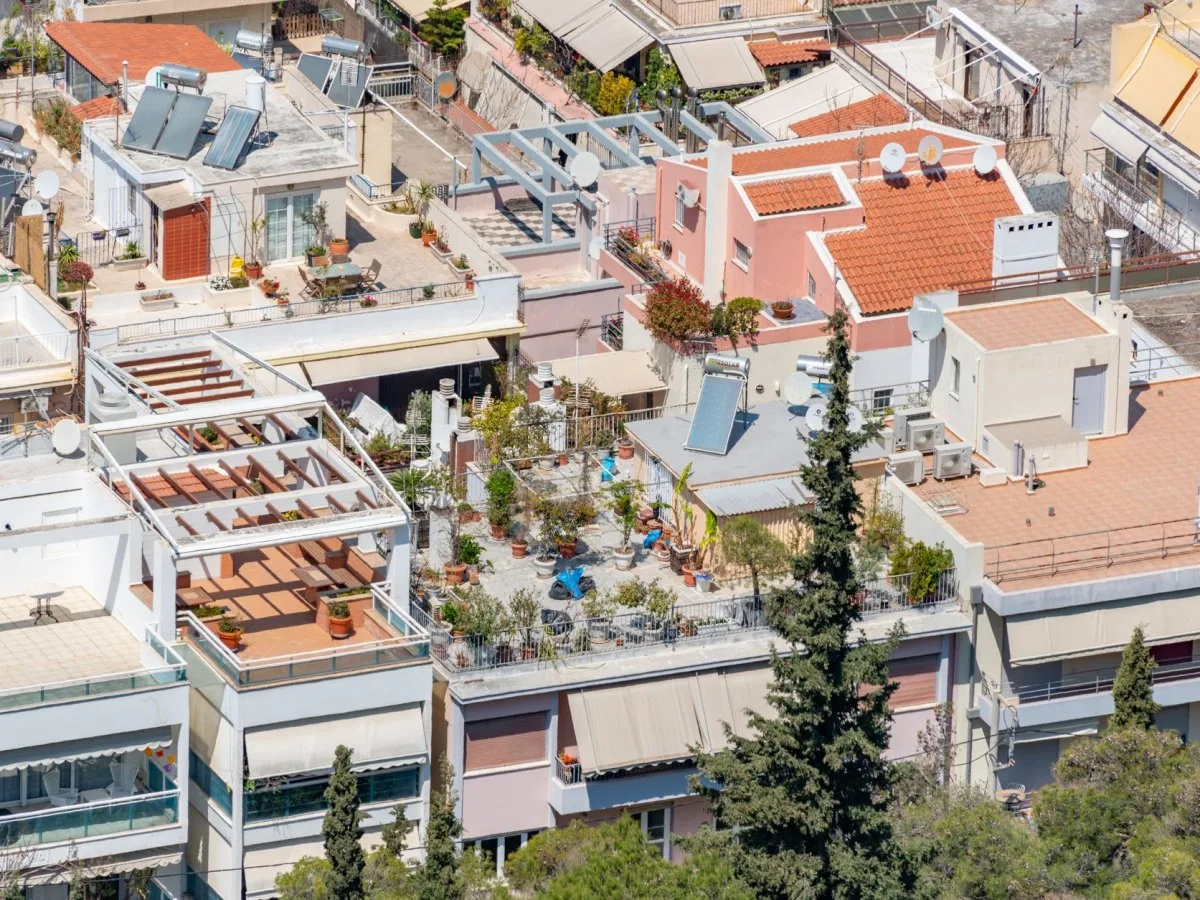
A balcony or rooftop can accommodate plants, but it is not simply a ground-level garden moved to a higher elevation. Wind, sun, rain and the building’s structure all affect what can work and how much care it will require. Thinking through these conditions first helps design decisions respond to the place rather than rely on an idealised image of abundant greenery.
Before choosing pots, understand the site’s limits
Weight is a central concern: containers, growing medium, plants and the people using the space all add load. Capacity varies by building and by the specific area of a roof or balcony; a surface should not be assumed to support any installation. Before planning changes, check whether permission is required and obtain an appropriate structural assessment. Complex projects may call for design and construction professionals.
Regulations also depend on the location and the property’s characteristics. In Lambeth, for example, the council says domestic green roofs do not normally require planning permission, but recommends seeking advice when a home is in a conservation area, is a listed building or is subject to a specific restriction. This is local guidance, not a rule that applies everywhere: requirements should be checked with the relevant authority.
These checks are not separate from the design process. They can determine whether a project is viable and what kind of intervention makes sense. Container placement, support systems and any alterations should respond to the roof’s actual conditions; it is not prudent to infer them from appearance alone.
Exposure shapes the garden, too
At height, sun and wind can be intense. A balcony beneath another level may also receive little rain. As a result, two spaces of similar size can offer very different growing conditions: the specific exposure, available shelter and ease of watering all matter.
Walls, railings and screens can provide protection, although a solid surface does not always reduce wind in a straightforward way: air can create turbulence on the other side. Latticework or mesh, which filters wind rather than blocking it completely, can be an alternative that creates a somewhat more sheltered environment. Any screen needs fixings appropriate to the site; its installation is also part of the structural checks.
Plant choices can work with these conditions. Options that tolerate sun and wind include some plants with small, narrow, hairy or waxy leaves, as well as certain alpines and low-growing bulbs. Dwarf pines, junipers and hardy evergreen shrubs can provide shelter or visual structure, while ground-cover plants occupy the strip closest to the ground. There is no universal combination: exposure and winter moisture can change what is suitable.
Containers, growing medium and water: connected choices
Wind and heat can dry containers quickly. A volume that accommodates roots and a material that limits moisture loss can be useful, but each choice has trade-offs. Large containers and wet growing medium also add weight; non-porous materials retain moisture better than terracotta, while some growing-medium mixes may be heavier than others. The balance depends on both plant needs and available capacity.
Drainage matters: containers need water outlets, and raising them can help prevent roots from sitting in waterlogged conditions. At the same time, excess irrigation needs an appropriate destination. In a larger area, an irrigation system may be an option; hand-watering allows greater precision but takes time. If the balcony is sheltered from rain, watering may be especially frequent.
Care continues after planting. Watering may be needed throughout the year except in freezing conditions; roots may need checking for congestion, and containers changed when necessary. Feeding, renewing the top layer of growing medium and pruning may also be part of maintenance. The amount of attention required depends on exposure, plants and containers: an elevated garden is not necessarily low-maintenance.
A design that starts with what is possible
Before imagining a complete arrangement, it is useful to observe which areas receive the most sun, where wind gathers, whether rain reaches the space and how water can be accessed. Options can then be considered in terms of the weight they add, the space they occupy and the care they require.
This approach does not make the project less ambitious. It allows shelter, pots and plants to be treated as parts of the same design, while distinguishing a green roof conceived as a building system from a collection of containers for growing plants on a balcony or rooftop. In either case, the most attractive solution will be the one that fits the actual conditions of the building and site.
At a glance
Scope
Editorial reading; it does not constitute a site visit or a technical assessment.
Sources and references
Photograph · Photo by Diego F. Parra on Pexels · Pexels License · Sources and references · Centred crop to 4:3, resizing and conversion to JPEG for House Angle.