





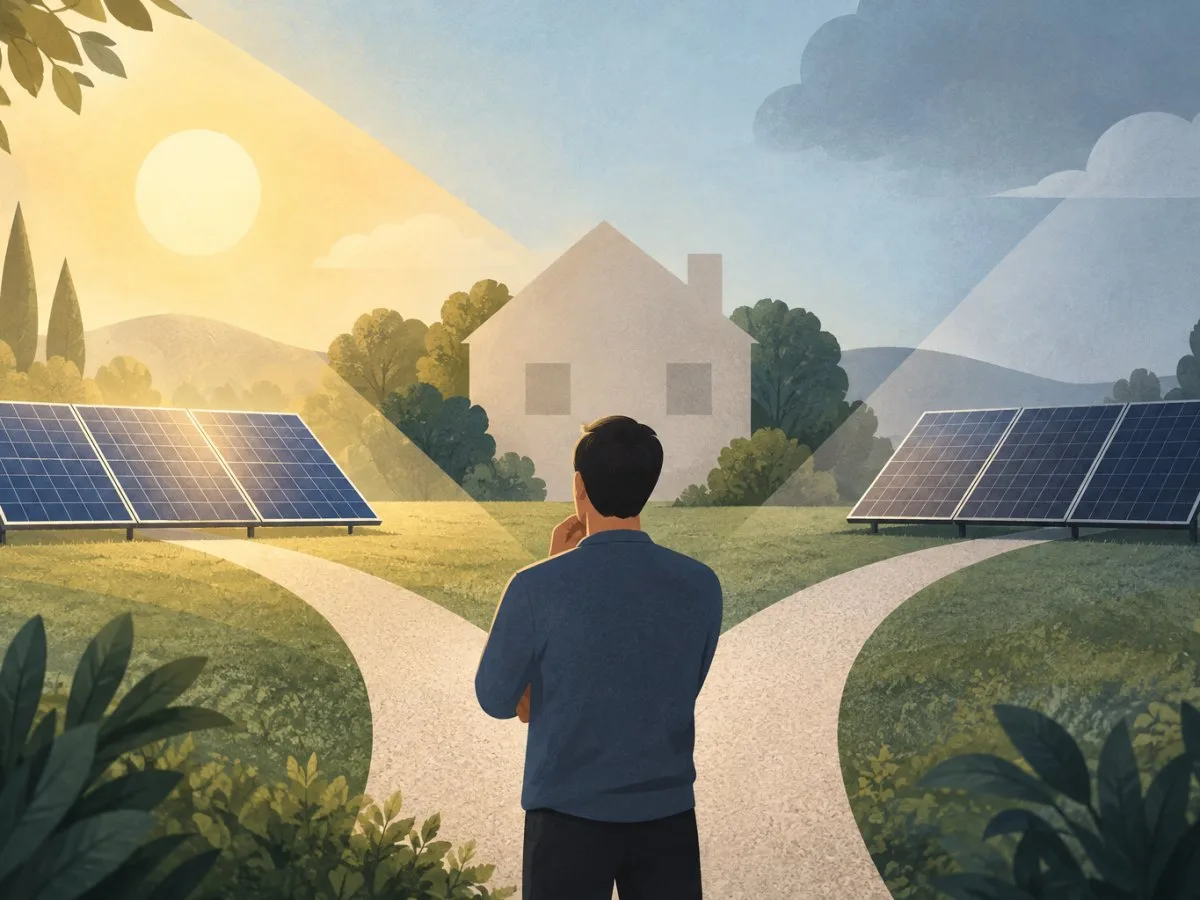
Choosing renewable energy for a home does not start with deciding how many panels to install. First, it helps to understand how much electricity the household uses, what efficiency improvements could reduce that demand, and which options fit the home, its ownership situation, and local rules. Solar photovoltaics are a common possibility, but they are not a universal solution and do not, by themselves, guarantee a lower electricity bill.
This guide helps organize initial decisions in the United States; it does not replace a professional assessment or checking state and local requirements. Grid-connection rules, electricity credits, and incentives vary by location and may change.
Start with energy use, not system size
Gather electricity bills from the past 12 months and look at both total use and seasonal variation. An annual average is a starting point, but it does not tell the whole story: heating, cooling, electric vehicles, usage schedules, and planned household changes can all affect demand.
Before sizing an installation, look for opportunities to use less energy. An energy audit can help identify losses and potential improvements, such as adding insulation, sealing air leaks, or replacing inefficient equipment. If a heating or cooling system is nearing the end of its life, it may also be useful to compare efficient alternatives, including heat pumps. Reducing demand can change the size and cost of an installation that would make sense.
Past energy use is not a promise of future use, either. If major changes are expected—for example, more occupants or new electric appliances—it is worth including them in conversations with anyone preparing a system assessment.
Which renewable options may be relevant?
Solar photovoltaics
Photovoltaic panels convert sunlight into electricity. They generate direct current; inverters convert it into alternating current for household use and the usual connection to the grid. Generation depends, among other factors, on the system’s characteristics and the sunlight it receives.
Solar can be installed on a roof or on a ground-mounted structure when space and rules allow. If the roof is unsuitable or someone does not own their home, community solar may be an alternative: multiple people participate in a shared installation, which may be located on or off their property. Availability and terms depend on the area and program.
Other technologies
Wind, geothermal, hydropower, and biomass are also renewable energy sources, but their relevance for a home depends greatly on location, the available resource, and the type of system. For example, a community option or a contracted supply arrangement may be more viable than installing equipment of one’s own. Concentrating solar power, by contrast, is used mainly in large power plants and is not a common residential technology.
Comparing options does not mean assuming that every one can be installed in every home. Ask what alternatives are available in your area and what they entail for the building, energy supply, and bill.
Assess the home and roof
The possible output of a residential solar system depends, among other things, on the roof’s orientation, pitch, shape, and size; shade from trees or other buildings; and local sunlight conditions. A south-facing roof is often favorable in the Northern Hemisphere, but other orientations may also work, depending on the circumstances. A map or estimating tool can provide an initial approximation, not replace a site assessment.
The roof’s age and condition matter, too. If it will need replacing soon, consider the timing before installing panels to avoid removal or additional work. A professional can assess the surface and determine whether repairs or other structural checks are needed.
Ownership and local restrictions are part of the assessment. If you rent, consult the owner before exploring an installation. If you belong to a homeowners’ association, condominium, or other residential organization, check the applicable procedures and your state’s rules: protections and restrictions vary. Zoning requirements or other limits may also apply to ground-mounted systems.
Decide how you want to use the grid and storage
Questions about grid connection and batteries should be raised before comparing proposals. With a grid-connected installation, the home can use available solar electricity and send excess power to the grid. How that electricity is credited depends on the utility and local rules; do not assume that each unit exported will be credited at the same value as a unit consumed.
Ask the electric utility what credit system operates in your area, who is eligible, what system sizes or equipment qualify, and how credits appear on the bill. Net metering and other mechanisms do not work the same way everywhere. Illinois rules, for example, should not be extrapolated to other states or to every utility in that state.
A grid-connected system normally stops supplying electricity during an outage unless it is designed with storage and equipment that allow it to operate safely without the grid. A battery can store some solar energy for later use, but it adds costs and does not automatically provide unlimited electricity during a blackout. Ask which loads the proposed system could back up, under what conditions and for how long, and whether it is designed for the operation you need.
An off-grid system requires careful planning to provide energy throughout the year and is not usually a straightforward solution for a home connected to public utilities. Its suitability depends on the location and household needs.
Compare proposals and terms, not just panels
Request several proposals based on an assessment of the home. To compare them, review each one’s estimated generation and assumptions, as well as the equipment, inverters, battery if included, warranties, maintenance, included work, and costs that might be excluded. Make sure the proposals address comparable goals and conditions; a larger system is not necessarily the better option.
Also consider how the project would be financed:
- Purchase: You pay for and own the system. The upfront cost may be substantial; responsibilities, benefits, and possible incentives depend on the rules in effect.
- Loan: Payments can be spread out, but review the interest, fees, term, security, and total cost—not just the advertised monthly payment.
- Lease or power purchase agreement (PPA): A third-party company usually owns the system. With a lease, you make agreed payments; with a PPA, you pay for the electricity generated under the contract. Read how payments are calculated, who receives incentives, what happens with maintenance and warranties, and how the agreement transfers if you sell the home.
Do not compare these options using a savings estimate that omits charges, possible rate changes, financing costs, or the value of exported electricity. Financial outcomes depend on consumption, actual generation, rates, contract terms, and applicable policies. Neither payback nor savings is guaranteed.
Tax incentives, rebates, and financing programs depend on the jurisdiction, eligibility, and date. Check current public resources and confirm details with the relevant authorities or a qualified tax professional before including them in a decision. Do not base a budget on a credit or grant mentioned in older material without checking whether it is still available.
Permits, grid connection, and choosing professionals
An installation usually requires coordination with the electric utility and local authorities. Before hiring a contractor, find out which building or electrical permits are needed, who will apply for them, and what interconnection process the utility requires. Requirements may vary by jurisdiction, mounting type, and system.
Get written proposals from several qualified installers. Ask about relevant experience and credentials, references, insurance, warranties, and who will be responsible for each stage. Read the contract, schedule, financing terms, and assumptions used to estimate generation carefully. Be wary of pressure to sign immediately or promises of results that are not backed by clear terms.
Do not try to design the electrical system or connection yourself. Assessments and work must comply with local codes and be carried out by qualified professionals. Also confirm what inspections are required and who will verify that they are complete before final connection.
A qualitative comparison to get started
Imagine two households without assigning them production or savings figures. At one, the roof receives little shade, is in good condition, and the owner expects to remain in the home. At the other, the roof needs repairs, there is significant shade, or the resident rents. In the first case, it would make sense to request an assessment for rooftop solar and compare options with and without a battery. In the second, it would be sensible to first review the roof’s condition and permits, talk with the owner, or consider whether community solar is available. Neither scenario alone determines financial viability: local data and specific contract terms are needed.
A short checklist before deciding
- Review 12 months of bills and planned changes in energy use.
- Identify efficiency improvements that could reduce demand first.
- Check the roof’s orientation, shade, condition, and replacement schedule.
- Decide whether your goal is to reduce electricity purchases, have backup during outages, or both.
- Ask the electric utility and local authorities about credits, grid connection, and permits.
- Compare several proposals, their assumptions, total costs, warranties, and financing.
- Verify current incentives and requirements before including them in your calculations.
- Make sure you understand who owns the system and what happens if you sell or move.
Public resources for further information
- The U.S. Department of Energy: Homeowner’s Guide to Solar brings together initial questions about suitability, generation, grid connection, storage, and financing.
- The U.S. Energy Information Administration: Photovoltaics and electricity explains how photovoltaic cells convert light into electricity and how they are grouped into panels and systems.
- For questions about energy use, roofs, permits, and grid connection, consult your electric utility and authorities in your state, county, or city. Rules in one place do not necessarily apply elsewhere.
Public tools can help you formulate questions and obtain preliminary estimates; they do not replace an assessment of a specific home or a review of current contract terms and regulations.
At a glance
nexo id
163
Sources and references
https://www.energy.gov/cmei/systems/homeowners-guide-solar ↗15/11/2026 U.S. Department of Energy, “Homeowner’s Guide to Solar”
https://www.eia.gov/energyexplained/solar/photovoltaics-and-electricity.php ↗15/11/2026 U.S. Energy Information Administration, “Photovoltaics and electricity”
Energía limpia en casa: cómo evaluar el consumo y una instalación solar ↗15/11/2026 Illinois Extension, “Homeowner’s Guide to Solar Energy”