





A company that extends beyond the catalogue
Project Vitra posed a useful question for thinking about design: where does a product end, and where does the environment that gives it meaning begin? Presented in 2017 at the Vitra Campus Fire Station in Weil am Rhein, the exhibition explored the company’s history from a perspective connecting furniture, architecture, communication and culture. It was an expanded version of an exhibition shown at the Philadelphia Museum of Art in 2014.
The story began with Vitra’s origins as a shopfitting company. The name, as the exhibition description explains, derives from vitrine, the French word for “display case.” It then traced the family company’s development and Willi and Erika Fehlbaum’s meeting with Charles and Ray Eames in 1957, which led to a partnership that became decisive in the company’s history.
The campus as part of the story
Architecture was not treated as a backdrop separate from the objects. The campus brought together buildings designed by different architects and, in the exhibition’s account, functioned as a physical expression of the company. Its landmarks include the Vitra Design Museum, designed by Frank Gehry; the Fire Station by Zaha Hadid; the Conference Pavilion by Tadao Ando; a petrol station designed by Jean Prouvé; and the VitraHaus by Herzog & de Meuron, made up of house-shaped elements stacked on top of one another.
This diversity allows the campus to be read as a collection of architectural responses rather than as an ensemble governed by a single appearance. The site’s development supports that interpretation: after the 1981 fire destroyed much of the factory facilities in Weil am Rhein, Nicholas Grimshaw prepared a master plan for development. Later, the idea of a homogeneous ensemble gave way to a more plural composition, associated with the company’s encounter with Gehry.
The exhibition also connected architecture with interior life. Alongside historical pieces, it included the development of the Vitra Home Collection and concepts related to the home, the office, public spaces and retail. Design could therefore be understood not only as the form of a chair, but also as the arrangement of the spaces where people live and work.
Classics, new proposals and memory
The history presented did not stop at classic furniture. Vitra continued to develop products with designers such as Antonio Citterio, Jasper Morrison, Hella Jongerius, and Ronan and Erwan Bouroullec. The exhibition grouped these themes with architecture, communication, contemporary products, Vitra Edition and the company’s museum institutions.
The Vitra Design Museum and the Vitra Schaudepot held an important place in this network. The modern furniture collection that prompted the museum’s creation also led to the organisation of exhibitions, the publication of catalogues, the gathering of archives and the production of objects connected with the exhibitions. Part of the collection is displayed in the Schaudepot. The museum, then, was not simply a container for objects: its exhibition and documentary work formed part of how Vitra built a public relationship with design.
An exhibition assembled as a collage
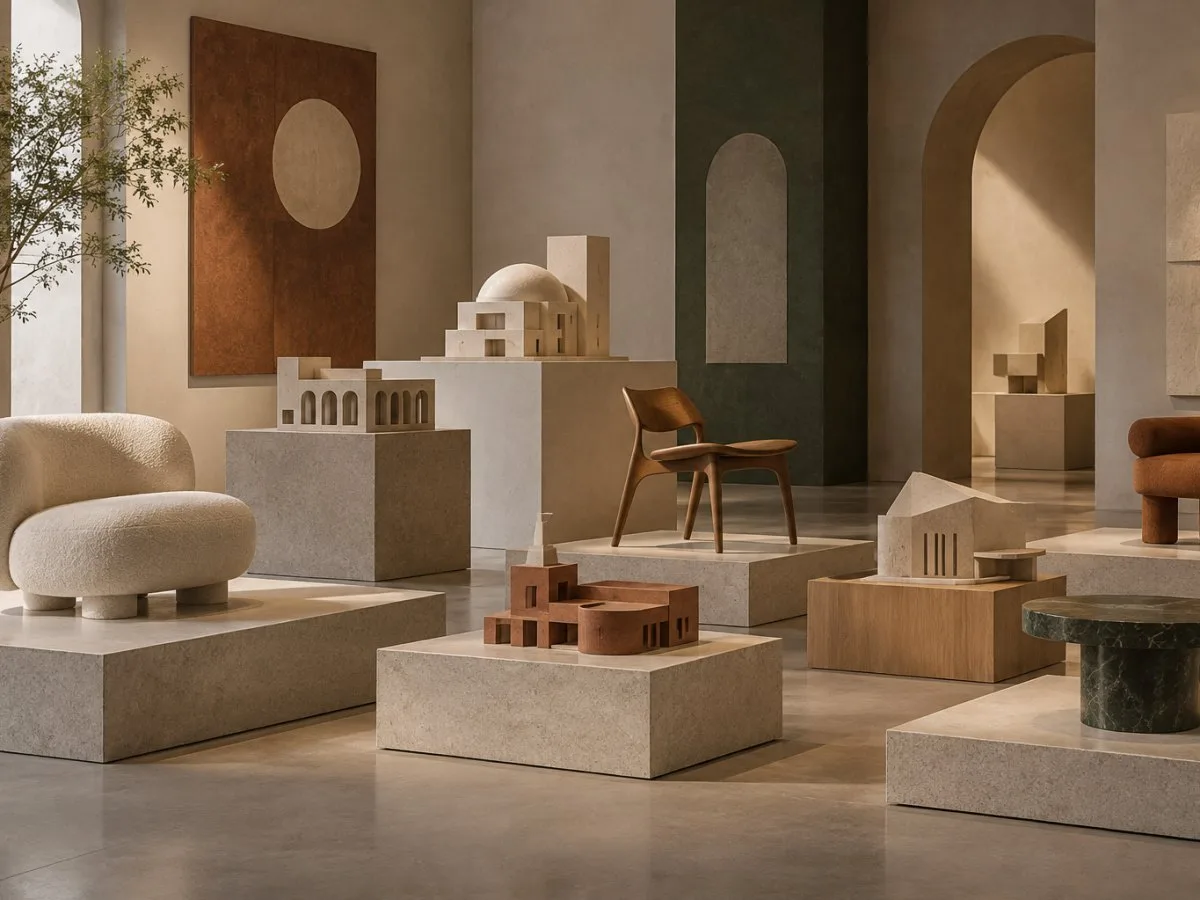
The exhibition’s form reflected the breadth of its subject. Products and objects shared space with historical materials, photographs, drawings, graphics, films and models. Rather than reducing the company’s history to a chronology of product launches, the collage brought different scales into relation: the object, the interior, the building and the cultural institution.
That structure also invites a critical reading. The variety can be difficult to organise: a company, an architectural campus, a museum and a furniture collection are not the same thing, even when presented here as connected parts of a project. The exhibition proposed this connection as a corporate identity; its value for visitors lay in being able to observe how that identity is constructed and where its components intersect.
Project Vitra was a temporary exhibition that opened in March 2017. Its interest today lies in the question it brings together: how can design take part in everyday life through objects, interiors, buildings and spaces for knowledge, without those dimensions losing their distinctness?
At a glance
Scope
Editorial reading; this is not a site visit or a technical assessment.
Sources and references
Project Vitra – Design, Architecture, Communications ↗26/10/2026 Vitra Design Museum, “Project Vitra – Design, Architecture, Communications”
Project Vitra | Official Vitra® Website UN ↗26/10/2026 Vitra, “Project Vitra”
2017 Projekt Vitra | Official Vitra® Website LP ↗26/10/2026 Vitra, “2017 Projekt Vitra”