





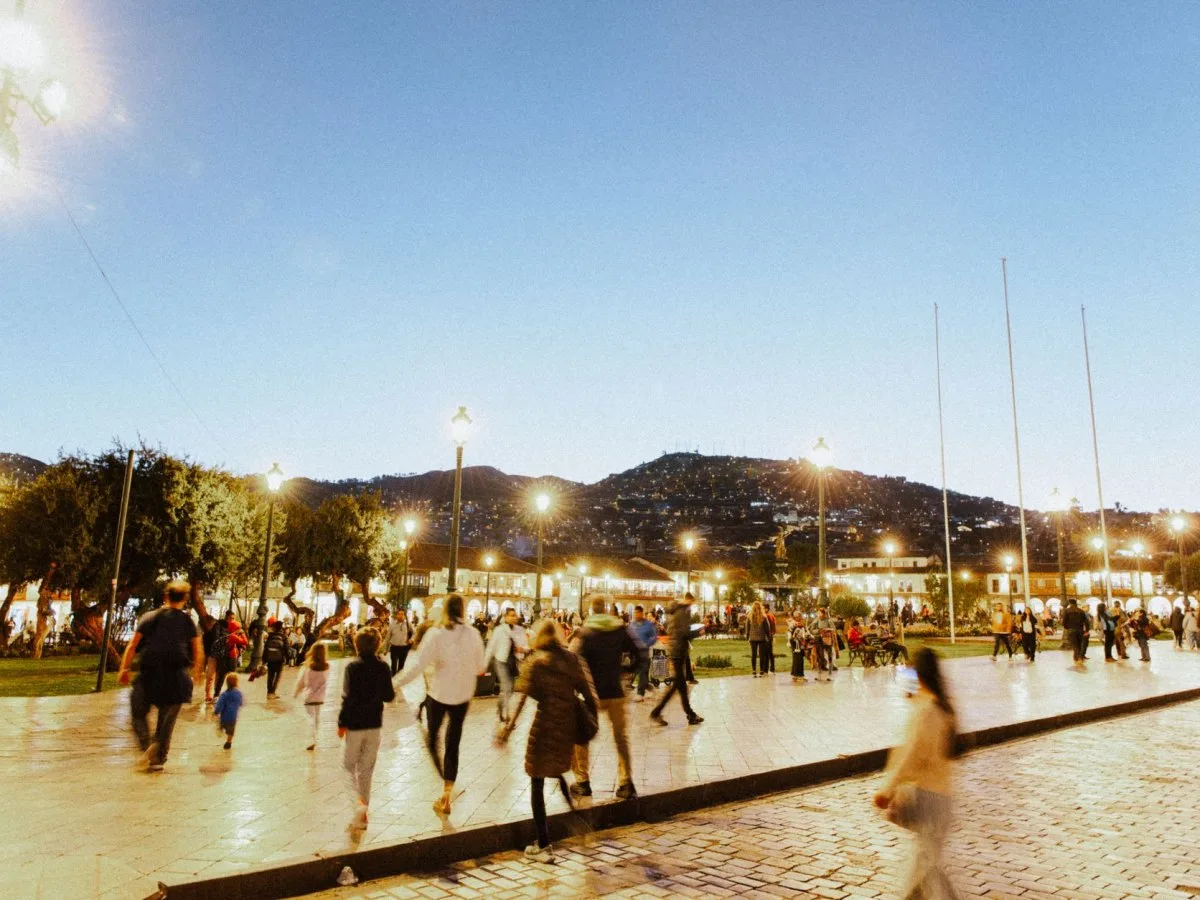
A park, a street or a square is more than a place between buildings. Each is part of a city’s everyday infrastructure: a space where people meet, economic activities take place and access to services becomes possible. From this perspective, public space is not a backdrop to urban life but a condition for the city to function more equitably.
Established in 2012, UN-Habitat’s Global Public Space Programme works with local governments to support safe, inclusive, connected and environmentally sustainable spaces. Its approach brings together assessment, planning, design, participation and management. This offers a useful way to understand everyday spaces: a place’s quality depends not only on its appearance, but also on who can use it, how it relates to its surroundings and what possibilities it offers over time.
A network of places, not a collection of projects
Streets, sidewalks, cycling lanes, squares, parks, waterfront promenades, gardens and courtyards can all be part of a city’s public spaces. Considering them together broadens the view beyond any single project. A square may feel welcoming, but its connections to nearby streets, walking routes and other spaces shape how it fits into everyday life.
The programme links local interventions with broader urban strategies and policies. Its stated aim is to support networks of public spaces and long-term planning frameworks, as well as contribute to national policies. The work involves local governments and civil society organizations, alongside academic and private-sector actors in the global network.
This network approach also makes continuity important: designing or renewing a space is only part of the work; its management and maintenance help sustain it. Management and maintenance frameworks are among the areas in which the programme provides support, although the available information does not describe a single model suited to every city.
Four intersecting dimensions
In 2024, the programme’s reported initiatives were organized around four areas: climate resilience, economy and livelihoods, social inclusion, and crisis response. These are not separate from urban form. An intervention in a park, street or market can affect several dimensions at once, although results depend on the local context.
- Climate resilience: Public space is considered part of urban responses to climate impacts. The programme’s documentation identifies this as an area of work but does not specify comparable climate outcomes for each project.
- Economy and livelihoods: Markets and other places of activity can support local exchange and opportunities. The 2024 report includes the revitalization of markets among the types of intervention.
- Social inclusion: Safety, accessibility and the opportunity to participate in design are part of the programme’s aims, with particular attention to vulnerable groups.
- Crisis response: Public spaces are also approached as elements of integrated urban solutions in crisis situations.
This combination matters because urban needs overlap. In informal settlements, for example, the 2024 report connects public spaces with organizing urban growth, improving liveability, delivering services, supporting livelihoods and building climate resilience. An intervention, then, is not understood only as a visual improvement: it can also relate to how a neighbourhood connects and functions.
Participation as part of design
The programme describes participatory tools and support for local governments in assessments, strategies, design principles and management frameworks. In this approach, participation is not a decorative add-on: it can help ensure that the priorities of people who use a space inform how a project is defined.
However, the existence of a participatory method does not, by itself, establish that everyone is represented or that their needs translate into outcomes. Assessing a particular case would require knowing who participated, which decisions they could influence and how agreements were maintained. The general information available here does not detail those points.
What the figures show—and what they do not
The 2024 report states that the programme operated in 13 countries and that its initiatives benefited more than 70,000 people that year. It also says the interventions included regenerating neighbourhood parks and streets, as well as revitalizing markets and civic spaces.
The programme page presents other cumulative figures and figures from earlier periods. For example, it reports support for more than 150 public spaces in over 100 cities since 2012, alongside measures of participation and access. The Global Public Space Network page gives a different count: 151 projects in over 100 cities, with a stated impact on more than 2.72 million people over the decade it describes. These figures refer to different pages and reporting snapshots; they should not be added together or treated as a single statistical series.
The figures describe reach, but they are not enough to compare the quality of spaces or attribute urban change to a single intervention. A local evaluation would require site-specific information about the place, its users, accessibility, maintenance and outcomes observed over time.
From a place to the right to the city
At the World Urban Forum held in Cairo in 2024, public space was presented as a practical entry point for advancing the New Urban Agenda and the Sustainable Development Goals. The 2024 report also links access to public space with access to adequate housing, land and basic services.
That connection changes the scale of analysis: an accessible sidewalk, a nearby park or an active market does not replace housing and service policies, but each forms part of how the city is experienced. The challenge is to connect decisions about specific spaces with the broader conditions that allow people to use them safely and equitably.
Looking ahead to its Strategic Plan 2026–2029, the programme says it aims to take on a more catalytic and connective role, strengthen local ownership, expand partnerships and consolidate global knowledge. The underlying idea is both simple and demanding: public spaces work better as urban infrastructure when they are planned as a network, shaped with attention to their users and sustained beyond the initial construction work.
At a glance
Scope
Editorial reading; this is not a site visit or technical assessment.
Sources and references
Global Public Space Programme: UN-Habitat’s initiatives towards safe, inclusive and accessible green and public spaces for all | UN-Habitat ↗26/10/2026 Global Public Space Programme: UN-Habitat’s initiatives towards safe, inclusive and accessible green and public spaces for all — UN-Habitat, report on activities in 2024, published in 2025.
Global Public Space Programme | UN-Habitat ↗26/10/2026 Global Public Space Programme — programme description, approach and reach figures.
Global Public Space Network | UN-Habitat ↗26/10/2026 Global Public Space Network — definition of public space and description of the global network.