





A life alongside design
In 2018, fifty years after the Panton Chair was first presented to the public, Marianne Panton recalled her life with Danish designer Verner Panton and the chair’s journey. Born in Sweden, she grew up on a farm and met Verner in Tenerife in 1962, while recovering from an accident. He was on holiday, though, as Marianne recalled, he still carried paper and pencil for drawing.
Marianne recalled that she and Verner travelled around Europe—including places such as Milan and Cannes—in search of a manufacturer. The proposal was difficult to accept because its shape departed from the conventional image of a chair. In her recollection, some people thought it looked more like an amoeba than a seat.
From idea to manufacture
Around 1956, Verner Panton began exploring the idea of a cantilevered chair made from a single piece; some sketches from around 1957 clearly anticipate the design. A full-scale polystyrene model helped him explore the shape and look for a manufacturer, but it was not suitable for sitting and was not the final design.
The collaboration with Vitra began in the 1960s. The chair was presented to the public in August 1967, and a small series was produced that year using cold-pressed, glass-fibre-reinforced polyester. Mass production using rigid polyurethane foam began in 1968. The process made it possible to produce more units, although it still required laborious manual finishing.
Later changes show that the object’s history was not simply a matter of turning a drawing into a finished product. The version made from thermoplastic polystyrene, produced from 1971 to 1979, facilitated injection moulding. However, the technical limitations of the time required changes to the profile and the addition of reinforcing ribs. The material proved less resistant to ageing and weathering than expected, and production was discontinued in 1979.
Vitra resumed production in 1990 with rigid polyurethane foam. In 1999 it introduced a polypropylene version developed together with Verner Panton. This chronology makes it possible to understand the chair as a design that evolved with industrial capabilities, rather than as a form that remained unchanged from the first sketch.
A curve that defines a space
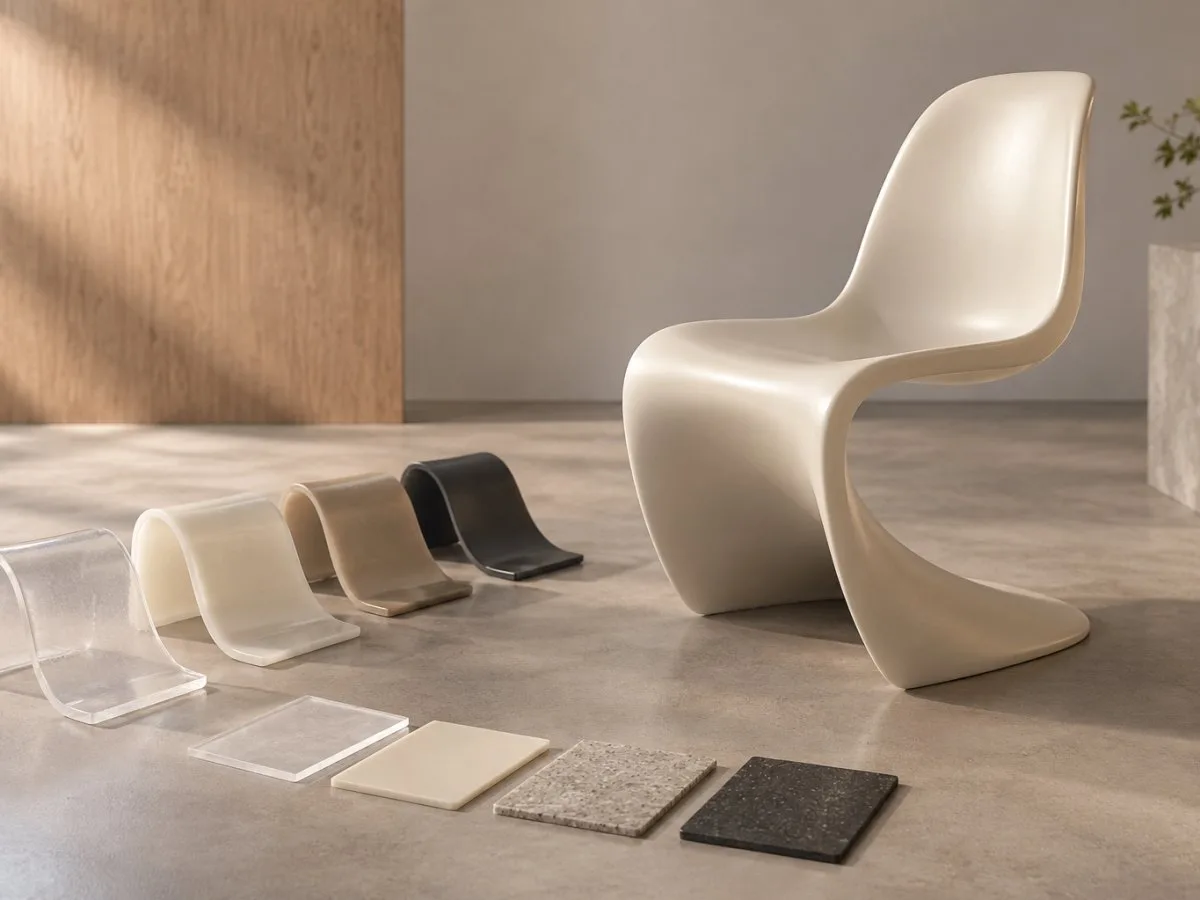
The Panton Chair is recognisable by its continuous S-shaped silhouette: the back, seat and base form a visually unified piece. This continuity allows it to be read both as a seat and as a sculptural volume. The lower section arches backwards, leaving space for the sitter’s legs and contributing to the stability of the base.
Its visual simplicity conceals a negotiation between formal intention and manufacture. The piece had to retain a slender profile while meeting the demands of production and use. The different versions and their changes in contour reflect this tension. Innovation lay not only in using plastic, but also in finding a way to produce a one-piece chair without giving up its characteristic curve.
In an interior, its continuous profile can stand out against furniture made of separate components; colour can make it an accent or help it blend into a more restrained composition. These are possibilities for visual interpretation, not a guarantee of how it will work in every space.
An idea sustained through collaboration
The chair’s journey also highlights that design does not depend solely on the person who conceives a form. Marianne recalled that Verner found an interested partner in Willi Fehlbaum of Vitra. Later, Rolf Fehlbaum visited Panton, saw a prototype and called Manfred Diebold, the head of product development, to meet him. Marianne recalled that Rolf had found the chair on the Pantons’ terrace; Vitra’s account does not specify where he saw the prototype.
Manufacture involved testing, changes of material, adjustments to the form and an interruption. The journey is a reminder that an iconic object does not emerge from a striking idea alone: it also depends on partnerships, technical resources and decisions about which characteristics to preserve as production methods change.
The history of the Panton Chair offers a concrete way to look at everyday design: to consider its form, as well as the conditions that make it possible to manufacture and keep it recognisable over time.
At a glance
Scope
Editorial reading; it does not constitute a site visit or a technical assessment.
Sources and references
Marianne Panton | Official Vitra® Website UN ↗11/11/2026 Jochen Overbeck, “Please, Have a Seat,” interview with Marianne Panton, originally published in Icon; Vitra, 2018.
Panton Chair - Verner Panton - Official ↗12/11/2026
Panton Chair | Official Vitra® Website LP ↗12/11/2026 �Panton Chair,” Vitra.
Panton Chair | Official Vitra® Website UN ↗12/11/2026
Panton Chair | Panton, Verner - Explore the Collections - V&A ↗12/11/2026 �Panton Chair,” Victoria and Albert Museum.