





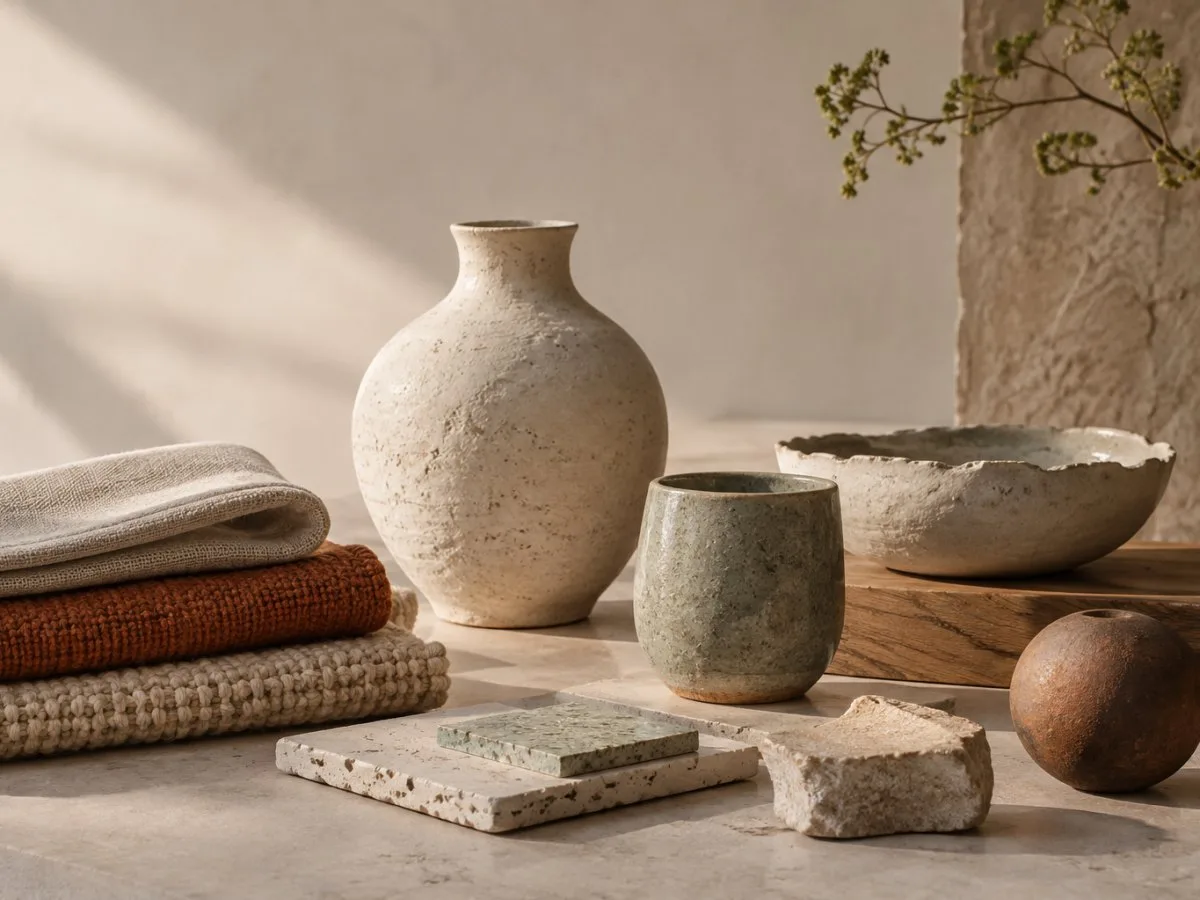
Objects are not neutral
A chair, a textile, or a vessel does more than occupy space. Its making involves materials, labour, and decisions; its use, in turn, forms part of habits and relationships. Dutch designer Hella Jongerius invites us to pay attention to these less visible dimensions: to read objects for clues about how they are made, what resources they draw on, and what value we assign to them.
This perspective does not present design as an automatic solution to social or environmental crises. It places design within them: designers take part in systems that can contribute to these problems and therefore also bear responsibility for imagining other ways of producing and living.
Between craft and industry
Jongerius’s career spans disciplines including furniture, textiles, ceramics, lighting, and sculpture. Her work brings research and intuition together with hands-on experimentation and industrial contexts. The point is not to resolve this tension once and for all, but to make it visible: materials and traces of the process can tell us as much as the finished object.
The retrospective Hella Jongerius: Whispering Things, presented by the Vitra Design Museum from 14 March 2026, brings together more than 400 works and documents across four themed galleries. It includes furniture, textiles, ceramics, sketches, prototypes, and films. The selection traces a path from early works associated with Droog Design to projects made with companies and institutions, and reveals processes that often remain behind the finished product.
In one gallery, samples, prototypes, and correspondence show how authorship, material integrity, and responsibility are negotiated within commercial frameworks. In another, colour and textile studies focus on observation and experimentation. The exhibition also presents works such as Angry Animals, which raise questions about coexistence between species and the capacity of objects to express relationships that usually go unnoticed.
Value is not limited to price
Jongerius challenges an understanding of value reduced to economic terms. From this perspective, deciding what to produce is not only a matter of the market: it also involves judgements about labour, resources, and durability. The designer connects this reflection to the idea of a “slow revolution”: changes that may emerge in small communities and in spaces away from the centre of established systems.
This is not a promise that objects alone can transform the conditions of production. It is an invitation to consider what practices, relationships, and forms of care might sustain broader change. Research into materials and their cycles, as well as attention to imperfection and to what might have a life afterwards, offers concrete questions for this reflection—not a universal formula.
Looking more closely at the everyday
The phrase “whispering things,” which gives the exhibition its title, points to a way of approaching design: observing the clues left by materials, techniques, and uses. The Jongeriuslab archive, acquired by the museum in 2024, brings together objects, prototypes, experiments, material tests, sketches, and documents. Together, they help convey a practice grounded in research and revision, not just the presentation of finished results.
For anyone moving through a home, office, or public space, this attention can take the form of simple questions: What materials are here? What labour and decisions remain hidden? How are things used and cared for? What happens to them when they no longer serve their original purpose? These are not criteria for issuing a verdict on every object, but ways to broaden our view beyond appearance or novelty.
Jongerius argues that design needs closer dialogue with philosophy, sociology, and politics. Her approach shifts attention from the isolated object to the relationships that make it possible: between people and materials, production and use, value and time. At this everyday scale, listening to things means considering not only what they offer us, but also the stories and responsibilities they carry.
At a glance
Scope
Editorial reading; it is not a visit or a technical assessment.
Sources and references
About responsibility, materials, and the quiet power of things | Official Vitra® Online Shop ES ↗17/11/2026 About responsibility, materials, and the quiet power of things, Vitra.
Hella Jongerius: Whispering Things ↗18/11/2026 Hella Jongerius: Whispering Things, Vitra Design Museum.
Online Collection Vitra Design Museum ↗18/11/2026 Hella Jongerius Archive, Online Collection, Vitra Design Museum.
Hella Jongerius: Whispering Things – Vitra Design Museum Shop ↗18/11/2026 Hella Jongerius: Whispering Things, Vitra Design Museum Shop.