





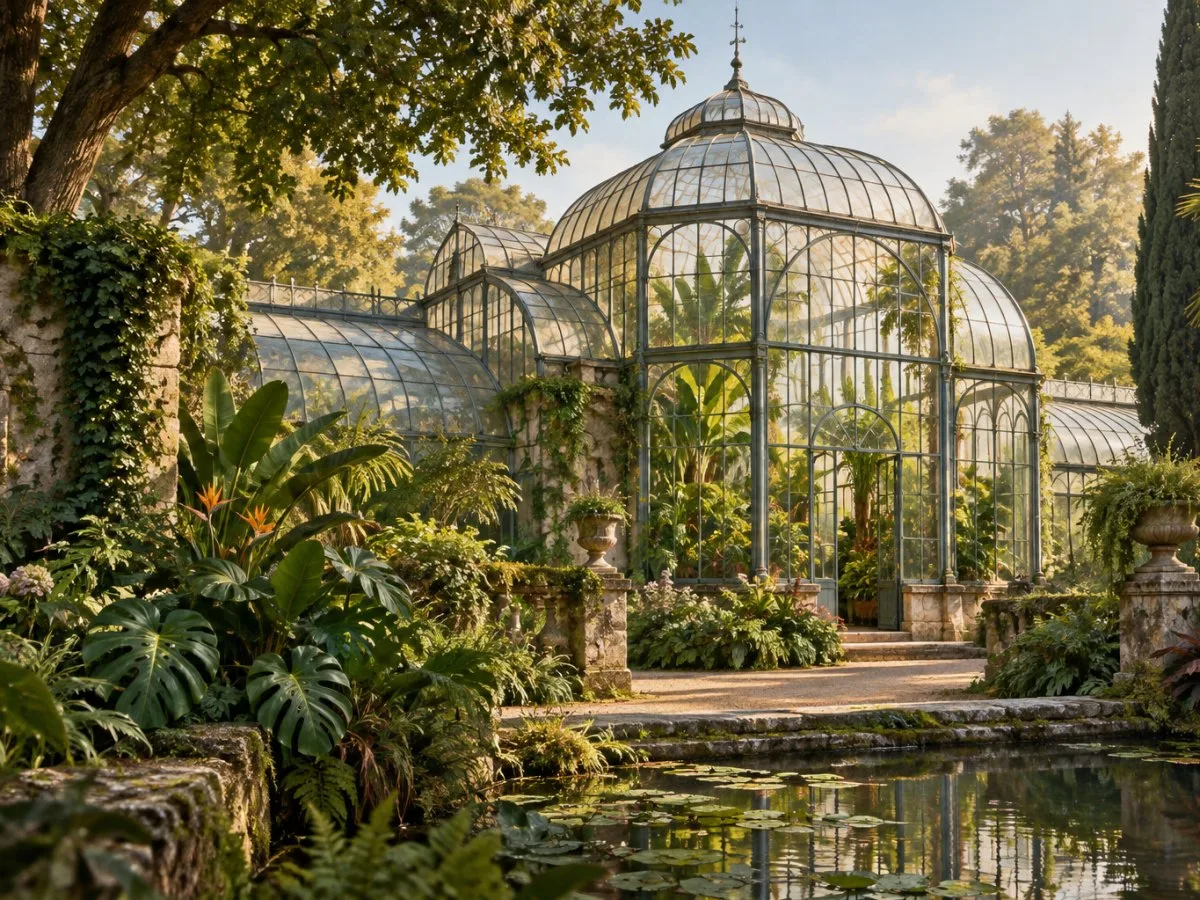
A garden shaped by layers of history
Kew is a historic landscape garden in which landscape, architecture and botanical collections have developed over time. Established in 1759, it includes features that illustrate significant periods in the art of gardens from the 18th to the 20th centuries. The grounds also reflect the history of earlier royal gardens: the layers of the site do not belong to a single moment of origin.
The Great Pagoda, designed by William Chambers in 1762, is one of the buildings within this landscape. There are also iron-and-glass houses, including the Palm House and the Temperate House, alongside plant collections and buildings from different periods. Considered together, these elements bear witness to developments in garden art and botanical science.
The Palm House: architecture for tropical plants
Designed by Decimus Burton and built by Richard Turner, the Palm House was constructed between 1844 and 1848 and completed in 1848. Its curved iron-and-glass structure was built on an ambitious scale using techniques drawn from shipbuilding; its silhouette may recall the hull of an upturned ship.
The building houses more than 1,000 species of tropical and subtropical plants, many of them threatened in the wild. The relationship between its structure and collections shows that the glasshouse is not simply an architectural form, but also a built environment for plants from tropical regions.
The Palm House was created to protect and study tropical plants gathered during the expansion of the British Empire. Today, Kew scientists use it as a living laboratory to study and conserve species from around the world. The building’s history therefore encompasses both its botanical function and the historical context of the collecting networks that helped shape its collections.
The Palm House remains open ahead of its planned 2027 renovation. Horticultural staff have begun moving plants in preparation for the conservation work, so the space may change during this process.
Conserving the garden as heritage
Kew brings together features from different periods, including Queen Charlotte’s Cottage, ornamental temples, glasshouses, ponds and botanical collections. The gardens developed from a royal retreat and pleasure ground into a national botanical and horticultural garden, and later became a modern institution connected with conservation ecology.
The site’s heritage is not limited to individual buildings. UNESCO’s assessment includes the landscape and its historical features in its description of the ensemble, and notes that development outside the property’s Buffer Zone may threaten its setting. This helps explain why conserving a historic garden also involves attention to its wider landscape context.
Reading the relationship between space and knowledge
One way to read Kew is to consider how its landscape, buildings and collections relate to one another. The Great Pagoda serves as an architectural landmark; the glasshouses house living collections, while preserved botanical material and documents form part of the garden’s scientific history. This relationship is an interpretation of the ensemble, not an account of a particular visit.
That reading raises a useful question for thinking about everyday spaces: how can a place foster an encounter between experience, knowledge and care without reducing nature to decoration? Kew offers a historical example, not a universal formula. Its collections include living plants, preserved plants and documents; its buildings reflect different periods and functions. Part of its interest lies in how these layers can be considered together without reducing them to a single image of harmony.
At a glance
Scope
Editorial reading; this is not a visit or a technical assessment.
Sources and references
Royal Botanic Gardens, Kew ↗25/10/2026 UNESCO World Heritage Centre, Royal Botanic Gardens, Kew.
Royal Botanic Gardens, Kew ↗25/10/2026
Royal Botanic Gardens, Kew ↗25/10/2026
Royal Botanic Gardens, Kew ↗25/10/2026
Royal Botanic Gardens, Kew ↗25/10/2026
Art and Architecture trail | Kew ↗11/11/2026 Royal Botanic Gardens, Kew, Art and Architecture trail.
Visit Kew's Palm House ↗12/11/2026 Royal Botanic Gardens, Kew, Visit Kew’s Palm House.
Royal Botanic Gardens, Kew, Non Civil Parish - 1000830 | Historic England ↗12/11/2026 Historic England, Royal Botanic Gardens, Kew, Park and Garden.
Royal Botanic Gardens, Kew, Non Civil Parish - 1000102 | Historic England ↗12/11/2026 Historic England, Royal Botanic Gardens, Kew, World Heritage Site.