





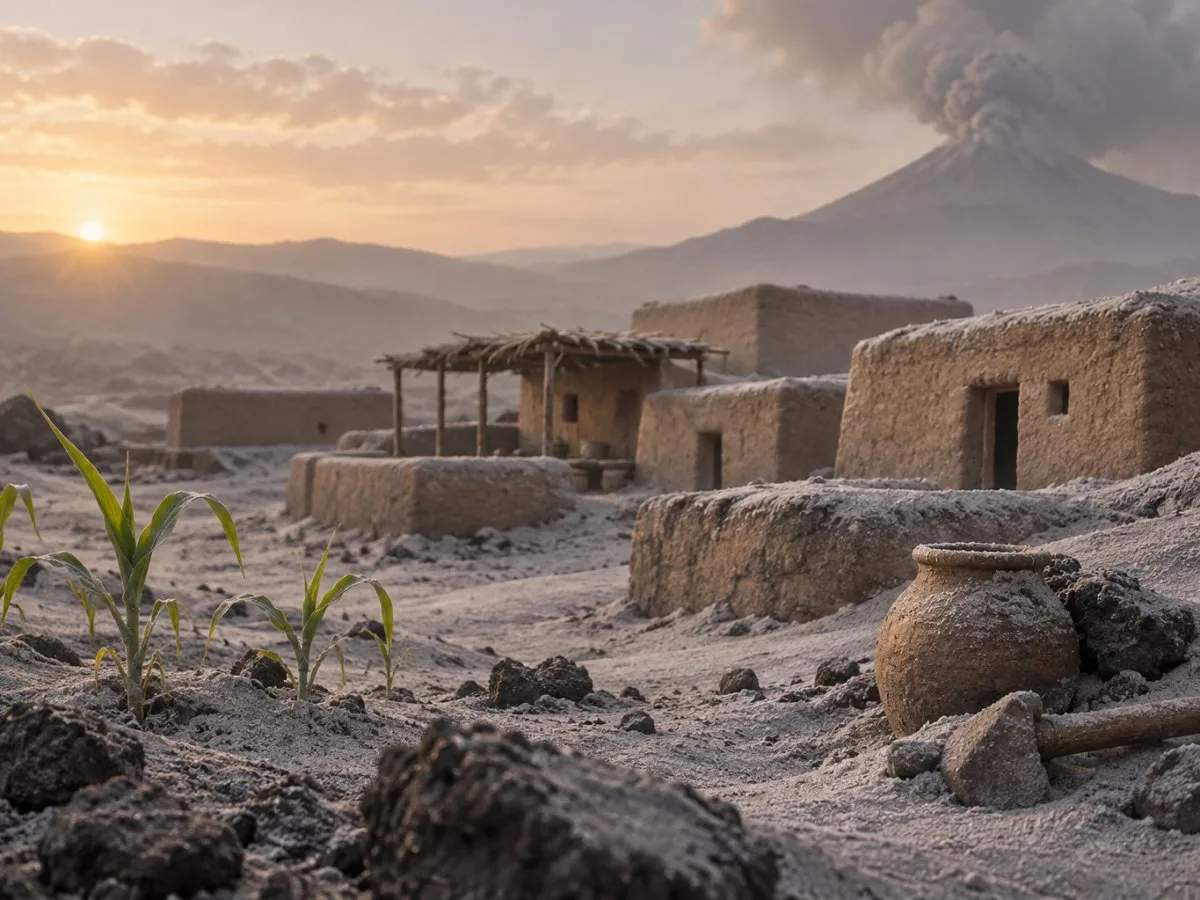
Joya de Cerén is more than a collection of ancient buildings. It is an agricultural village whose remains reveal relationships among homes, storage, cooking, cultivation and shared-use spaces. Archaeological studies attribute the eruption that buried the settlement in the seventh century AD to the Loma Caldera volcano; UNESCO’s description, by contrast, names Laguna Caldera. The ash preserved structures and objects in contexts that help reconstruct everyday activities, although not all buildings’ functions or relationships can be established with certainty.
A village preserved beneath the ash
The site is in the Zapotitán Valley in El Salvador. The volcanic event is dated in different ways across the available documentation: UNESCO places it in the seventh century AD; McKee reports that a sample of roof thatch yielded a date of 590 ± 90 AD; and the study published in Antiquity places the eruption in autumn around 660 AD. The sample date alone does not provide an exact date for the eruption. August 2017 is the publication date of the Antiquity study, not the date of the volcanic event.
Volcanic ash protected remains that would normally degrade readily in tropical conditions. Earth structures, utensils, plant materials and traces of crops have survived. Some organic remains were preserved in carbonized form or as casts in the ash deposits, making it possible to study the forms of materials that had decomposed.
This preservation offers a particular perspective: the remains are not simply isolated buildings, but spaces and objects found in relation to their uses and places of deposition. The excavated area remains partial. UNESCO counts 18 identified structures, 10 of which were completely or partly excavated in the information it presents. McKee reports 11 excavated structures and known locations for at least five more. These figures reflect different counts and documentary scopes; on their own, they do not describe the current state of excavations. The relationship between some structures and the identified household groups is also still unclear.
Homes, kitchens and storehouses within household groups
The excavated structures show that the activities of a household unit could be distributed among several buildings. In one identified group, for example, one structure is interpreted as a home, another as a storehouse and a circular building as a kitchen. A milpa and a garden lay nearby. Daily life was therefore not concentrated in a single room serving every purpose.
The excavated homes included earthen platforms, wattle-and-daub walls and thatched roofs; some had two rooms and a bench in the interior space. Structure 6, identified as a storehouse for Household Group 1, contained ceramic vessels with their contents, stone tools and grinding stones. By contrast, Structure 7, interpreted as a storehouse for Household Group 2, contained vessels with grains and other foods, stone and bone tools, jade and shell beads, and hematite and cinnabar pigments. A structure interpreted as a kitchen contained a hearth, utensils and grinding stones. These identifications are based on the arrangement of buildings and the objects found in them, but they remain archaeological interpretations, not labels inscribed on the structures.
Earth and plant materials: architecture connected to its setting
At Joya de Cerén, architecture was built mainly from earth and plant materials. Public buildings and the sweat bath were made of rammed earth; domestic structures used wattle and daub: a plant framework coated with mud. Thatched roofs and objects recovered in positions of use complete the picture of architecture made with materials associated with different activities.
These techniques also help distinguish between spaces. An earthen platform could raise a structure; walls and roofs defined areas for living, storage or cooking; and benches built into some rooms helped organize their interiors. These are observations about the preserved remains, not a complete reconstruction of how every building looked or was used at every point in time.
Cultivation was part of the inhabited space
The productive landscape was not separate from the village. Evidence of maize cultivation has been found in agricultural areas. The study of plant remains documents plants in fields, gardens and household settings, and examines how they were distributed across those contexts. The presence of plants within a household does not, by itself, prove that they were cultivated there. Read alongside the homes and storehouses, these finds connect food production with everyday life.
Tools, stored food and cultivated areas allow researchers to interpret different stages of an everyday economy: growing, storing and preparing food. That relationship is reconstructed from material evidence, not from a direct account of the tasks performed by the inhabitants.
What the archaeological record reveals—and what remains unresolved
Joya de Cerén is especially valuable for studying the everyday life of an agricultural community, not only the residences of rulers or elites. The combination of buildings, utensils, organic remains and cultivated fields supports interpretations of domestic activities, production and community practices.
But the site does not provide a complete picture free of uncertainty. Although many structures have been identified and, according to UNESCO’s count, some have been wholly or partly excavated, some buildings cannot be assigned with confidence to a household group or function. Earth architecture and organic materials are also fragile. Their long-term preservation requires protective measures and conservation interventions.
Reading Cerén through its everyday spaces means paying attention to the connections between buildings and activities without mistaking an interpretation for absolute certainty. The village preserves exceptional traces of habitation and of the landscape’s use, but each conclusion depends on what the remains allow us to establish.
At a glance
Scope
Editorial reading; this is not a site visit or a technical assessment.
Sources and references
Joya de Cerén Archaeological Site ↗27/10/2026 UNESCO World Heritage Centre, Joya de Cerén Archaeological Site.
Joya de Cerén Archaeological Site ↗27/10/2026
Joya de Cerén Archaeological Site ↗27/10/2026
Joya de Cerén Archaeological Site ↗27/10/2026
Joya de Cerén Archaeological Site ↗31/10/2026
08 La reutilización de materiales arqueológicos en el sitio Cerén, El Salvador – Brian McKee – Simposio 8, Año 1994 – Asociación Tikal ↗11/11/2026 Brian McKee, La reutilización de materiales arqueológicos en el sitio Cerén, El Salvador, published in 1995 in the proceedings of the VIII Simposio de Investigaciones Arqueológicas en Guatemala.
Identifying ‘plantscapes’ at the Classic Maya village of Joya de Cerén, El Salvador | Antiquity | Cambridge Core ↗12/11/2026 Alan Farahani, Katherine L. Chiou, Anna Harkey, Christine A. Hastorf, David L. Lentz and Payson Sheets, Identifying ‘plantscapes’ at the Classic Maya village of Joya de Cerén, El Salvador, Antiquity, volume 91, issue 358, August 2017, pp. 980–997.
Household Archaeology at Cerén, El Salvador | Ancient Mesoamerica | Cambridge Core ↗12/11/2026 Payson D. Sheets, Harriet F. Beaubien, Marilyn Beaudry, Andrea Gerstle, Brian McKee, C. Dan Miller, Hartmut Spetzler and David B. Tucker, Household Archaeology at Cerén, El Salvador, Ancient Mesoamerica, volume 1, issue 1, Spring 1990, pp. 81–90.
Joya de Cerén Archaeological Park ↗12/11/2026