





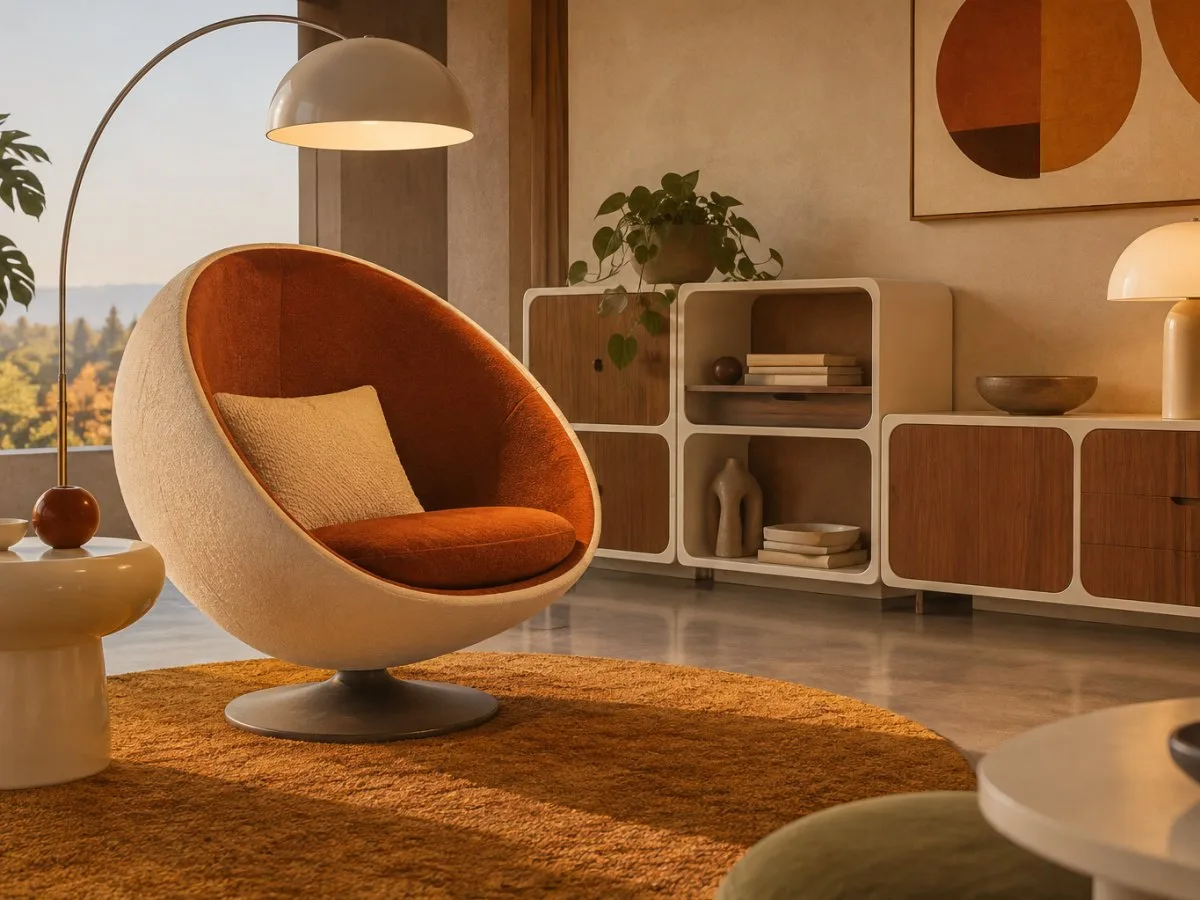
Joe Colombo (1930–1971) approached domestic design as something broader than the creation of isolated objects. In his projects, seating, storage, lighting and technology could form part of an environment organised for different uses. This idea appears in both individual pieces of furniture and interiors conceived as integrated wholes.
From object to environment
Colombo studied art at the Brera Academy in Milan and, in the early 1950s, joined the Nuclear Painting movement founded by Enrico Baj and Sergio Dangelo. He also developed an early interest in architecture and design. From around 1962, he worked as a designer in collaboration with companies including Kartell, Zanotta, Stilnovo, O-Luce, Alessi and Rosenthal.
His work ranged from chairs, lighting and furniture made from diverse materials to designs for fields such as automobiles, watches, ski bindings, eyewear and Alitalia’s in-flight service. The breadth of these commissions reflects a rational approach to design, guided by research and the possibility of organising objects and functions in a more coordinated way.
The Universale chair, developed between 1964 and 1967, was one of the first chairs moulded from a single material. Other pieces, such as the Tube Chair and Multi Chair, offered different possible uses. In storage furniture, too, storage could help shape a space rather than remain a secondary feature.
Elda: a piece that defines a place
Designed in 1963, the Elda armchair brings this exploration to an intimate scale. Its enveloping seat and swivel base suggest a zone of one’s own within a room: a place to sit that, in Colombo’s vision, could be connected to media such as television and the telephone.
The piece combines fiberglass and vinyl. Its seat, described as cocoon-like, invites an interpretation of the chair as a small refuge; the swivelling base, in turn, allows the seat to be reoriented without making it fixed in one direction. This is a reading of the object as a small environment, not proof that furniture alone determines how a home is used.
Visiona 1 and the home as a whole
In 1969, Colombo designed Visiona 1 for a series of temporary exhibitions about contemporary living. From 1968 to 1972, Bayer rented a boat during the Cologne Furniture Fair and turned it into an exhibition space. The initiative presented the latest developments in interior textiles. In the case of artificial fibres made by Bayer, collaboration with designers aimed to combine their technical possibilities and practical applications with aesthetic and artistic approaches.
Visiona brought together projects by several designers: Colombo created Visiona 1 in 1969; Verner Panton produced Visiona 0 in 1968 and Visiona 2 in 1970; and Olivier Mourgue designed Visiona 3 in 1971. The series offered a platform for presenting ideas about living and debating its cultural significance.
The retrospective devoted to Colombo grouped Visiona 1 with his 1970 apartment and the 1971 Total Furnishing Unit as projects from his final years. In these works, domestic objects were integrated into multifunctional interiors, conceived as systems capable of responding to the needs and desires of their inhabitants. The ambition was to bring furniture, functions and spatial organisation together in a single project; it was not simply a matter of adding more pieces to a room.
This idea makes it possible to read Elda and Visiona 1 as part of a continuous exploration, even though they operate at different scales. The armchair shapes an individual zone within the home; the integrated interior extends that logic to the dwelling as a whole. In both cases, domestic space appears as something that can be reorganised through design.
A vision of the future, not a universal formula
Colombo’s work is associated with the futuristic imagination of the 1960s: striking forms, technology and domestic settings that could seem drawn from science fiction. But his interest went beyond appearance. The underlying question was how to coordinate objects and functions to make an environment more adaptable.
His projects express a historical vision of the future, not a universal solution for today’s homes. The ambition to integrate functions into complex units invites us to consider how a piece of furniture directs activities and how the arrangement of objects defines areas of use. It also leaves an open tension: the more an environment is integrated, the more its inhabitants’ experience depends on a system designed in advance.
Colombo died in 1971, aged 41. The brevity of his career did not prevent him from producing an extensive body of work, from individual objects to proposals for complete interiors. His legacy is especially legible in this shift of scale: from a seat that creates a refuge to a home imagined as a coordinated whole.
At a glance
Scope
Editorial reading; it does not constitute a visit or a technical assessment.
Sources and references
Joe Colombo ↗27/10/2026 Vitra Design Museum, Joe Colombo.
Visiona ↗27/10/2026
Visiona ↗31/10/2026 Vitra Design Museum, Visiona.
Elda Chair, no 1005 | The Art Institute of Chicago ↗12/11/2026 Art Institute of Chicago, Elda Chair, no 1005.