





Preparing a home for a baby does not mean filling every room with accessories. It means removing hazards, limiting access to risky areas and checking how the child’s reach changes. It is worth starting before the baby crawls: rolling, moving around and pulling up to stand can happen sooner than expected. No lock, gate or protector replaces adult supervision.
This guide can help you organize a home safety review. Installation requirements and products vary by country; a recommendation from another country is not the same as a local regulation. For electrical installations, anchors, windows and hot water, follow the manufacturer’s instructions and seek professional help if you cannot verify that the installation is compatible or securely fitted.
1. When to start and how to see the home from a child’s level
Before your child starts moving around, go through the home room by room and get down to their height. Look under tables and sofas, check what they could pull down from a surface and notice which furniture might serve as a step. Then repeat the walkthrough imagining a child who can open drawers, turn handles and drag a chair.
Start with hazards that could have serious consequences: accessible water, stairs and windows, furniture that could tip over, cords, medicines, chemicals, batteries and small objects. Then address bumps, cuts and trip hazards along everyday routes. You do not need to buy a product for every risk: removing an object or moving it elsewhere can be part of the solution.
Check visitors’ bags, too: they may contain medicines, coins or devices with batteries. The review should work for everyone who cares for the child, including grandparents, relatives and caregivers.
2. Risks by developmental stage: focus on what the child can do
Age ranges are approximate. Do not wait for a particular date to remove a hazard, and do not assume that a child who is not yet walking will stay where you left them.
| Approximate stage | Risks that need attention | What to check first |
|---|---|---|
| First year, including before crawling | Falls from beds and changing tables, suffocation during sleep, burns and drowning in the bathroom | Clear sleep surface, diaper changes at floor level, hot drinks and supervision near water |
| Baby who rolls, moves around or crawls | Choking, poisoning, cords, stairs and objects they can reach by pulling on a cord | Floor, low furniture, drawers, cords and access to the kitchen and bathroom |
| Toddler who walks and climbs | Furniture tipping over, falls from windows or balconies, cuts, bumps and access to water or hazardous products | Anchors, furniture that can be used as a step, gates, locks and outdoor spaces |
Safety depends on abilities, not just age: learning to open a lock changes the protection needed, even if the child is still very young.
3. Living room: tipping furniture, cords and small objects
Anchor furniture that could tip over and secure the television using systems designed for each product and for the wall or floor support. A low dresser, bookcase or piece of furniture that looks heavy can also be dangerous if a child climbs or opens drawers. Putting a television on top of furniture is not the same as securing it.
Recheck anchors after moving furniture. Keep tempting objects away from places that invite climbing, and put heavy objects on lower shelves. In a rental home, agree on a way to secure the furniture before using an unstable piece; do not improvise an anchor you cannot verify.
Remove accessible cords and loops from curtains and blinds. Moving a crib or sofa farther away can reduce access, but it does not make a loose cord safe. Follow the safety measures designed for the installed system and check that no loops are within reach.
Protect hard corners along the child’s route and check that protectors do not come loose and become small parts. Keep coins, toy parts belonging to older siblings and small decorative objects out of reach. During meals, the child should be seated and accompanied: running or playing while eating increases the risk of choking.
Button batteries and small magnets need particular attention. Check remote controls, decorative lights and other devices; their battery compartments should be closed and undamaged. Keep used batteries out of reach, too. If you suspect that a child has swallowed a button battery or small magnets, call emergency services or the local poison center immediately and seek urgent medical attention. Do not wait for symptoms or delay the call. The call does not replace urgent medical assessment.
4. Kitchen: keep the child away from heat and poisonous substances
Store medicines, cleaning products and laundry capsules out of sight and out of reach, preferably in a locked space. Keep products in their original containers and close them again after use. Do not transfer them to drink bottles. A child-resistant container is not impossible to open.
Fit compatible locks on hazardous cupboards and drawers and check that they catch each time. Keep knives, scissors, plastic bags and other sharp objects or items that could cover the face out of reach. A lock the child has learned to open no longer does its job.
When cooking, use the back burners where possible and turn pan handles towards the back of the hob, out of the child’s reach, without leaving them over another burner. Keep small-appliance cords from hanging over the edge and keep them out of reach. Keep the child away from cooktops, oven doors and hot utensils, including while they cool.
Do not drink anything hot while holding the baby or leave it on an accessible edge. Before sitting down with the baby, find a place where they cannot reach it or pull it down. Kitchen safety depends on both the layout and repeating these actions while using the room.
5. Bathroom: warm water and an adult within reach
Get the towel and everything else you need ready before starting. Stay with the baby or toddler throughout the bath, close enough to reach them. Do not leave them in the care of a sibling, and do not leave to get something or answer the phone. If you have to leave, take the child with you.
A bath seat does not replace supervision. Drowning can happen in very little water and without an audible call for help. Empty the bathtub when finished, and leave buckets, tubs and other containers empty when not in use. Limit access to the bathroom and toilet with suitable locks.
For a young child’s mixed bath water, 37–38°C is an approximate upper-temperature reference. Check the temperature before putting the child in and mix the water thoroughly to avoid hotter spots. Use a thermometer and make sure the water feels warm, not hot. For newborns or particular medical circumstances, follow the advice of the healthcare professional caring for the child.
Do not confuse bath-water temperature with tap or stored-water temperature. Protection against scalding may require a thermostatic mixing valve or temperature control installed and maintained by a professional. Do not lower the stored-water temperature yourself: preventing bacteria and meeting installation requirements also matter.
Keep cosmetics, medicines, cleaners and appliances such as hair straighteners out of reach. Keep these appliances away while they cool, with their cords inaccessible.
6. Child’s bedroom: safe sleep and clear windows
During the first year, place the baby on their back for every sleep, on their own suitable sleep surface that is firm, flat and level. The mattress should fit the product and have a fitted sheet. Keep the sleep space clear of pillows, cushions, soft toys, padded cot bumpers and loose bedding. Do not add positioners or accessories that incline or soften the surface.
A damaged crib or sleep product, one with missing parts or one without instructions needs to be checked before use. Do not improvise repairs or modifications. If the baby falls asleep in a bouncer or other seat that is not a suitable sleep surface, move them to one as soon as possible.
Move the crib, bed, dressers and chairs away from windows and cords. A window screen does not prevent a fall. Use compatible, correctly installed window locks or guards; check that they close properly, are maintained and can be opened by an adult if the window is part of an emergency exit.
There is no single opening measurement that can be applied to every home: check local rules and the specifications for the protection. The aim is to prevent a dangerous opening without blocking a necessary evacuation route.
7. Stairs, doors and balconies
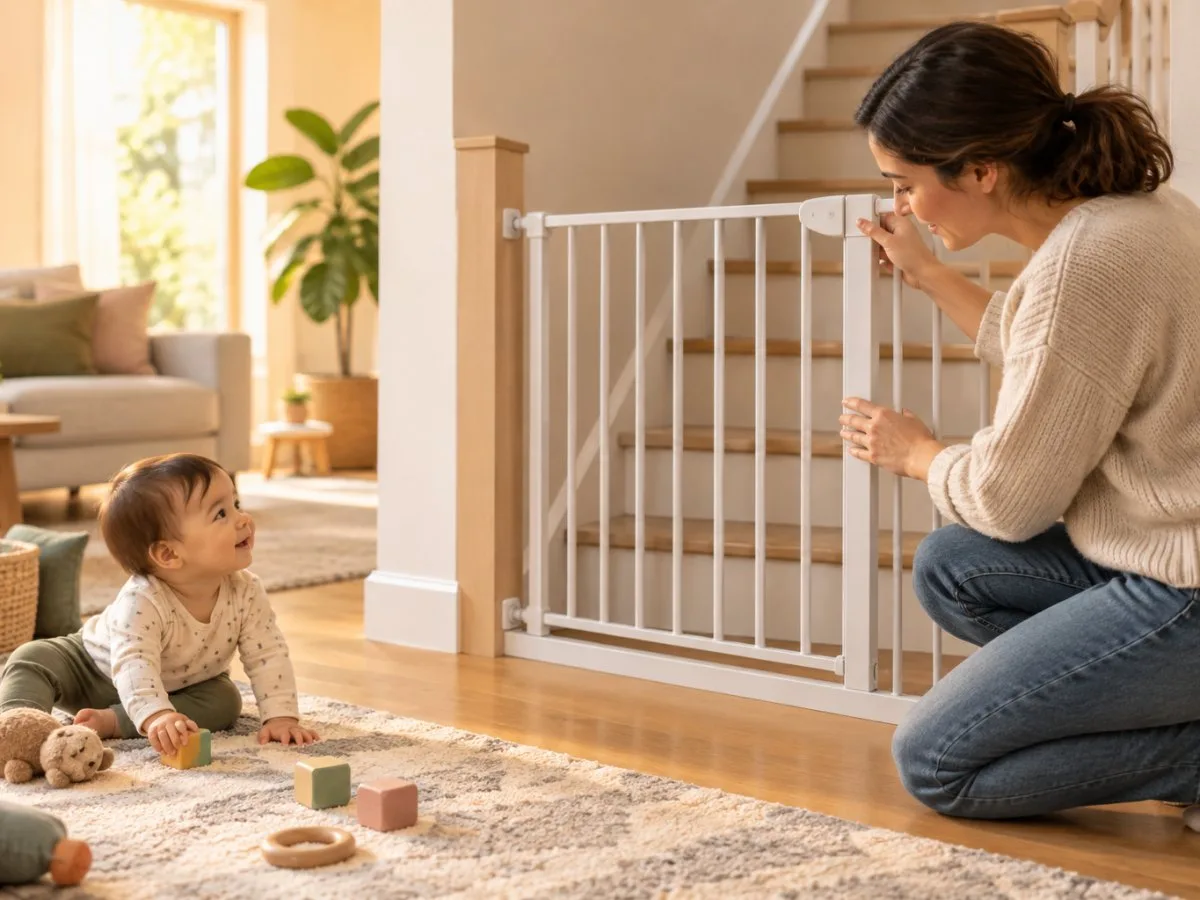
Install child safety gates at stair access points and keep them closed. At the top of the stairs, use a child safety gate secured with screws according to its instructions, not a pressure-mounted gate. Check the support, locks and any age or use restrictions specified for the product. A pet gate is not a substitute for a child safety gate.
Do not leave toys or other obstacles on the steps. Learning to go up and down is part of development, but it does not remove the need for supervision.
Door finger guards should stay firmly in place and be compatible with the door’s operation. Do not leave a door permanently open if it needs to close to contain smoke or fire. A finger-trapping prevention device must not prevent an adult from evacuating quickly.
On balconies and terraces, remove chairs, planters and other items that could be used to climb near an edge. Keep the child away from railings and edges, control access and accompany them in these spaces. Do not improvise nets or enclosures: any protection installed must be suitable for the location and comply with local regulations.
8. Electricity and fire
Check the type and condition of outlets before adding protectors. There is no universal plug cover suitable for every outlet: some systems have built-in shutters, and an incompatible accessory may be unsuitable. Ask an electrician about the protection needed for the installation. If using a protector, make sure a child cannot remove it easily or swallow it.
Keep cords and chargers away from play areas, avoid overloading extension leads and keep hot appliances out of reach. Damaged covers, faceplates or outlets need repair; do not try to fix them with an improvised accessory.
Install suitable smoke alarms and maintain them according to their instructions and local recommendations. Test that they work every month and include that check in the household routine, following the device’s instructions and local fire-prevention recommendations.
Prepare a family evacuation plan. Decide who will help each baby or toddler, what alternative route you will use if an exit is blocked and where you will meet outside. Practise with everyone who cares for the child. If there is a fire, get out, stay outside and call emergency services; do not go back in to retrieve belongings.
9. Garden, terrace and pool
As a preventive measure, separate the pool from the house and the rest of the garden with a fence enclosing all four sides, with a gate that closes and latches by itself. Check that the child cannot climb it or use nearby objects as steps. Alarms and covers are additional layers; they do not replace an appropriate fence or active supervision. Check local rules on the features and installation of this protection; this guidance does not replace those requirements.
When near water, explicitly assign an adult to supervise without being distracted by a phone. Empty and put away paddling pools after use, and also restrict access to ponds and containers holding water.
Check plants and mushrooms that may be within reach, including those in pots. Do not let the child eat leaves, flowers or berries from the garden; identify uncertain plants and restrict access to poisonous ones. Store tools, fertilizers, pesticides and other products in a locked, inaccessible place. Keep products in their labelled, original containers.
10. Printable room-by-room checklist
Print this table or copy it onto a sheet. Mark a box only after checking the item in the home; a checked box does not certify that a room is hazard-free. Note outstanding tasks, the person responsible and the date of the next review.
| Done | Room or area | What to check |
|---|---|---|
| ☐ | Whole home | Walkthrough at the child’s height; small parts, bags, cords and reachable objects removed |
| ☐ | Living room | Furniture and television secured; cords and battery compartments inaccessible; corners checked |
| ☐ | Kitchen | Chemicals, medicines and sharp objects stored safely; locks engaged; pan handles towards the back of the hob, not over another burner; small-appliance cords out of reach and not hanging over the edge |
| ☐ | Bathroom | Supplies ready; adult within reach; water checked; containers emptied afterwards |
| ☐ | Bedroom | Firm, clear sleep surface; furniture away from windows and cords; window locks checked |
| ☐ | Stairs and doors | Child safety gates closed and correctly installed; steps clear; finger protection compatible with evacuation |
| ☐ | Balcony or terrace | Access controlled; no climbable objects by the edge; protection checked |
| ☐ | Electricity and fire | Outlets and cords in good condition; alarms tested; caregivers know the exit plan |
| ☐ | Garden and pool | Fence and gate checked; supervision assigned; plants and tools reviewed |
| ☐ | Emergencies | Home address and local phone numbers available; caregivers know where to find them |
Review date: __________ Responsible person: __________ Outstanding tasks: __________
Repeat the walkthrough when the child starts rolling, crawling, standing, climbing or opening locks, and after moving furniture or spending a few days in another home. During use, check that doors and gates close and that small objects do not appear. Regular reviews complement daily attention; they do not replace it.
11. What to do in case of poisoning or an accident
If the child is unresponsive, has difficulty breathing, has a seizure or has a serious injury, call the emergency number for the place where you are immediately. Follow the call-taker’s instructions. Explain what happened and where you are; do not delay getting help to search for information online.
If poisoning is possible, get medical help immediately and contact the poison center or emergency services. Do not wait for symptoms. If possible, keep the product container or identification to show healthcare staff. Do not induce vomiting or improvise treatments. Ask for and immediately follow emergency services’ or the poison center’s instructions about food and drink for the substance involved; do not give them on your own initiative without professional advice. Specific instructions for button-battery ingestion take priority over general guidance: confirm them immediately with those services and follow them without delaying urgent care.
If you suspect that a button battery or magnets have been swallowed, call emergency services or the poison center immediately and seek urgent care, without waiting for symptoms or delaying help. Follow their specific instructions for that exposure. This guide does not teach choking first aid, resuscitation or treatments: follow the emergency service’s instructions and train using an accredited pediatric first-aid resource. The call does not replace urgent medical assessment.
| Location | Emergency services | Poison information |
|---|---|---|
| Spain | 112 | Poison Information Service: 91 562 04 20, available 24 hours a day |
| Other European Union countries | 112, free | Check the country’s official center; the service and number are not the same throughout the EU |
| United States | 911 | Poison Help: 1-800-222-1222; covers the United States |
| Outside these areas | Local emergency number | Official local poison center; check it before you need it |
112 exists alongside other national emergency numbers in different EU countries; it is not a universal number worldwide. The language of this page does not change the geographic coverage of these phone numbers. Before travelling or staying with relatives, note the contacts for your destination and make them accessible to everyone caring for the child.
Sources and references
NHS — Baby and toddler safety ↗Consultado el November 12, 2026 · 12/11/2026
NIH NICHD — Ways to Reduce Baby’s Risk ↗Consultado el November 12, 2026 · 12/11/2026
US Fire Administration — Fire Safety for Children ↗Consultado el November 12, 2026 · 12/11/2026
Government of South Australia — Hot water safety ↗Consultado el November 12, 2026 · 12/11/2026
Electrical Safety First — Socket covers ↗Consultado el November 12, 2026 · 12/11/2026
ACCC Product Safety — Toppling furniture and televisions guide ↗Consultado el November 12, 2026 · 12/11/2026
NHS — Poisoning ↗Consultado el November 12, 2026 · 12/11/2026
Ministerio de Justicia de España — Urgencias toxicológicas ↗Consultado el November 12, 2026 · 12/11/2026
National Capital Poison Center — Get help for a poisoning ↗Consultado el November 12, 2026 · 12/11/2026
European Commission — 112 emergency phone number ↗Consultado el November 12, 2026 · 12/11/2026
CPSC — Childproofing Your Home ↗Consultado el November 12, 2026 · 12/11/2026
ACCC Product Safety — Toys that have magnets guide ↗12/11/2026
US Fire Administration — Smoke Alarms ↗12/11/2026
CDC — Preventing Drowning ↗12/11/2026
CPSC — Button Cell and Coin Batteries ↗12/11/2026
National 911 Program — Calling 911 ↗12/11/2026
NYC Health — Poison Control ↗12/11/2026
HRSA Poison Help — Poison Centers ↗12/11/2026
National Capital Poison Center — Swallowed a button battery ↗12/11/2026