





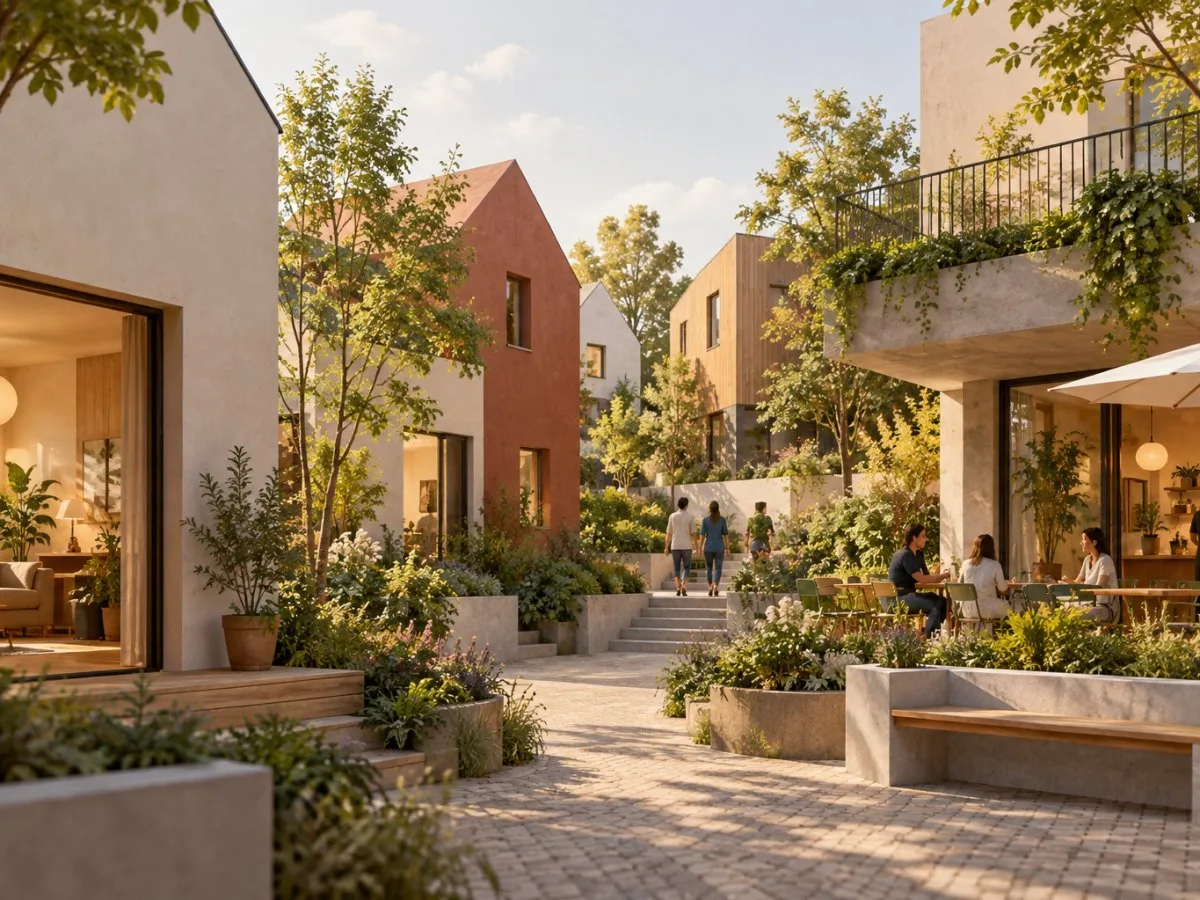
The home as part of a network of spaces
A worktable alone cannot resolve what happens when several people study, work, and rest in the same home. The spatial question is broader: how to alternate between concentration, interaction, and privacy without assuming that every activity has its own room. Separation can be temporary or movable, and can also depend on the shared spaces available outside the home.
This perspective connects two scales. Indoors, what matters is how a space accommodates different activities; in the neighborhood, it matters whether everyday places—such as libraries, cafés, or coworking spaces—allow activities to be distributed. Thinking at one scale leads to the other, but that does not mean a domestic solution can simply be transferred to urban design.
Ivry-sur-Seine: housing alongside other uses
The renewal of central Ivry-sur-Seine began in 1962 and continued for more than two decades. Among those involved were architect Renée Gailhoustet and architect Jean Renaudie. The resulting development is not limited to residential blocks: it incorporates housing, shops, offices, facilities, and circulation spaces, with different configurations from one building to another.
At Jeanne-Hachette, for example, housing and shops relate to public terraces and pedestrian routes. The project’s design includes covered passages and connections between streets and buildings, as well as terraces that form part of the relationship between private and collective spaces. In other parts of Ivry, courtyards, changes in level, and gardens contribute to a varied urban composition.
The significance of this example does not lie in a single form that can be replicated. It lies in the intention to bring uses together and make the routes between them part of the urban experience. A mix of uses, by itself, does not guarantee a particular kind of community life: how places connect, and how they are maintained and used over time, matters.
Multiple centers, not one answer
A city organized around multiple areas of activity can bring some everyday destinations closer to where people live. In this scenario, work would not always need to be concentrated in a single center; neighborhoods could combine housing, learning, work, retail, and leisure. This is an approach to organization, not an automatic consequence of remote work.
Dan Hill’s interview presents this idea through the image of a city with multiple nodes and mentions Tokyo as an example of a metropolis with numerous subcenters. The comparison helps us imagine a polycentric structure, but it is not a recommendation that other cities imitate a specific urban form: every place has its own conditions and history.
It is also worth distinguishing the distribution of activities from its effects. Changing where people work could alter demand for central offices, commuting, and neighborhood activity, but the documents considered here do not quantify those effects. Nor do they demonstrate that working from home, by itself, reduces congestion or pollution.
A useful principle: observe the transitions
When thinking about a home or a neighborhood, it may be more productive to observe the transitions between uses than to seek a perfect space for every activity. Where can someone work without permanently taking over the place where they rest? What options are there to step away for a while or meet other people? Do everyday routes connect homes with services and shared spaces?
These questions are not technical specifications or a universal checklist. They help show that everyday design encompasses both objects and boundaries inside the home and connections with the surroundings. Ivry offers one way to bring housing, facilities, retail, and circulation together; its tensions and context mean it cannot be treated as a formula that can be transferred without adaptation.
At a glance
Scope
Editorial reading; it does not constitute a site visit or technical assessment.
Sources and references
A Chance to Rethink Cities and Places | Official Vitra® Online Shop US ↗09/11/2026 Dan Hill, “A Chance to Rethink Cities and Places,” interview published by Vitra.
The architecture of Ivry, a series of encouters | Magazine | Pavillon de l'Arsenal ↗11/11/2026 �The architecture of Ivry, a series of encounters,” Pavillon de l’Arsenal.
Urban Brutalism: Unpacking Renée Gailhoustet’s Trailblazing Work in Ivry-Sur-Seine | ArchDaily ↗11/11/2026 Matthew Maganga, “Urban Brutalism: Unpacking Renée Gailhoustet’s Trailblazing Work in Ivry-Sur-Seine,” ArchDaily.