





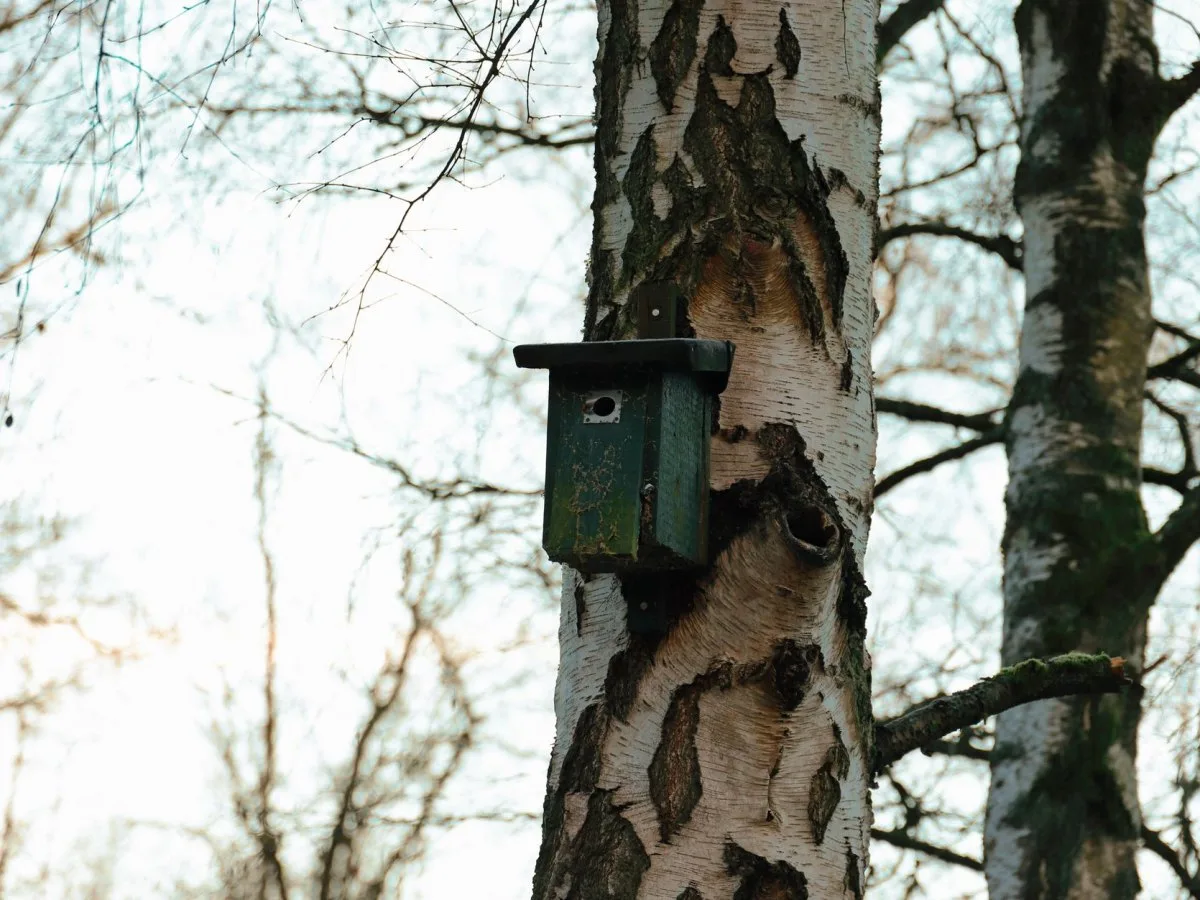
A birdhouse as a design question
What does it mean to build a house for a bird? Dwellings took that question as the starting point for an exhibition at South London Gallery in London. Conceived by the Computer Room studio and the Flock Together birdwatching collective, it brought together 22 objects and images created by artists and designers. The exhibition was presented in the Orozco Garden and Clore Studio from 31 August to 1 September 2024.
The brief was deliberately open: to respond to the idea of a birdhouse, without necessarily making a conventional nest box. The proposals therefore ranged from solutions close to functional objects to abstract, sculptural or conceptual responses. Their varied approaches make it possible to see design not only as the final form of an object, but also as a process for exploring a shared idea through different practices.
Shelter, form and materials
Some works retained recognisable features of a nesting box; others transformed its scale, silhouette or material. Bird Metropolis, by Jesse Crabtree Butterfield, is a wooden structure inspired by skyscrapers and modernist architecture. Its tower, carved into organic forms that evoke trees, provides nesting space for eight pairs of house sparrows.
Daniel Schofield proposed a birdhouse made from renewable cork bark as an alternative to wood. The project itself highlights a tension: using a natural material to make an artificial shelter can prompt reflection on the relationship between habitats and objects designed to replace them. The exhibition does not resolve that contradiction; instead, it makes it visible as part of the conversation about how spaces for other species are built.
In Ovulo, Jaclyn Pappalardo used a welded form reminiscent of shapes found in nature. Its curved profile incorporates a hook for hanging the piece from a branch, and it was made using a process that inflates metal with water. George Baggaley, meanwhile, brought his characteristic organic forms into ceramics, using glazes to accentuate the undulating surfaces.
Other proposals began with an image or a play on scale rather than a familiar nest box. The Guest House For An Ostrich, by Rio Kobayashi, is a raised wooden structure in which an ostrich could hide its head instead of burying it in the ground. Its aerodynamic form and scorched front surface allude to the bird’s speed and the friction of air.
Making through collaboration
Collaboration was another way to approach design as a process. Andu Masebo developed his piece remotely with his uncle Dan O’Connell, a trained carpenter who lives in Cork, Ireland. They sent materials back and forth between London and Ireland, making successive alterations without discussing each intervention. The object took shape through this exchange, with the condition that a birdhouse would emerge at the end.
Oliver Hawkes worked with the charity Global Generation to build birdhouses from material offcuts donated by eyewear brand Cubitts. The project aimed to involve young people in making and introduce them to environmental issues and living alongside birds. Here, the value of the piece is inseparable from who takes part in making it and from the materials put to use.
From object to relationship with nature
Taken together, Dwellings shifts attention from the isolated form to the relationships a birdhouse entails: between shelter and observation, human intervention and animal space, designed object and environment. A nest box may seem like a straightforward brief, but by responding through architecture, ceramics, metalwork, photography and other practices, the participants opened up very different interpretations.
The exhibition presented both expressive proposals and solutions described as practical. This variety does not amount to an assessment of their effectiveness for birds: the available documentation provides no evidence of use, comparative testing or detailed technical criteria for evaluating their performance as shelters. What it does offer is a way to consider how an everyday object can frame questions about who builds, who it is built for, and what home means when its inhabitant is not human.
Many of the pieces were available to purchase, and all proceeds would help support South London Gallery’s community and learning programmes.
At a glance
Scope
Editorial overview; not based on a visit or technical assessment.
Sources and references
Photograph · Photo by Christina & Peter on Pexels · Pexels License · Sources and references · Centred crop to 4:3, resizing and conversion to JPEG for House Angle.