





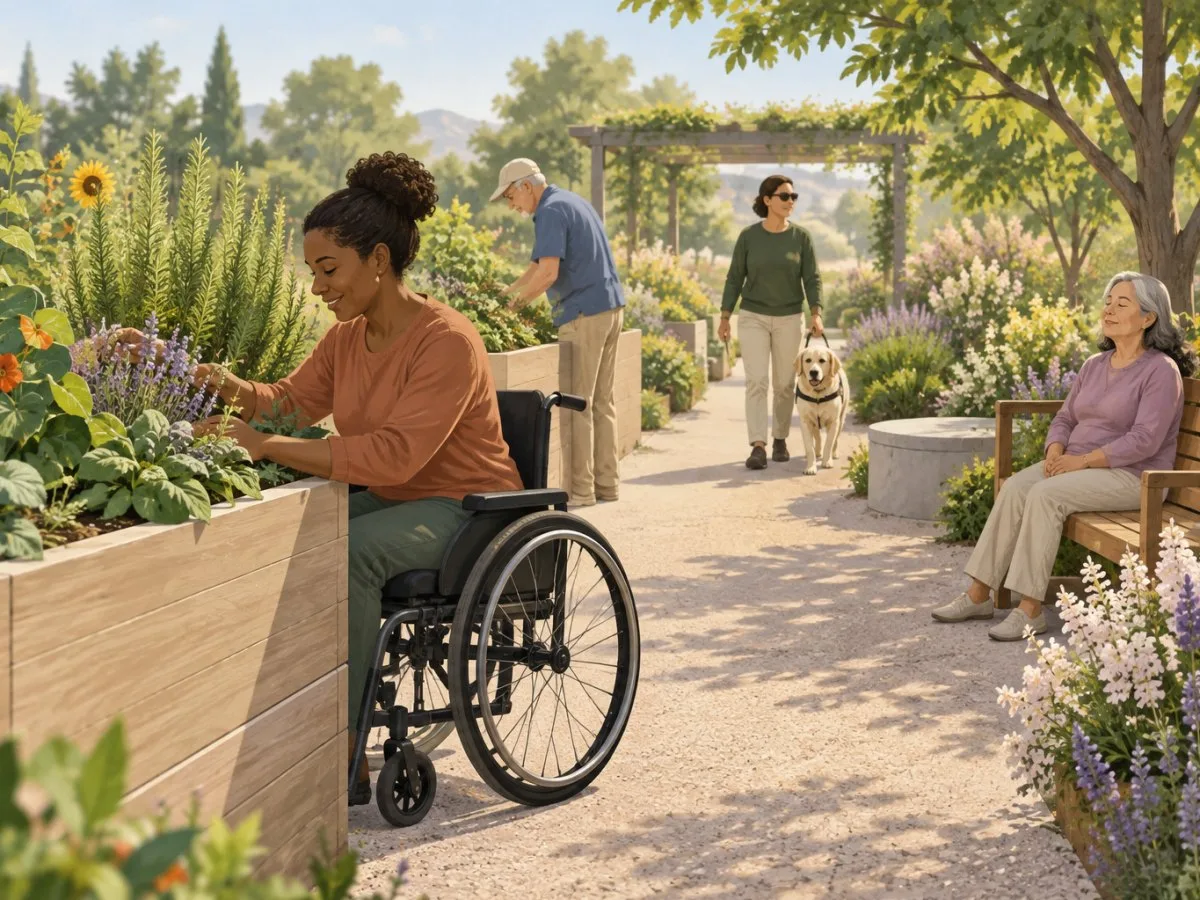
An inclusive garden is not created by adding a ramp or raised planter to a finished design. It is planned from the outset so that people with different abilities can reach, navigate, move through, rest in and help care for the plants. This includes people who are blind or have low vision, wheelchair or walker users, people with cognitive disabilities, and people who communicate using sign language.
Accessibility does not mean that everyone needs the same things. The most reliable way to find out what works is to co-design with the people who will use the space, test decisions on site and revise the design in light of that experience. The suggestions below are design principles, not universal legal requirements: applicable obligations and measurements depend on the country, type of space and local regulations.
Start with people and how they will use the garden
Before choosing paving or plant species, consider who will use the garden and what they want to do there. They may want to walk independently, work the soil while seated, meet in a group, find a quiet corner or reach a restroom easily. Involving disabled people during planning can help identify barriers that may not be apparent from a plan alone.
Walking through the site with future users makes it possible to observe how people enter, where puddles form, which obstacles narrow the path, and where shade or seating is needed. It also helps determine which sensory cues aid orientation and which distract or cause discomfort. Preferences can differ from person to person, so it is better to offer choices than to impose a single sensory experience.
A route that is easy to recognize and follow
A clear route connects the entrance with frequently used features: growing areas, seats, water if present, and facilities. A continuous route that is easy to recognize reduces the need to search for the next section. In some gardens designed for people with dementia, a circular or figure-eight route can make walking easier by avoiding dead ends. If there is a risk that someone might leave the space without an accompanying person, the entrance, boundaries and supervision need specific planning, agreed with users and the people who accompany them. A boundary concealed by planting should not hide the garden’s limits from someone who needs to recognize them or make a safe exit difficult.
Transitions can be marked with consistent, perceptible cues: for example, a clearly defined tactile change in the paving, an aromatic plant beside a particular area or the localized sound of water. These cues should complement, not replace, an understandable route. Avoid placing important cues beside noise sources that mask them, or using texture changes that suggest danger when there is none.
Visual information matters too. Contrast between the paving, its edges and elements along the route can make the space easier to read for people with low vision. Lighting that limits glare, together with surfaces that do not reflect too much light, can help both with visual orientation and with communication using sign language, which depends on clear lines of sight.
Stable surfaces and predictable changes in level
For walking or wheelchair travel, routes should prioritize a surface that is firm, stable, even and slip-resistant when wet. Consider the climate, drainage, maintenance and intended use before selecting a material. Loose gravel, wide joints, raised edges and puddles can make movement difficult or create tripping hazards. A texture contrast that helps with wayfinding should not create a discontinuity that destabilizes wheels, canes or a person’s footing.
Wherever the design allows, limit changes in level. If they are necessary, make them legible through consistent cues, contrast and appropriate tactile references, without relying on just one sensory mode. Keep the route clear and prevent branches, tools, hoses or pots from encroaching on the path.
There is no single width or slope measurement here that applies to every garden and territory. Design should check dimensions, slopes, turning spaces and connections to accessible routes against local regulations and the specific conditions of the site. Natural spaces or places with environmental restrictions may allow less room for intervention; this does not remove the need to consider alternatives and improve access as far as possible.
Use touch, sound and scent for wayfinding without adding risks
Sensory cues work best when they are clear, consistent and optional. A tactile cue can mark a boundary or transition; a water feature can help locate an area; an aromatic plant can identify a garden bed. Test cues with users: ambient sound may be confused with other noise, and a scent may be imperceptible or intense depending on the person, wind and season.
Water can provide an acoustic reference, but its design must also prevent slips, hard-to-detect edges and fall risks. Keep useful sounds close to the place they identify, and avoid requiring people to approach a wet surface or dangerous edge.
Choose plants that suit the site and are safe for the intended kind of contact. In areas that invite touching or growing, avoid toxic species, thorns and sharp edges; check each plant’s identification and risks using local horticultural sources. Do not assume that a plant is harmless because it is common or aromatic. It is also useful to combine sensory cues with legible, accessible names rather than relying exclusively on visual signs.
A range of plants that shows seasonal change can make the passage of time and changes in the garden visible. Contrast between vegetation and its background can help some people with low vision recognize edges. In quiet areas, a less stimulating palette and a secluded corner can offer an alternative to crowded or sensory-intense spaces.
Rest, shade and places to talk
Distribute seats along the route rather than placing them all in one spot. Benches with backs and armrests can make sitting down and standing up easier; some people may need adjacent space for a wheelchair, walker or companion. Shaded seating can make resting more comfortable, but it is also worth providing sunny places for people who prefer them.
Movable seats can encourage socializing and allow the space to be rearranged, as long as they can be moved without blocking the route. A low wall can serve as informal seating and, if its height and design are suitable, bring seated users closer to a planting area or water feature. It should not become an unexpected edge: make it recognizable and keep the path clear.
If the garden has restrooms, the route to them should be easy to locate and follow. Consistent signs repeated along the way help people find them; their location should be considered from the beginning rather than added as an isolated afterthought.
Planters within reach and opportunities to take part in growing
Raised planters can bring the soil closer to people who garden while seated, use wheelchairs or have difficulty bending. One height will not suit everyone: planters of different heights and growing areas accessible from several sides can be combined, after testing reach with users. Leave space to approach and turn beside the planters, and make sure supports or edges do not encroach on the route.
A firm edge can provide support or a seat, but it should be comfortable, stable and easy to recognize. The weight and location of pots and tools matter too: tasks can become more manageable when supplies are stored nearby, suitable tools are available and work is shared among participants.
Gardening can be a social and meaningful activity, but universal medical or therapeutic outcomes should not be promised. If a project is presented as therapeutic, specify who leads it, what activities it offers and how safety and support needs are addressed; taking part in horticulture does not replace healthcare.
Adapt choices for a community or therapeutic garden
In a community garden, start by identifying shared tasks and access barriers: arriving with tools, finding a garden bed, working in a group and resting. Accessible plots, seats, clear routes and tool-storage points can be combined. Trial sessions with participants help establish whether cues, routes and heights work in everyday use.
In a therapeutic or care garden, wayfinding should be adapted to the people concerned and the conditions of the service. A simple route with recognizable cues may suit some groups; another may need quiet areas, accompaniment or a clearly supervised exit. No single layout can be recommended for everyone with dementia, autism or vision disabilities. Regular reviews with users, caregivers and relevant professionals help identify changes in needs, plants and maintenance.
Check before opening
- Did the people who will use the garden take part in decisions and get to try the route?
- Can people recognize the entrance and main destinations without relying on just one visual or auditory cue?
- Does the surface stay firm, stable and usable in rain, and are obstacles and puddles cleared?
- Can changes in level, edges and water features be detected and avoided safely?
- Are seats distributed along the route, with shade and space beside them for different ways of moving?
- Can people approach the planters and work from different positions?
- Were plants accessible to touch selected with toxicity, thorns and maintenance in mind?
- Were local regulations, drainage, maintenance and the garden’s support needs reviewed?
A good inclusive garden is not a collection of devices, but a space whose routes, pauses and activities are understandable and usable in different ways. Co-design, on-site trials and ongoing maintenance help keep that accessibility real over time.
At a glance
nexo id
189
Sources and references
https://www.asla.org/focus-areas/diversity,-equity,-inclusion/universal-design-guide/universal-design-guide-gardens ↗15/11/2026 American Society of Landscape Architects, Universal Design: Gardens.
https://www.access-board.gov/aba/guides/chapter-10-outdoor/ ↗15/11/2026 U.S. Access Board, Chapter 10: Outdoor Developed Areas.
https://www.rnib.org.uk/living-with-sight-loss/community-connection-and-wellbeing/leisure/gardening/ ↗15/11/2026 Royal National Institute of Blind People, Gardening for the blind and partially sighted people.
https://www.rhs.org.uk/advice/health-and-wellbeing/gardening-with-a-disability ↗15/11/2026 Royal Horticultural Society, Tips for Gardening with Disabilities.
Staveley Residential and Community Care Centre – The Landscape Institute ↗15/11/2026