





What makes a classic enduring
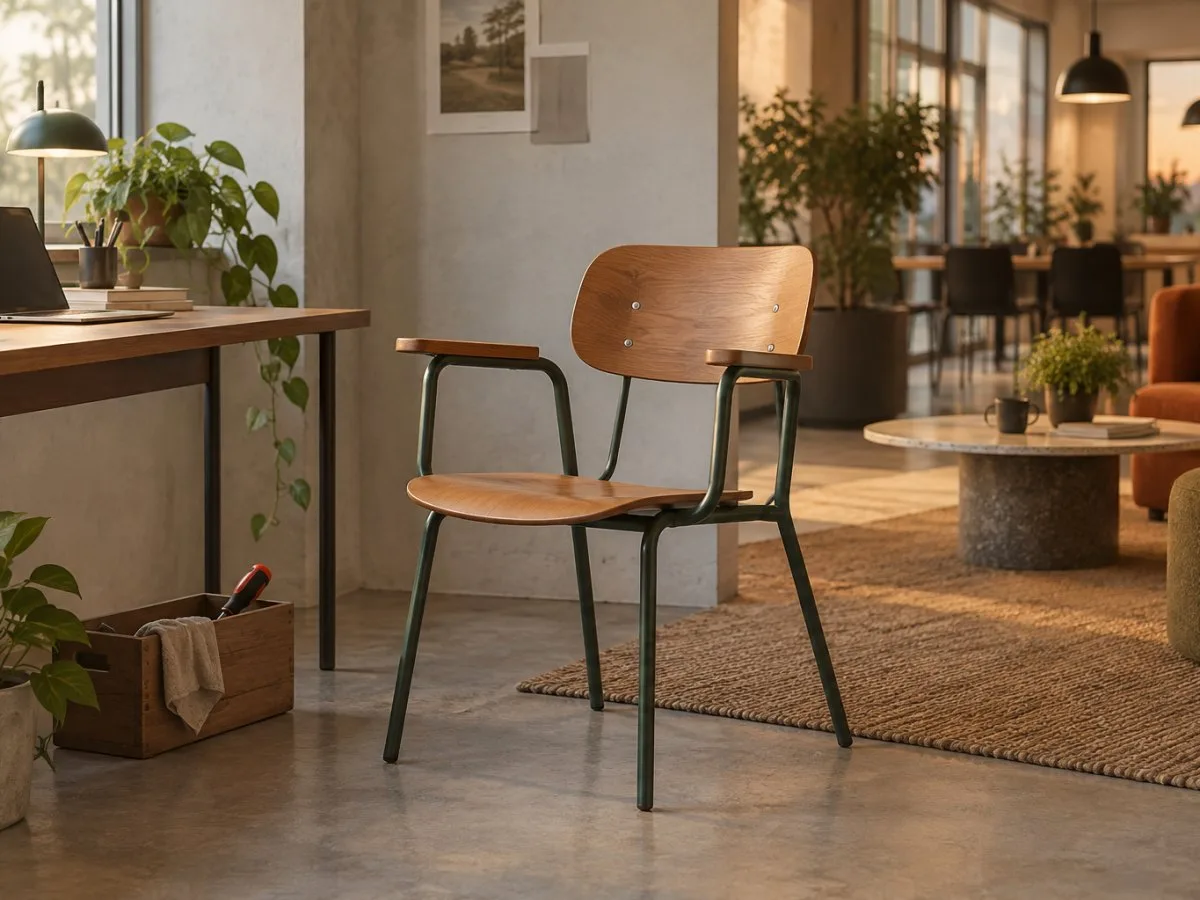
A piece of furniture’s enduring relevance depends on more than whether its silhouette looks contemporary. In Jean Prouvé’s designs, visible construction, joints and proportions are part of each object’s character. The structure shows how it is conceived and how forces are distributed: for example, the legs of the Standard chair are thicker where, according to Christian Grosen’s explanation, the greatest pressure is exerted.
The idea of a “classic” also has a cultural dimension. Rolf Fehlbaum describes it as a design that challenges established norms and can continue to seem contemporary even when it comes from another era. This is an interpretation of design, not a guarantee that a piece will suit every office or retain its configuration unchanged.
From shared spaces to the office
Several of Prouvé’s pieces were conceived for shared spaces, such as universities and schools. That history helps explain why his designs can appear in professional, domestic and public settings. The Standard chair and its wooden version, Chaise Tout Bois, are mentioned in cafés and restaurants; examples of the chair can also be found in homes. The Fauteuil Cité is described as suitable for both living rooms and airport waiting areas.
These uses show possibilities, not a one-size-fits-all solution. Every office, hybrid home and public space has its own needs. A piece used in a common area will not necessarily meet the demands of a regular workstation. Installation examples also do not, on their own, demonstrate ergonomic performance, comfort over long working days or suitability for a particular project.
The history of modern design offers another context for understanding this movement between uses. In the 1920s, several designers explored tubular steel and the cantilever chair; examples include the MR10 by Mies van der Rohe and Lilly Reich, and Marcel Breuer’s B32. In the 1960s, polypropylene and other plastics expanded the possibilities for production, stacking and colour. This evolution is a reminder that furniture’s adaptability depends on techniques and materials as well as an appearance that seems timeless.
Materials, structure and colour
The relationship between material and construction is central to Prouvé’s designs. According to Christian Grosen’s interview, Prouvé preferred to preserve the natural colour of wood and aluminium whenever possible, and to paint metal parts that could rust in order to protect them. Colour also had an expressive role: it could give a piece of furniture a particular presence.
The collection’s palette expanded to include shades such as Gris Vermeer, Blé Vert, Bleu Dynastie and Bleu Marcoule, alongside earlier colours such as black, Japanese Red and Blanc Colombe. This expansion illustrates a tension inherent in enduring design: preserving a logic of construction while allowing new combinations. The fact that certain colours are offered for homes and offices does not mean they are suitable for every project; that choice depends on the setting and design decisions.
Durability: an aspiration that requires care
Longevity is often one reason for considering a classic. Replaceable components and repair or refurbishment options can help extend a piece of furniture’s life. A project at the University of Bern refurbished 50-year-old Eames Fiberglass Chairs. This is a specific example, not a measure of how long any chair will last.
Durability does not mean indestructibility, nor does it by itself demonstrate a lower environmental impact. A product’s actual lifespan depends on its use, care and repair options. Refurbishment and reuse can keep products in circulation; recycling components is another possibility at the end of their useful life. Without an independent environmental comparison, these practices do not make it possible to quantify one piece’s impact against another’s.
A practical way to assess a choice
When considering a classic for an office, it is useful to distinguish observable features from project expectations:
- Construction: Consider whether the joints, proportions and materials suit the intended use.
- Context: Distinguish between a common area, waiting room, meeting space and regular workstation.
- Adaptation: Check which colour, material or configuration options are available for the specific need.
- Maintenance: Find out what care, repair or component replacement the piece may require.
- Evidence: Do not confuse installation examples or brand claims with comparative evidence of comfort, total cost or environmental impact.
A classic’s contribution to an office lies in more than its historical appearance. It may also lie in a construction whose logic remains legible across different spaces and uses. Whether that possibility is realised depends on the needs of the place, the care the piece receives and the information available about its performance.
At a glance
Scope
Editorial reading; this is not a site visit or a technical assessment.
Sources and references
Why design classics remain relevant, even in the office | Official Vitra® Online Shop CH ↗12/11/2026 �Why design classics remain relevant, even in the office,” interview with Christian Grosen, originally published in OnOffice
Classics in the Office | Official Vitra® Website UN ↗12/11/2026 �Classics in the Office,” Vitra
Classics in the Office | Official Vitra® Online Shop US ↗12/11/2026
Chairs - 1920s - Design Museum ↗12/11/2026
Chairs - 1960s - Design Museum ↗12/11/2026