





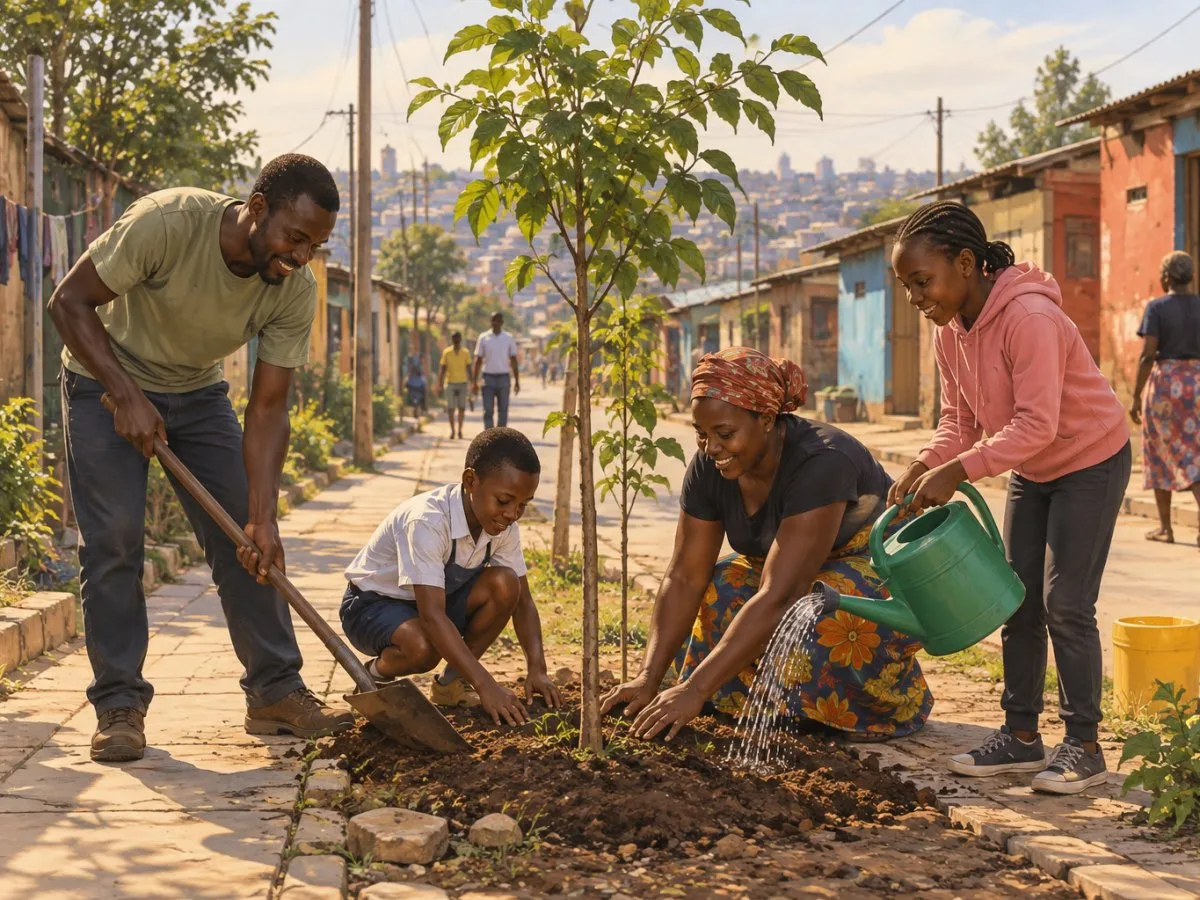
In Dandora, a Nairobi neighbourhood long associated with accumulated waste and a lack of services, improvements to public space began at a domestic scale: in the shared courtyards of residential compounds. The Model Street initiative connected this work with interventions on the street, turning everyday places—used by neighbours, children and small businesses—into the focus of a collective design process.
The intervention did not eliminate the Dandora dumpsite or resolve problems across the whole area. Its significance lies elsewhere: it shows how a local physical improvement can create conditions for collaboration and broaden the conversation about who cares for and shapes common spaces.
Starting with the courtyard
The shared courtyards served between 20 and 50 households and were central spaces for the people living around them. Some were dirty and filled with rubbish and discarded objects. Through the annual Changing Faces challenge, groups of residents, largely young people, cleaned these spaces. When they saw the results, other residents joined in and cleaned their own courtyards.
This small beginning was about more than appearance. Removing waste from a shared space made a tangible possibility for improvement visible and helped collaboration spread from one courtyard to a street. The initiative then expanded to clearing drains, planting trees, paving and installing waste bins, as well as building four gateways that gave a new identity to the stretch known as Badilisha Street, or “change street.”
Designing with the people who use the street
The process combined research into public spaces, planning workshops and community workdays. In Minecraft workshops, participants imagined and shaped the shared space using a digital tool. Weekend building parties brought residents together to make improvements; the process also incorporated different activities and formats to broaden participation by women, young people, children and people with disabilities.
The resulting street is more than a paved surface. Clear drains, lighting, trees, places to play and waste bins all contribute to a broader everyday experience. Paving facilitated access and, according to the project description, favoured small businesses alongside the road. Play spaces also opened up new possibilities for children: a later UN-Habitat account notes that some began skating in the street.
These outcomes should be interpreted carefully. Improvements in perceived safety and commercial opportunities are described as effects of the project, but the available documentation does not provide an independent evaluation that would establish that all these changes resulted solely from the intervention. Nor does the project prove that the same formula would work in every neighbourhood: the process depended on its residents, organisations and local partnerships.
A network to sustain change
The initiative brought together residents, youth groups, local authorities, community organisations, businesses and supporting organisations. The community played a leading role and contributed labour; the local Member of Parliament supported the initiative by paving the whole street through the Constituency Development Fund, while partnerships helped assemble resources and expertise. Community involvement also continued after construction: young people took part in maintenance, and residents contributed financially to support some of this work.
Continuity, however, does not follow automatically from a completed project. It depends on agreements, resources and shared responsibilities. The project described residents’ proposals to generate income by renting spaces for meetings and celebrations or adding play facilities. These are ideas linked to this particular case, not guarantees of funding or a universal model.
Scale matters, too. The transformation began in courtyards, extended to the street and reached towards the neighbourhood and the city. The annual Changing Faces challenge and the interest it attracted in other Nairobi neighbourhoods show that the approach drew attention beyond Dandora, although any replication requires adapting collaboration and priorities to each place.
Everyday space as a starting point
Dandora illustrates a relationship between urban design and collective care: cleaning, clearing drains, planting, lighting and paving are material actions, but they also make visible who takes part in managing a place and how trust is built between neighbours and institutions. The courtyard and the street, ordinary spaces, thus become social as well as physical infrastructure.
The lesson is not that an aesthetic intervention can solve structural problems. The dumpsite still existed when the project was documented, and the available information does not establish that Dandora’s environmental and urban problems have disappeared. More narrowly, the case shows that starting with shared spaces and keeping the community at the centre can open a practical path to improving the everyday environment and sustaining new forms of collaboration.
At a glance
Scope
Editorial reading; this is not a visit or a technical evaluation.
Sources and references
Nairobi’s Dandora neighborhood shines again - thanks to UN-Habitat’s waste management led public space planning | UN-Habitat ↗13/11/2026 UN-Habitat, “Nairobi’s Dandora neighborhood shines again - thanks to UN-Habitat’s waste management led public space planning”.
New Model Street launched in Dandora, Kenya | UN-Habitat ↗13/11/2026 UN-Habitat, “New Model Street launched in Dandora, Kenya”.
'Model Street' - making cities together ↗13/11/2026 World Habitat, “Model Street: Making Cities Together”.
Model Street – making cities together | use: urban sustainability exchange | Metropolis ↗13/11/2026 Metropolis, “Model Street – making cities together”.