





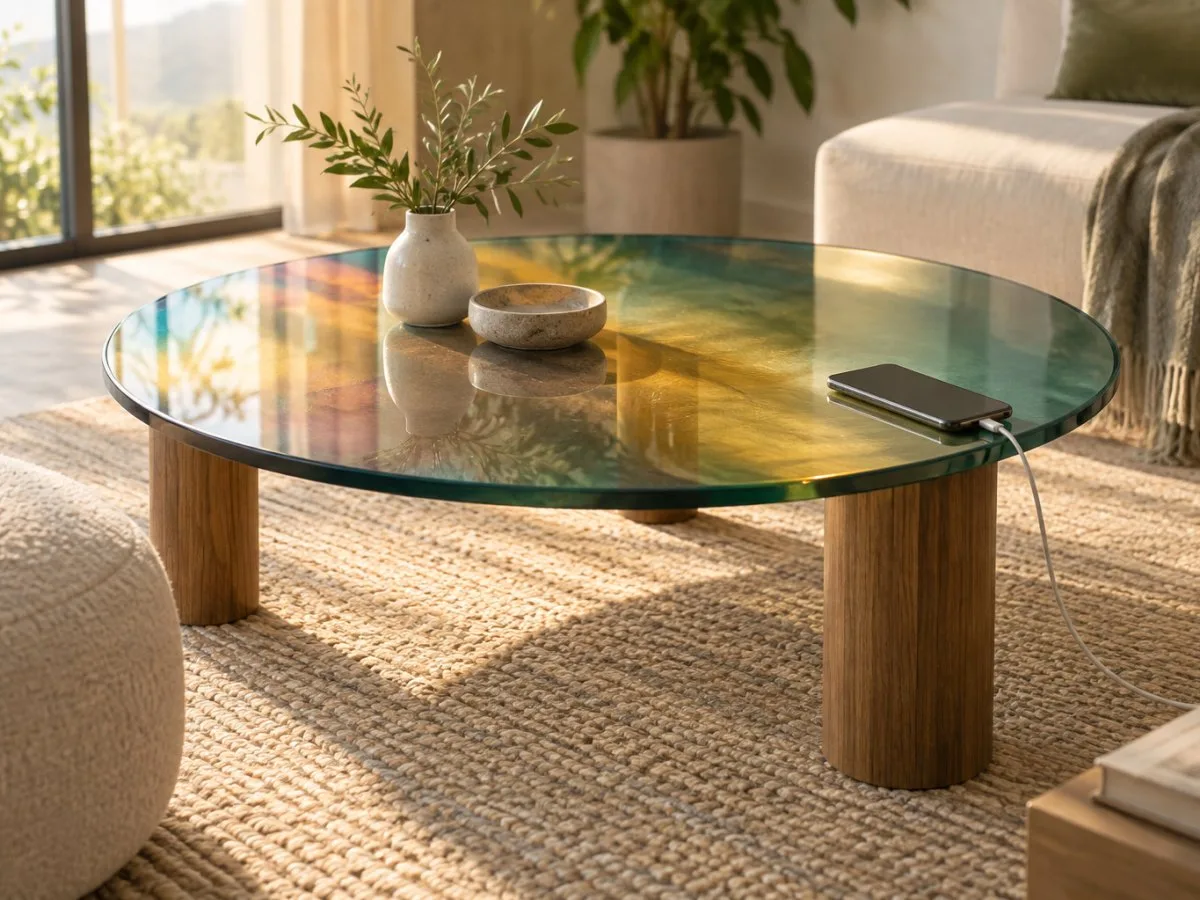
A table usually provides a setting for an activity: working, eating or keeping objects close at hand. Current Table adds another function to this everyday presence: its surface incorporates dye-sensitised solar cells that convert light into electricity and store it for charging devices. The idea is not to conceal energy harvesting in a separate installation, but to build it into the furniture itself.
A surface that takes part in how the table works
The table was designed by Marjan van Aubel and developed under the name Caventou. Its glass surface contains dye-sensitised solar cells, a technology that uses a dye’s response to light to generate an electric current. The process is often compared with photosynthesis: both systems use light-sensitive materials, although they are not the same biological process.
In Current Table, colour is more than a finish. The dye is part of the harvesting mechanism and gives the surface its coloured appearance. The energy generated is stored in an integrated battery and can later be used through a USB port, for example to charge a phone or power a compatible lamp.
Diffuse light, but not unlimited energy
Unlike conventional solar panels described in the project documentation, dye-sensitised cells can work in diffuse light and do not require direct sunlight on the surface. This makes indoor use possible, but it does not mean they produce the same amount of energy in every room.
The availability of light remains decisive: a bright space can help with harvesting, while cloudy conditions or a dim room reduce the energy generated. The table is best understood as a supplementary source for devices, not as a promise of continuous power or a general replacement for a household electrical connection. Charging figures reported in 2015 were estimates attributed at the time to the designer and to a future generation of the product; they do not necessarily describe the performance of every unit or version.
Furniture as everyday infrastructure
The design extends a table’s familiar function without abandoning its recognisable form. The surface remains a usable plane while also becoming an active part of an energy system: it captures light, converts it and stores it for later use. This integration makes a broader design question visible: can everyday objects take on infrastructure tasks while remaining objects for everyday use?
In Current Table, the answer is a piece whose technology is expressed through coloured glass and an accessible charging point. The project’s interest lies as much in this dual function as in the dependency it reveals: for the furniture to collect energy, it needs suitable lighting conditions. Its autonomy, therefore, is relative to its surroundings and to the energy actually harvested.
The table’s documented public appearances include design exhibitions in London at different times. This visibility records the project’s circulation, but by itself it does not establish its current commercial availability or demonstrate uniform performance. Its clearest contribution is conceptual and material: integrating solar harvesting into a domestic surface, making colour and light part of how the furniture works.
At a glance
Scope
Editorial reading; this is not a site visit or a technical assessment.