





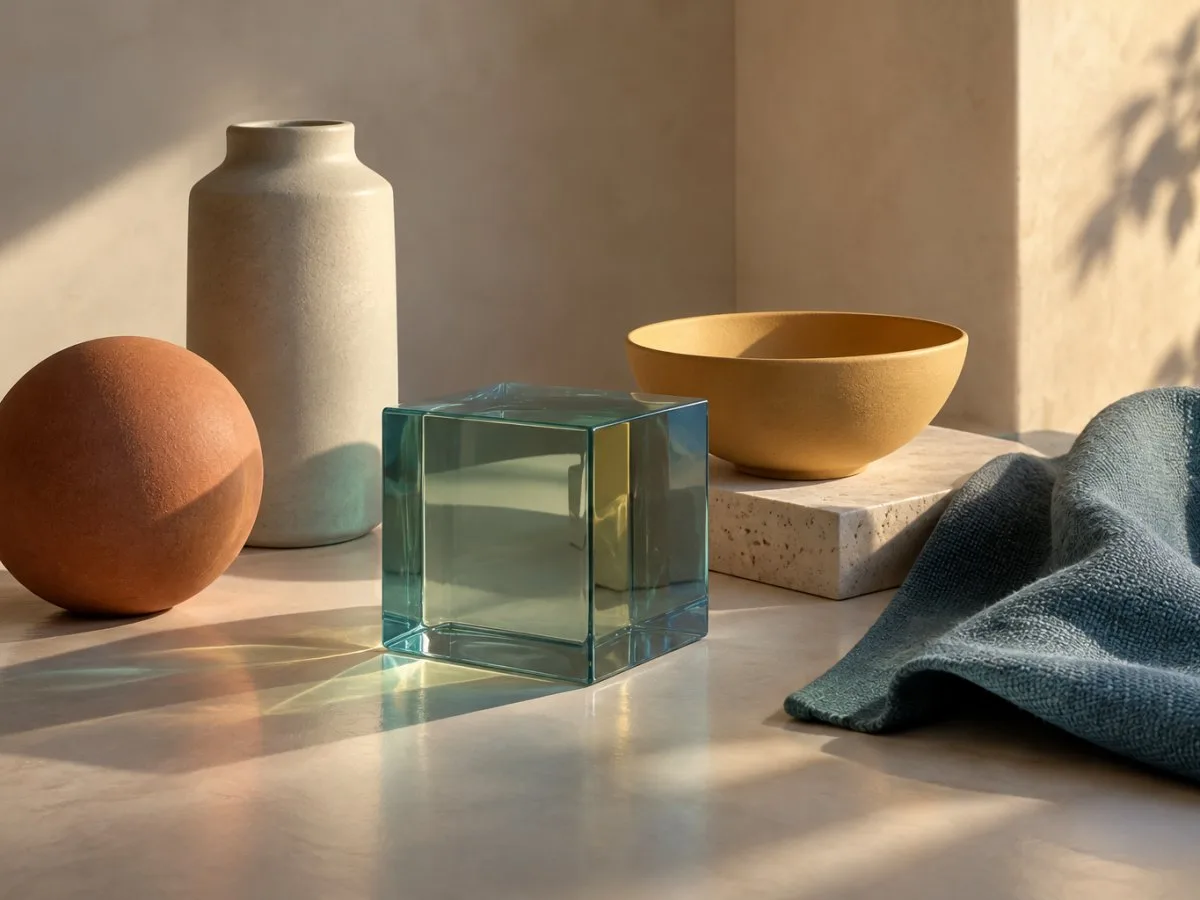
Colour depends on the conditions in which it is seen
In Breathing Colour, Hella Jongerius approached colour not as an isolated quality, but as something whose perception changes with light, shadows, reflections, form and materials. Presented at London’s Design Museum in 2017, the exhibition brought together installations and works developed from the designer’s research into these relationships.
A central idea was metamerism: the phenomenon in which two colours can appear identical under one set of viewing conditions and different under another. Rather than treating this variation as a flaw to be eliminated, Jongerius proposed considering it part of the experience of colour. The exhibition invited visitors to notice what changes when an object moves from one lighting environment to another.
A journey from morning to evening
The exhibition was organised into sections called Morning, Noon and Evening, each exploring different daylight conditions. The sequence made a simple idea visible: how we perceive a surface depends not only on its hue, but also on its lighting and visual context.
In the morning section, hanging translucent and semi-translucent beads offered a way to explore light and fragmented reflections. The works called Crystal Stones and Crystal Beads examined how colour changes when light passes through materials. At noon, the exhibition emphasised more intense light, strong contrasts and defined shadows. In the evening section, shadows took centre stage through furniture designs by Charles and Ray Eames, Jean Prouvé and Verner Panton, presented alongside forms that made their visual imprint perceptible.
This journey did not function as a universal chart for choosing colours. Instead, it offered a way to observe how lighting and nearby elements contribute to the appearance of objects and surfaces.
Colour Catchers: surfaces that gather their surroundings
The Colour Catchers were three-dimensional objects with faceted surfaces. Their folds and planes were designed to absorb and reflect nearby colours, allowing a surface to show gradations and nuances shaped both by its base colour and by its surroundings. Jongerius described them as tools for studying colour, shadows and reflections, and as a kind of three-dimensional colour chart.
The idea shifts attention from the object considered on its own to the relationships it creates: form organises light and shadow, while reflections connect its surfaces with the surrounding environment. In this sense, colour appears as a situated experience, not as a property that can be read without regard to visual conditions.
Textiles, mixtures and dark tones
The exhibition also used textiles to explore how different threads, materials and finishes affect the perception of colour. In Woven Movie, a series of ten textiles reinterpreted the image of a Colour Catcher at different times of day. The pieces could be viewed individually or as a sequence of still images, like a woven film.
Other textiles experimented with producing black tones without using black materials. The optical combination of wool, linen and cotton threads, with different textures and finishes, made it possible to explore a range of hues and blacks. The approach contrasted with the use of carbon black to darken colours: here, variation emerged from the visual mixing of a limited palette.
The exhibition also included Colour Vases (series 3), an installation of 100 unique vases made in 2010. Mineral-oxide finishes produced different colours, although the technique was not considered suitable for achieving stable colouration. The work added another dimension to the project: pigments and manufacturing processes also shape how colour is made and perceived.
An invitation to look at everyday spaces
The exhibition offers a question to carry into everyday observation, without turning it into a design rule: what happens to a colour when the light, shadows, texture or nearby objects change? A wall, a textile or a piece of furniture may be perceived differently depending on these relationships. The point is not to assign them a predetermined result, but to look more closely at the conditions that contribute to their appearance.
Breathing Colour turned this observation into a journey through objects, textiles and light. Its interest lies in showing that form and colour do not necessarily act as independent elements: folds create shadows, surfaces gather reflections, and materials alter how tones are read.
At a glance
Scope
Editorial reading; this is not a visit or a technical assessment.
Sources and references
Breathing Colour by Hella Jongerius ↗30/10/2026
Breathing Colour by Hella Jongerius: touring exhibition ↗30/10/2026
The Subjectivity of Colour ↗30/10/2026
Breathing Colour by Hella Jongerius ↗11/11/2026
Breathing Colour by Hella Jongerius at the Design Museum, London – smow Blog ↗11/11/2026
Hella Jongerius asks designers and consumers to embrace "unstable" colour in new exhibition ↗11/11/2026