





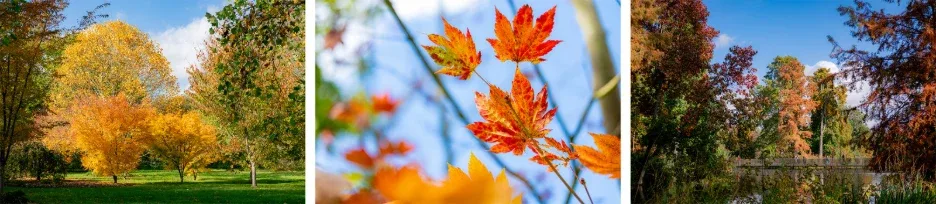
Autumn colours are changing across the south of England as a result of climate change, according to experts at the Royal Botanic Gardens, Kew. But there are reasons to be hopeful.
Changing seasons transform Kew Gardens into a landscape of reds and golds
Despite the challenging conditions posed by the record‑breaking summer temperatures and drought, some well‑loved species such as the common red oak (Quercus rubra) and Golden Honey Locust (Gleditsia triacanthos 'Sunburst') have erupted into a riot of colour around the Gardens.
Autumn favourites such as the iconic Maidenhair trees (Ginkgo biloba) have turned the lawns outside Kew's Orangery into a sea of yellow, and several Japanese maples (Acer palmatum) have turned crimson red.
The Winter Garden has a wonderful display on with the leaves of Cornus sanguinea 'Anny's Winter Orange' and Cornus alba 'Sibirica' (Westonbirt Dogwood) taking on an autumn tinge, highlighting their red and orange stems as their leaves drop away. Nearby trees of Acer amoenum var. matsumurae, Acer sieboldianum and sugar maple (Acer saccharum 'Glaucum') look equally impressive with hues of yellow and orange.
And venturing deeper into the Gardens and the Arboretum, stop by the Waterlily Pond to see a lovely combination of purple Cotinus obovatus x goggyria, golden yellow gingkoes and rusty orange golden larches (Pseudolarix amabilis). The leaves of a Swamp cypress (Taxodium distichum) around the pond are turning rusty orange, as are those of a mulberry‑leaf maple (Acer morifolium).
Many trees are struggling, however
Many trees are struggling, however, and have turned over early or lost their canopies entirely because of the intense summer and spring droughts. This phenomenon, known as 'False Autumn', has resulted in a mixed landscape across swathes of the UK.
Cutting‑edge research and horticultural science
Cutting edge research and horticultural science developed at Kew is helping to identify which of our trees are well adapted to deal with our changing climate, and which tree species should be planted today to give them the best chance of survival well into the future.
Research published by Kew's experts has shown species such as Farges' fir (Abies fargesii), Iberian alder (Alnus lusitanica), cherry hackberry (Celtis cerasifera), Montezuma pine (Pinus montezumae) and spoon oak (Quercus urbani) are well adapted for a warmer and drier future.
Many of these trees have been identified in Kew's 2024 Landscape Succession Plan: Planting for the Future report, which combined novel climate modelling with horticultural research to assess the vulnerability of Kew Gardens' trees by the year 2090.
Kevin Martin on tree diversity
Kevin Martin, Head of Tree Collections at Kew, says: 'At Kew Gardens, our 11,000 trees represent an extraordinary diversity of species from around the world that make the Gardens a living laboratory to understand how trees respond to climate change.
'We expect autumn to come forth with a spectacular burst of colour, but we can already see that the pressures of our record‑breaking summer are altering the timings of when trees change colour, how long their displays last and how well they cope with environmental stress.
'By studying such a diverse collection of trees in one place, we can better understand which species are most vulnerable, and which have the potential to thrive in the warmer, drier conditions that the UK is likely to experience in the future.'
Hollies and glasshouses
The hollies (Ilex) on the other side of Holly Walk look exceptional right now, with a variety of leaf shapes and bright red berries. Established in 1874, Kew's collection is one of the most comprehensive and diverse in Europe.
Now is also the perfect time to visit Kew's iconic glasshouses, which provide a bit of warmth and tropical comfort as the cold starts to set in. Be sure to visit the Princess of Wales Conservatory for your last chance to see the giant Victoria waterlilies before they are removed by the end of the month for the winter.
Inside of the Temperate House, several tea plants (Camellia sinensis) continue to put out flowers in both beds on the southern end, and if you are lucky enough, you might spot a large imperial lemon (Citrus lemon 'Imperial') staring back at you from amidst the foliage.
Within the glasshouse's central block, the main entrance is framed by the pink and cream trumpet‑like flowers of Brugmansia cultivars. Wander down either path to the left and right and marvel at the yellows of Abutilon x hybridum 'Canary Bird', reds of veined abutilon (Callianthe picta) and Cestrum fasciculatum.
You will also find several attractive pelargoniums, young palms and passionflowers as you explore the Victorian marvel.
Visit Kew Gardens this autumn
Besides the dazzling autumn colours on display at Kew Gardens, visitors are encouraged to come and check out the variety of events, workshops and exhibitions, which you can read about here: What’s on at Kew Gardens and Kew Wakehurst this November. These include:
Christmas at Kew | 13 November 2026 – 3 January 2027 | 4.20pm – 10pm | Last entry times vary by entry gate
London’s most enchanting festive trail returns this month, transforming Kew Gardens into a stunning botanical world filled with light, music and the festive spirit. Experience 30 immersive installations, large‑scale artworks, and atmospheric soundscapes, including new commissions from internationally acclaimed artists, alongside returning elements.
For the first time, Christmas at Kew will introduce dedicated adult‑only evenings on 3 and 9 December. Open to visitors aged 18 and over, the evenings offer a chance to experience the trail in an adult‑only setting - perfect for festive celebrations with friends, colleagues or partners. With all the magic and creativity of the main event, these evenings offer a unique way to enjoy the festive light trail.
Henry Moore: Monumental Nature | until 31 January 2027
Experience the largest‑ever outdoor exhibition of Henry Moore's sculptures set against the backdrop of autumn colour at Kew Gardens. Featuring over 100 pieces including 30 monumental sculptures displayed throughout the Gardens, alongside over 90 works on paper, models, and smaller pieces displayed in the Shirley Sherwood Gallery of Botanical Art. Join us for this once‑in‑a‑generation event, organised with the Henry Moore Foundation.
Fascinating world of fungi | 27 November | 10.30am to 1pm or 2pm to 4.30pm | Workshop is for adults aged 18+ only
Join this unique hands‑on workshop with the Calley Brothers teaching you how to grow your own mushrooms, including an exclusive guided tour of Kew’s renowned Fungarium. Working with a variety of real, edible mushroom specimens, you’ll discover the remarkable role they play in the natural world. You’ll also learn about mycelium, the hidden living network beneath our feet that gives rise to every mushroom.
Archives Revealed - unlocking the colonial archive | until 14 January 2027 | 10am to 4pm | Kew Herbarium and Library | Free, no booking required
As part of Kew's Archives Revealed project, explore a community co‑created exhibition highlighting Kew’s role in empire through this free exhibition. Featuring historic records, beautiful botanical illustrations and official documents on the production of quinine in India, many of these collections contain hidden voices and unseen Indigenous botanical knowledge, along with evidence of colonial exploitation and extraction, in which Kew had a part to play.
Press release content from Royal Botanic Gardens, Kew, translated and formatted for this edition.
Royal Botanic Gardens, Kew · 2026-11-06
Autumn foliage at Kew Gardens, image supplied with the press release. © RBG Kew · Material de prensa
Sources and references
Royal Botanic Gardens, Kew · Autumn colour of the future: Kew reveals climate-resilient trees ↗Reino Unido · 2026-11-06 · 13/11/2026
media.image · RBG Kew · Material de prensa · Material de prensa facilitado para uso editorial con atribución · Sources and references · WebP