





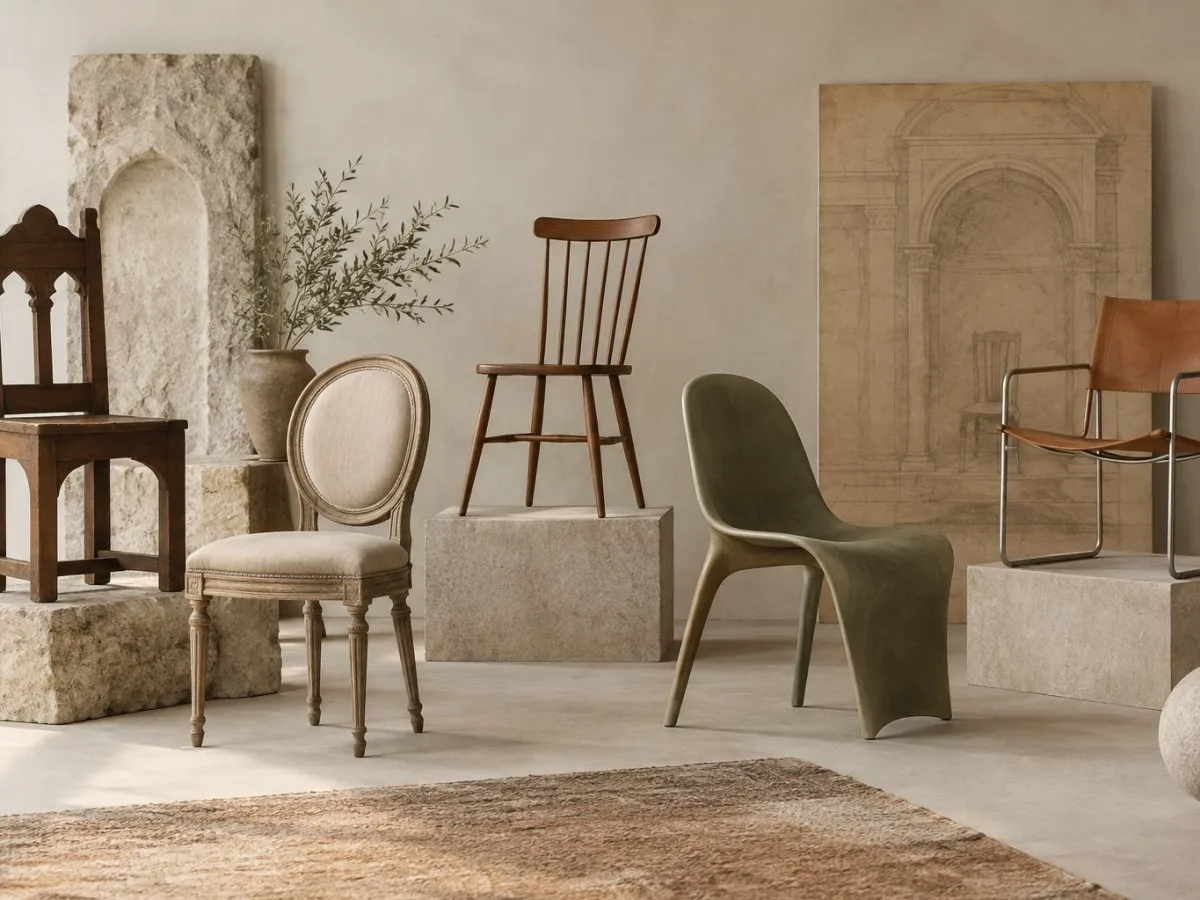
Furniture can be understood through its forms, materials and construction, but also through the contexts in which it was designed and used. Published by the Vitra Design Museum in November 2019, Atlas des Möbeldesigns (Atlas of Furniture Design) organizes part of that history through objects, images and texts. Its breadth makes it possible to explore different periods; its selection, however, represents a particular curatorial perspective, not a complete inventory of furniture design.
What the Atlas brings together
The publication runs to more than 1,000 pages and documents 1,740 objects by more than 540 designers, accompanied by more than 2,800 images. These include photographs of objects and design drawings, as well as interiors, artworks, patents, brochures, buildings and portraits of designers.
The starting point is the Vitra Design Museum collection, which records more than 20,000 objects, including over 7,000 pieces of furniture. The book presents a selection of 1,740 pieces. The stated selection criteria include representing important movements, designers, materials, construction forms and typologies, alongside familiar objects and less predictable choices. The Atlas therefore offers a broad overview, but it is neither neutral nor exhaustive: its inclusions and omissions reflect decisions about what to select.
A journey through periods and designers
The book spans objects from the past 230 years and places examples from different eras side by side: nineteenth-century furniture in bentwood and metal; designs associated with Art Nouveau and the Vienna Secession; modernist figures such as Le Corbusier, Gerrit Rietveld, Charlotte Perriand, Marcel Breuer and Eileen Gray; and postwar, postmodern and contemporary pieces associated with Charles and Ray Eames, Eero Saarinen, Gae Aulenti, Finn Juhl, Ettore Sottsass, Philippe Starck, Hella Jongerius, Jasper Morrison and Konstantin Grcic.
The editorial arc runs from the beginnings of industrialization to digitization, which Mateo Kries, the museum director and a co-editor of the book, describes as an increasingly important influence on furniture design. That breadth does not mean every period, place or tradition receives equal space: the Atlas’s scope is shaped by its collection and curatorial criteria.
Direct research on the objects
The publication brings together more than 20 years of research at the Vitra Design Museum and involved a team of more than 70 authors and experts. During the work, researchers had access to the collection’s physical objects; pieces selected for the Atlas were photographed again.
This direct contact made it possible to examine details such as upholstery seams, fabric textures, wood joints and manufacturers’ marks. Kries notes that consulting the objects directly helped identify inaccuracies in books and other sources. This is a useful documentary basis for comparing information, although it does not make every attribution or interpretation in the book independently verified or certain.
Texts, images and reference tools
The Atlas combines several editorial formats:
- Essays on the sociocultural context and history of furniture design.
- More than 550 detailed texts on objects considered stylistically significant.
- Infographics and timelines, including representations of the development of typologies such as the cantilever chair (Freischwinger) and the monobloc chair.
- Appendices with designer biographies, bibliographies, glossaries of manufacturers and materials, and an index of terms.
The combination supports different ways of exploring the book: readers can look up a particular piece, follow a typology or compare images and periods. This variety makes it a reference work for collectors, researchers and professionals, while also offering accessible entry points for people interested in design more generally.
Different ways to read a history
Kries suggests that the Atlas can be approached as a collection of models or a history of styles; as an account of evolution and rupture; as a history of objects, images and social conditions; or as a collective trajectory of designers. It can also be read without recourse to complex theories, by focusing on the objects and the information accompanying them.
These perspectives complement one another, but they are not interchangeable: a chronology of styles does not answer the same questions as a social history or an image-centred reading. Comparing them helps readers recognize both what the book documents and the perspective through which it organizes its material.
The collection as foundation and limit
The museum’s collection has been systematically expanded over three decades with the aim of offering a broad picture of furniture design over the past two centuries. The Atlas turns part of that collection into a reference publication; it does not replace the collection or represent every history of furniture on its own.
A careful reading distinguishes among the information about each object, the interpretations in the texts and the book’s overall selection. It is also useful to compare entries with other catalogues or records when a question depends on an attribution, date or history that the Atlas does not resolve by itself.
A reference, not a definitive canon
The Atlas’s value lies in bringing together a large number of objects, images and analyses in a structure that can be explored from several perspectives. Its object-based documentation and breadth make it a relevant reference for studying modern furniture design. At the same time, like any work built from a collection and an editorial selection, it offers a situated map: it helps raise questions and make comparisons, but does not close the history or replace other collections and approaches.
At a glance
Scope
Editorial overview; not a visit or a technical assessment.
Sources and references
Atlas des Möbeldesigns ↗10/11/2026 Vitra Design Museum, Atlas des Möbeldesigns.
Atlas des Möbeldesigns | Offizieller Vitra® Online Shop DE ↗10/11/2026
Der Atlas des Möbeldesigns | Offizieller Vitra® Online Shop DE ↗10/11/2026 Vitra, Der Atlas des Möbeldesigns.